Banking Application Testing: Successful Quality Assurance for Financial Apps
A banking app crash during a rent transfer is not just a technical failure. For the person on the other end, it is a moment of genuine panic. Banking applications handle billions of transactions daily. When something goes wrong, the consequences are immediate and personal. That is what makes banking app testing different from testing most other software. The margin for error is smaller, the stakes are higher, and the complexity runs deeper than it first appears.
Banking applications handle billions of transactions daily, with financial services facing average data breach costs of $5.9 million per incident, making them the second-most targeted sector by cybercriminals.
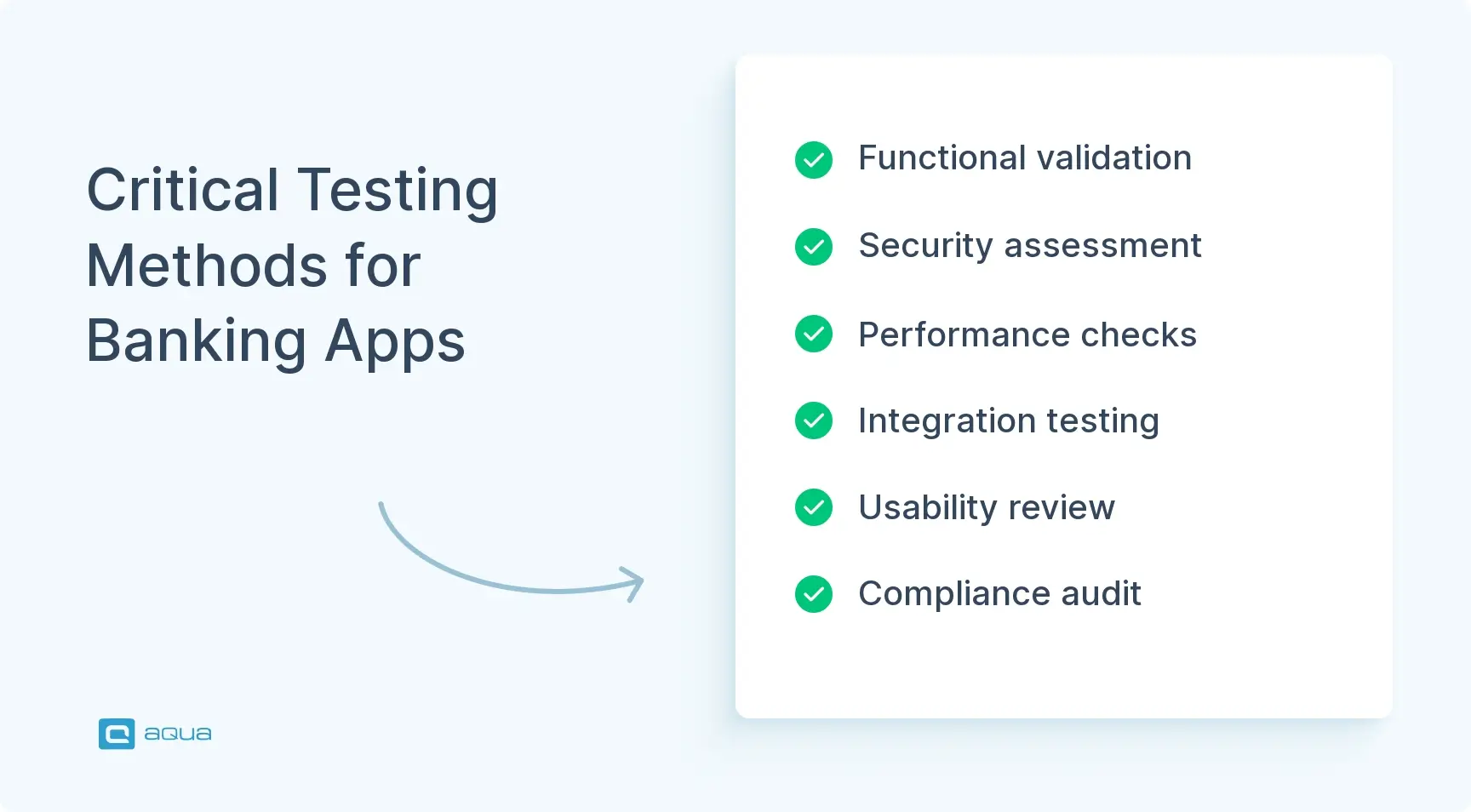
Comprehensive banking app testing requires multiple methodologies including functional testing, security testing, performance testing, integration testing, and usability testing to ensure zero-tolerance for errors.
Effective banking application testing faces challenges from technical complexity, rapidly changing regulatory requirements, evolving security threats, and the paradox of balancing security with user experience.
Banks with reliable, secure applications see 23% higher customer retention rates compared to those with technical issues, while 32% of customers would immediately stop using a bank after a security breach.
Best practices include risk-based testing prioritization, cross-functional collaboration between QA and development teams, continuous skill development, and strategic tool selection that integrates across platforms.
Testing banking applications is all about preventing financial catastrophes that can cost millions and destroy customer trust. Discover how proper QA strategies protect everything from mobile transactions to regulatory compliance 👇
Why Does Quality Assurance Matter in Banking?
Quality assurance in banking is what prevents technical failures from becoming financial disasters. Financial institutions are among the most targeted by cybercriminals. IBM’s Cost of a Data Breach Report puts the average breach cost in financial services at over $5.9 million per incident. Beyond the financial hit, the reputational damage is harder to recover from. Research shows 32 per cent of customers would stop using a bank immediately after a security breach. And 65 per cent would lose trust permanently.
Robust banking software testing does more than prevent disasters. Banks that deliver smooth, secure experiences consistently see measurably higher customer retention. Those dealing with recurring technical issues lose ground fast.
The regulatory dimension adds another layer. Financial institutions operate under frameworks like PCI DSS, GDPR, and FDIC requirements. A single compliance gap does not just create an operational headache. It can trigger audits, fines, and mandatory shutdowns. Compliance testing is not a formality. It is a core part of protecting the business.
What Types of Testing Do Banking Applications Need?
Banking applications are complex systems. No single testing method covers everything they need. They connect to legacy infrastructure, process sensitive personal data, and need to work for a first-time smartphone user just as well as for someone managing ten accounts. That range of requirements is what makes a layered approach necessary.
Manual testing handles scenarios that require human judgment. Does this mortgage application flow make sense to someone filling it in for the first time? Does this error message help the user or confuse them? Automation handles the volume. Thousands of transaction scenarios run in regression suites. APIs get validated continuously. Security scans catch vulnerabilities before they ship.
The full picture of what needs to be covered across banking and financial application testing:
Functional testing: Core operations work as specified, including transfers, payments, account management, and loan applications
Security testing: Encryption, authentication, injection prevention, and vulnerability assessment
Performance testing: Application behaviour under peak load during paydays, month-end periods, and high-traffic events
Integration testing: Communication between mobile apps, web platforms, ATM networks, payment gateways, and core banking systems
Usability testing: Interface clarity across demographics and accessibility standards
Compliance testing: Adherence to PCI DSS, GDPR, SOC 2, and jurisdiction-specific regulations
Compatibility testing: Consistent behaviour across operating systems, devices, browsers, and network conditions
Amid the heightened complexity of banking application testing, having the right test management system becomes as critical as the testing itself. aqua cloud offers a secure foundation specifically designed for financial institutions navigating these challenges. With ISO 27001 certification and full DORA compliance, aqua provides the robust security framework necessary for handling sensitive financial data while meeting stringent regulatory requirements. What sets aqua apart is its domain-trained AI Copilot that can generate comprehensive test cases using techniques like Boundary Value Analysis and Decision Table Testing, particularly valuable for validating complex banking transactions and compliance scenarios. Unlike generic testing platforms, aqua’s unified repository creates complete traceability from requirements to test execution, providing the audit trails financial regulators demand while reducing documentation overhead by up to 80%.
Generate banking-specific test cases with AI while maintaining compliance with aqua cloud
What Are the Core Testing Methodologies for Financial Apps?
Each testing methodology in banking protects a different part of the application. Skipping any one of them leaves a gap the others cannot cover.
Functional testing is where the foundations are laid. When someone taps “Transfer $500,” the system needs to move exactly $500. It needs to update both account balances. It needs to generate proper records and send confirmation. That sounds simple. The complexity comes in the edge cases. What happens when a transaction times out mid-process? What about concurrent transactions hitting the same account? Functional testing in banking covers all of it.
Security testing goes well beyond penetration testing. For financial applications, it includes multi-factor authentication checks, session timeout behaviour, API security, and certificate pinning. It means simulating credential stuffing attempts and man-in-the-middle interceptions. Security testing with AI is increasingly being used to anticipate new attack vectors, not just to validate against known ones.
Performance testing answers one question: what happens when everyone uses the app at the same time? Transaction speeds under load, API response times, and memory behaviour during extended sessions all need validation. This needs to happen before peak periods arrive, not during them.
Compliance testing verifies that the application handles data the way regulations require. Audit trail completeness, data retention policies, and access controls each have specific requirements. Those requirements vary by jurisdiction and change over time.
Accessibility testing covers 15 per cent of the global population with disabilities. Screen reader compatibility, colour contrast, keyboard navigation, and voice control all need validation. This is both a legal requirement under WCAG 2.1 and ADA guidelines and a basic matter of the app working for everyone.
Compatibility testing addresses device fragmentation. Banking apps need to work consistently across iOS and Android versions going back several years. Across dozens of device manufacturers. Across browsers for web banking application testing. And across network conditions ranging from 5G to unreliable public Wi-Fi.
What Makes Banking Application Testing So Difficult?
Banking app testing is difficult because it is never testing just one thing. A mobile banking application connects to core banking platforms that may run on decades-old mainframe infrastructure. It communicates with payment processors, credit bureaus, and fraud detection systems. It needs to stay synchronised across all of them. Each connection point is a potential failure. When something breaks, identifying where the issue originated is itself a significant undertaking.
Regulatory change is a constant pressure. Global banks operating across multiple jurisdictions deal with compliance requirements that sometimes conflict with each other. The testing coverage required changes quarterly. Building automation for one regulatory update while three more are announced is the normal pace of work.
Security threats do not stand still. New attack vectors emerge continuously. From AI-powered social engineering to zero-day exploits targeting specific mobile operating systems. QA testing banking application security is not a phase that ends. It is ongoing, and the adversaries are well-resourced.
The user experience challenge creates a genuine tension. Customers want strong security and frictionless convenience at the same time. Every authentication step added for security is a potential reason to switch to a competitor. Testing needs to confirm that fraud prevention does not flag legitimate transactions. That step-up authentication only triggers when genuinely necessary. Those security features feel protective, not obstructive.
What Are the Best Practices for Banking App Testing?
Effective banking application testing starts with risk-based prioritisation. Direct the most effort toward the areas where failure causes the most damage. Transaction processing and authentication need exhaustive validation. Cosmetic elements need lighter coverage. A risk matrix that considers both likelihood and impact of failure keeps effort focused where it matters.
Involving QA from the start of development catches problems when they are cheapest to fix. When testing teams join architecture reviews, they spot testability concerns before code is written. Security scanning before code reaches QA reduces the volume of issues that appear later.
Breaking down silos between teams produces better coverage than any single team working alone. Security architects know which threat models are most relevant. Compliance officers know which regulatory scenarios are likely to be audited. Developers know which architectural decisions might hide unexpected test conditions. Each group has context the others need.
Using realistic test data without exposing real customer information is a practical requirement. Synthetic data generation creates datasets that mirror production characteristics accurately. Data masking lets teams work with sanitised production snapshots while maintaining referential integrity.
Choosing tools that integrate rather than tools that add complexity keeps the workflow manageable. Automation frameworks that support mobile, web, and API testing from a unified codebase reduce maintenance overhead. The best test management tools for banking are the ones that fit the existing workflow rather than forcing the workflow to adapt around them.
Treating every production incident as testing feedback closes the loop between what is tested and what actually fails. Every bug that reaches customers points to a gap in the testing process. Customer support tickets reveal real-world scenarios that no test plan anticipated. Production monitoring alerts should trigger corresponding additions to automated validation.
As banking applications continue evolving with increasing complexity and regulatory demands, quality assurance must evolve alongside them. aqua cloud stands as the ideal partner in this journey, offering purpose-built compliance features designed specifically for financial institutions. With its AI-powered test case generation capabilities, your team can automatically create test scenarios that verify both security controls and transactional integrity. It reduces test creation time by up to 97% while ensuring thorough coverage. The platform’s granular role-based access controls and automated audit trails make regulatory compliance significantly more manageable, eliminating the documentation burden that often slows QA teams. Most importantly, aqua’s domain-trained AI Copilot understands financial testing contexts, learning from your project’s documentation to generate deeply relevant test cases that speak your organization’s language. For banking applications where trust is paramount, aqua delivers the perfect balance of robust security testing, regulatory compliance, and accelerated delivery that today’s financial institutions demand.
Achieve 100% test coverage with banking-specific AI and built-in compliance controls
Banking application testing is what stands between a customer’s financial life and the failures that can disrupt it. The complexity is real. Infrastructure spanning decades. Regulations that change faster than development cycles. Security threats that evolve daily. Users who expect both strong security and instant convenience. The teams that navigate this well treat testing as a continuous discipline, not a release phase. They validate across functional, security, performance, compliance, and usability dimensions consistently. The result is not just fewer bugs. It is applications that people trust with their savings, their rent payments, and their financial lives.
Banking application testing is the process of validating that financial software works correctly, securely, and in line with regulatory requirements. It covers functional behaviour, security vulnerabilities, performance under load, accessibility, and compliance with frameworks like PCI DSS and GDPR. Mobile banking application testing adds another layer to this: verifying that the app works consistently across different devices, operating systems, and network conditions. Because banking applications handle real money and sensitive data, the tolerance for errors is far lower than in most other software.
Why is quality assurance important for financial applications?
Quality assurance stops technical failures from becoming financial and reputational disasters. A security breach in a financial institution costs an average of $5.9 million per incident. The reputational damage goes further. Banking domain application testing ensures that every part of the system, from core transaction logic to third-party integrations, is validated before it reaches production. The cost of finding a bug in testing is a fraction of what it costs to fix it after it has affected real customers.
What are the key types of testing for banking applications?
Banking and financial application testing requires functional testing, security testing, performance testing, integration testing, compliance testing, accessibility testing, and compatibility testing. Banking application automation testing is particularly valuable for regression suites, API validation, and continuous security scanning, where running thousands of scenarios manually would be neither practical nor fast enough to keep pace with release cycles.
How does security testing protect banking apps?
Security testing protects banking apps by verifying that authentication works correctly, session management behaves as expected, and data is encrypted in transit and at rest. It also includes testing biometric authentication, secure key storage, and the application’s ability to detect rooted or jailbroken devices. For banking web application testing specifically, this extends to browser-level vulnerabilities, cross-site scripting, and session hijacking scenarios that are unique to the web environment.
What are the main challenges in banking application testing?
The main challenges are technical complexity, regulatory change, evolving security threats, and the tension between security and usability. Banking applications span legacy infrastructure and modern APIs, each representing a potential failure point. Regulatory requirements change frequently and vary by jurisdiction. Security threats evolve faster than testing cycles. And customers expect strong security with no friction, which requires constant balancing across mobile banking application testing, web banking application testing, and every other channel the bank supports.
Enhancement of the aqua product is Martin’s main responsibility and biggest mission. His expertise covers ITIL Process Consulting, Change Management, Quality Assurance, Quality Management, and Requirements Management. Martin works in QA services for regulated industries for more than 18 years being an irreplaceable leader at…
Nurlan, a QA Coordinator & Quality Standards Officer, takes pride in orchestrating seamless QA operations. His expertise in coordinating QA-focused projects and integrating QA solutions has consistently yielded top-tier client satisfaction. Aside from a full-time QA coordinator, Nurlan's role involves creating compelling content that educates…
Home » Testing with AI » Banking Application Testing: Successful Quality Assurance for Financial Apps
Do you love testing as we do?
Join our community of enthusiastic experts! Get new posts from the aqua blog directly in your inbox. QA trends, community discussion overviews, insightful tips — you’ll love it!
We're committed to your privacy. Aqua uses the information you provide to us to contact you about our relevant content, products, and services. You may unsubscribe from these communications at any time. For more information, check out our Privacy policy.
X
🤖 Exciting new updates to aqua Intelligence are now available! 🎉