What Is Agentic Testing? The Complete Guide for QA Teams in 2026
For years, most QA teams have hovered around 25% automated coverage and gone no further. You can throw more scripts at the problem and the number barely moves. Agentic testing is a different approach to the same problem: instead of writing every step yourself, you hand an AI agent a goal and let it plan, build, run, and maintain the tests. This guide walks through what that actually looks like day to day, and what your team has to change to make it work.
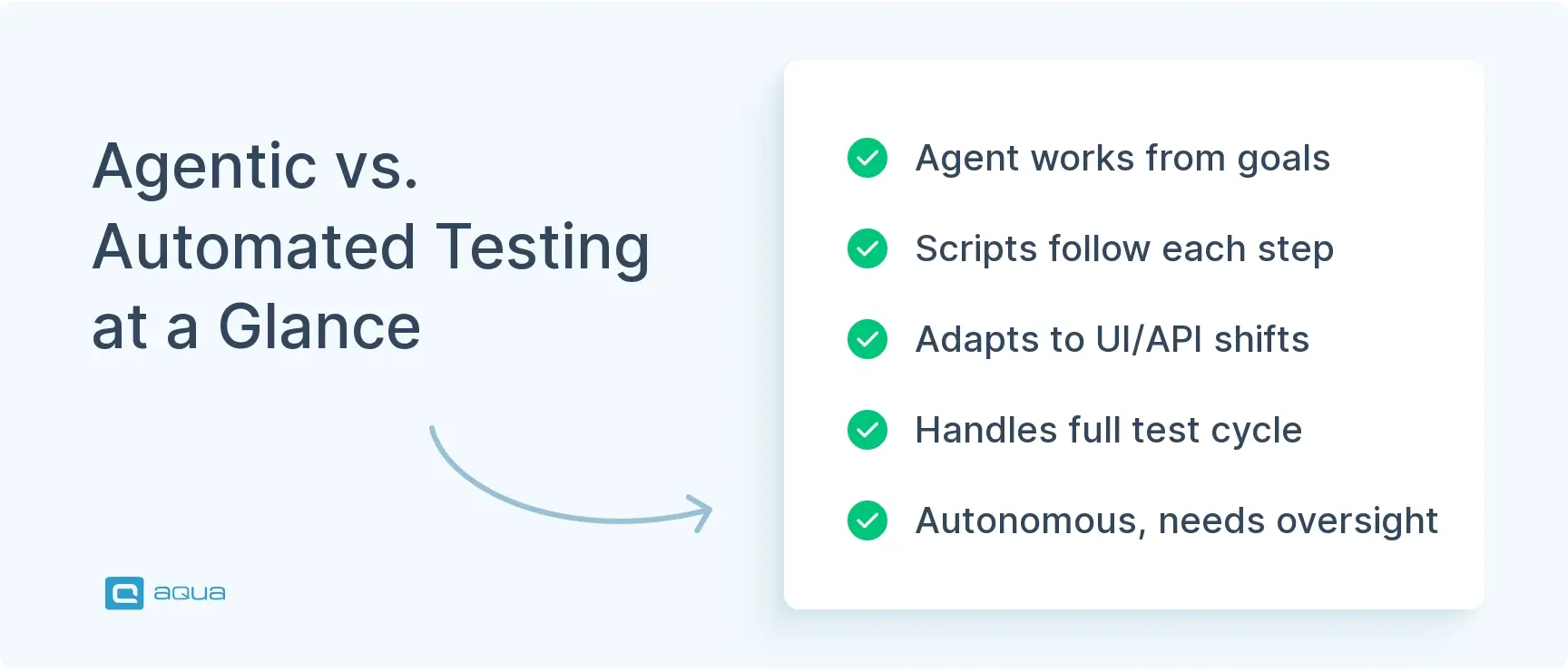
Agentic testing hands the whole test cycle to AI agents that work from a goal, not a script. You tell them what to check. They plan it, build it, run it, and keep it alive.
Most teams have been stuck near 25% automated coverage for years. Scripts need a human to picture every scenario in advance and babysit fragile locators, so coverage stalls.
When the UI moves under it, an agentic tool heals itself mid-run. It knows the difference between a button that shifted and a feature that actually broke, so it stops flagging drift as failure.
In 2026 the common setup is hybrid: agents cover 60 to 70% of the work (regression, UI checks, exploratory) and hand the compliance-critical paths back to locked scripts.
Maintenance drops from eating 20 to 30% of a sprint down to 5 to 10%. That time goes back to your engineers for the judgment work agents can’t do.
What Is Agentic Testing and How Is It Different From Test Automation?
Here’s the plain version. Agentic testing is an AI agent chasing a goal you gave it, instead of replaying a script you wrote line by line. You say “test the checkout flow,” and the agent figures out the rest. It reads your requirements, writes the test cases, runs them, adjusts when the UI changes on it, and hands back the bugs with proof attached.
Old-school automation just follows orders. Click here, type this, check that. If you didn’t spell out a step, it never happens. An agent works off intent. You give it the what, and it sorts out the how, making calls as it goes and remembering what happened last time.
Think of agentic QA as a mid-level tester who happens to work across a few hundred cases at once. So when someone asks what is agentic testing, the honest answer is that the machine stopped taking orders and started chasing outcomes.
The Three Levels of AI in Software Testing
There are three depths of AI in testing, and most teams live at all three at once depending on what they’re checking.
Level 1 is AI-assisted. Autocomplete, element suggestions, a nudge toward the next step while you write. It makes authoring quicker. You’re still writing and maintaining every script by hand.
Level 2 is AI-augmented. Self-healing shows up here. A button ID changes, the tool catches it through visual recognition or DOM analysis, and rewrites the locator on its own. Your maintenance load drops. But you’re still designing all the test logic upfront. The AI patches your fragile selectors and leaves the actual test design to you.
Level 3 is agentic. Now the agent runs the whole cycle with barely any input from you. You point it at the user stories, the acceptance criteria, the API contracts, and it takes it from there: planning cases, writing steps, running them, adapting on the fly, logging bugs with screenshots and network traces, and getting smarter each time based on what worked before. It picks what to test and covers edge cases you never wrote down.
Level 3 is where that 25% wall finally comes down. And that’s the thing to hold onto about agentic testing in software QA: this level of autonomy is a whole different animal, not a snappier version of levels one and two.
What "Autonomous" Actually Means in a QA Context
Autonomous doesn’t mean nobody’s watching. It means the agent runs on its own inside limits you set, scope, risk tolerance, what counts as success, and a human still checks the output. The agent takes the execution, the adapting, the first-pass triage off your plate. You keep the sign-off.
Picture a normal morning. Before your standup, an autonomous testing agent has already combed your Jira board, pulled the stories flagged for QA, worked out from the acceptance criteria what needs checking, written the cases, run them against staging, dropped two bugs in your lap with full repro steps, and marked three stories clean for release. You skim the flagged issues, approve or kick them back, and get on with your day. The grunt work is done. The decisions are still yours.
That split is the whole game. Let the agent run wide open with no review and you get false positives, missed edges, and compliance headaches. Watch it too closely and you’ve paid for a fancy autocomplete. The teams getting real value from agentic testing in 2026 treat these agents like a junior-to-mid engineer who’s fast and capable but still gets reviewed on anything near production or regulation. Autonomous QA agents earn their keep when you give them clear edges and check in at the right moments.
Speed by itself won’t clear the wall, though. What actually separates the teams that break through from the ones that stall is how they orchestrate the work above execution. You need something deciding which tests are worth running, tracking coverage against real requirements, and holding the traceability that turns a pile of results into something you can make decisions with.
That’s the job aqua cloud does. aqua Intelligence runs on models trained for this domain with RAG grounding, so you can spin up test cases straight from your Jira or Azure DevOps requirements in seconds, pulled from your project’s own docs instead of some generic guess. It plugs into your agentic execution tools and keeps a full audit trail for compliance, so your agents spend their energy testing the right things rather than just testing quickly.
Turn autonomous execution into strategic coverage with aqua's AI-powered orchestration
Why Forrester Renamed Its Testing Category to "Autonomous Testing Platforms" in 2025
Forrester changed the name because “test automation” had stopped describing what the good tools were doing. The old platforms were about execution, running your scripts faster and more reliably. The new ones are about intelligence: planning, writing, adapting, and learning across the entire cycle.
The rename really just followed the buyers. QA leaders quit asking whether a tool could run their Selenium suite in parallel. They started asking whether it could clear 60% of their untested backlog without a bigger team. Different question, different kind of product. The vendors worth watching now are decision engines that run tests as one piece of a much bigger job.
How Does an Agentic Testing System Actually Work?
Under the hood, an agentic system stitches together large language models, computer vision, reinforcement learning, and orchestration logic, with each piece owning a slice of the cycle. Working together, they turn out results that are reliable and traceable with almost no hand-holding. If you’re weighing whether to adopt one, understanding how agentic testing works is worth the half hour.
How Does the Agent Read Requirements and Figure Out What to Test?
It starts with whatever you’ve written down: user stories, acceptance criteria, API specs, the occasional mockup. Rather than scanning for keywords, it builds a picture of what the feature is supposed to do and where it could fall over. Take a story like “as a customer, I want to filter products by price range so I can find items within my budget.” The agent reasons its way to the filter UI, the backend query, the ugly cases like zero results or a negative range, and what happens when this filter runs alongside a category or brand filter.
This is the line between goal-directed AI testing and a plain script. A script does precisely what you typed. An agent fills in the gaps. It understands on its own that a price filter drags in boundary testing, bad inputs, and state that has to survive a refresh, without you writing a paragraph about each one.
Most agentic testing platforms let you dial how adventurous the agent gets. Keep it hugging the written acceptance criteria, or let it wander past the spec into edges nobody documented. That one dial is what makes the same tool fit a cautious bank team and a move-fast startup.
How Does the Agent Generate Test Cases From Goals Instead of Scripts?
Once it knows what needs checking, the agent writes cases as intent, not as fixed steps. “Proceed to checkout” instead of “click button with ID checkout-btn.” Whether that turns into a click, a tap, or an API call gets decided at runtime, based on the environment and where the app actually is. That’s AI test case generation in the real world, and it’s exactly why agentic test case generation shrugs off the brittleness that snaps ordinary scripts.
Say your devs rename the checkout button during a UI refresh. The scripted test dies. The agentic one keeps going, because it was aiming at the idea of checking out, not a hardcoded selector. It leans on visual recognition, DOM analysis, and a memory of past runs to find the right target even when the surface changes.
The cases it writes come with variety baked in: the happy path, the edges, the nasty ones. For a login flow you’ll get valid credentials, wrong password, a locked account, a reset, a timed-out session. Then it sorts what to run first by risk, weighing what code changed recently, where the traffic is, and which areas have burned you before. Next sprint it reshuffles that order based on what it learned.
How Does the Agent Handle UI or API Changes While Tests Are Running?
The agent looks at what each action did before deciding the next one, so it never just machine-guns through a fixed list. Click “Delete Account,” expect a modal, no modal shows up. It doesn’t keep hammering the button. It stops, grabs the current state, looks around for another path like an error message or a reload, then either reroutes or raises a flag. That’s autonomous test execution doing its thing.
All of it runs on a feedback loop. The agent holds what it sees up against what it expected, live. Match, and it moves on. Mismatch, and it works out whether it’s looking at a real defect, a legit UI change, or just noise, using a blend of rules and patterns from earlier runs. If it’s seen this exact hiccup before and it turned out to be nothing, it loosens its trigger before crying wolf.
APIs get the same handling. A response field goes from “userId” to “user_id.” The agent notices, checks whether the meaning survived the rename, and quietly updates its model. It can tell a schema change that broke something from one that’s just the API growing up.
What Does Self-Healing Mean, and What Doesn't It Cover?
Self-healing means the system rides out locator changes, small UI shuffles, and flaky one-off failures without you rewriting anything. What it doesn’t do is patch broken application logic or paper over requirements you never wrote. If checkout is calculating tax wrong, self-healing won’t quietly smooth that over. It flags it as the defect it is. Self-healing test automation is there to cut maintenance, not to hide the bugs you actually need to see.
The stuff it handles: a button that slid from top-left to top-right, a dropdown that went from a native select to a custom React thing, a field that picked up a new aria-label. The agent uses computer vision, the accessibility tree, and semantic matching to recognize an element by its purpose even when its technical fingerprint changes. It logs the shift, updates the reference, and carries on. Nobody has to touch it.
Where it bows out: a schema-breaking API change, a feature that got deleted, a new auth wall that wasn’t there yesterday. When the app’s behavior genuinely changes, the agent kicks it up to a human instead of guessing. It halts, saves the context, and waits. That’s the right instinct. The last thing you want is an agent cheerfully running tests against a feature that no longer exists.
How Does the Agent File Defects With Evidence Attached?
Find a bug and the agent writes it up properly in whatever tracker you use, Jira, Azure DevOps, Linear. The ticket lands with repro steps, screenshots, video, console logs, network traces, and the surrounding context already attached. It captures the exact state at the moment things went sideways, the input it fed in, expected versus actual, and a confidence score on whether this is real or probably a flake.
Handing you the evidence upfront is what saves the triage hours. Your developers aren’t pinging you for repro steps or asking which browser. It’s all right there. The agent also lines the bug up against past failures, so it’ll flag a pattern if the same assertion has died twice in three sprints, or bump priority when a stable area suddenly starts failing.
Some platforms push further and go looking for the cause. Checkout fails, the agent bisects the flow, reruns the pieces, and traces it to payment, tax, or inventory. It won’t crack a gnarly bug for you, but it shrinks the haystack so your developers spend their time fixing instead of reproducing.
How Does the Agent Learn From Past Test Runs to Improve Over Time?
The reason agentic testing in software QA keeps getting more useful is that the agent doesn’t wipe its memory after each run. It’s building a picture. A test that sails through staging but dies in production teaches it there’s an environment-specific gotcha to watch for. If CSS class name tweaks never once turned out to be real bugs, it stops treating them as alarms and puts its attention on the signals with a track record.
That learning lives on your feedback. Every time a QA lead tags a failure as a false positive or an environment fluke, that’s training data, and the false positive rate keeps sliding down sprint over sprint.
Test generation sharpens the same way. If the agent wrote 20 cases and only 3 caught anything, it studies what those 3 had in common, the input ranges, the state combos, the order they ran in, and leans harder on those traits next time. The suite tightens up, so you’re not wading through a swamp of redundant tests.
What Problems Does Agentic Testing Solve That Traditional Automation Does Not?
The real difference is that agentic testing automates the thinking across the whole cycle, not just the running. That’s how it clears walls scripts keep bouncing off. Put agentic testing vs automated testing side by side and it comes down to scope: one just executes, the other handles the whole chain end to end.
Why Does Automated Testing Coverage Plateau at 25%?
Most teams pour money into automation, climb to about 25% coverage, and then just sit there. The other 75% stays manual, half-explored, or never touched at all, because a script needs a person to imagine every scenario, write every step, and keep every fragile locator breathing. The cheap tests get done first, the simple happy paths on static screens. Everything past that is too tangled or moves too fast to be worth the authoring cost.
Agents break the ceiling because they don’t make you script it all in advance. They write tests on demand as the requirements move. Your product team bolts a new filter onto the search page, the agent reads the story, works out what to check, writes the cases, and runs them. You wrote nothing. For a whole class of tests, that authoring bottleneck just disappears instead of merely running faster.
The teams clearing 60% in 2026 lean on agentic testing for regression, for poking at new features, for edge cases. They’ll still hand-write scripts for the compliance paths and the hairy integrations. But the bulk of the coverage comes from goal-directed AI testing that scales past what any human team could keep up with. That’s agentic testing 2026 in practice.
Why Does Test Maintenance Overhead Grow With Every Sprint?
Maintenance is where automation ROI quietly bleeds out. You build 500 tests. Your front-end team reworks the nav. Now 200 of them fail on selector changes that have zero to do with any real bug, and you burn days chasing false positives while the feature backlog piles up behind you.
Agents don’t make maintenance vanish, but they take a real bite out of it. Self-healing soaks up most of the locator drift. Adaptive execution absorbs the small UI moves without anyone stepping in. What’s left is the strategic stuff: updating goals when the business logic shifts, re-ranking risk, tuning how the agent behaves. You’re steering a coverage strategy instead of patching selectors all afternoon. That’s the honest answer to any agentic testing vs automated testing question.
A thousand scripted tests can eat 20 to 30% of every sprint in upkeep. A thousand agentic ones run closer to 5 to 10%. That gap is real hours your team gets back for the work that actually needs a brain.
How Does Agentic Testing Handle Dynamic UIs and Complex Business Logic?
Dynamic UIs wreck scripted automation. Single-page apps, live dashboards, feeds that scroll forever, you can’t pin down the DOM at any given instant. So you end up writing wait conditions and retry logic and custom sync hooks just to get tests that mostly hold together, and even then you’ve only covered the scenarios you happened to think of.
Agents take dynamic UIs in stride. Instead of waiting on a specific element ID, the agent waits on intent, like whether the checkout button is actually visible and clickable. It reads state through visual recognition and accessibility markers rather than betting on a brittle selector. And it goes poking at variations nobody scripted. What if the user scrolls before the lazy content loads? What if two filters land at once? Those are real paths through the feature, so it writes and runs them without being told.
Tangled business logic gets the same treatment. Multi-step wizards, branching workflows, state machines. The agent maps out the states, spots the critical paths and the edges, and writes tests for transitions you’d never have the patience to script by hand. That’s where most of the missing 75% is hiding, and this is what finally reaches it.
What Is the Authoring Bottleneck, and How Does Agentic Testing Remove It?
Even with low-code tools, writing tests is slow. Somebody has to sit down, learn the feature, design the cases, and type them all out, and that somebody is usually a QA engineer who’d rather be doing exploratory work or risk analysis. That authoring bottleneck is a big reason so many teams can’t keep step with their own devs.
Agents lift most of that off you. They read the requirements, write the cases, and check them against the app without a person authoring every step. Your team shifts from writing tests to reviewing and steering them, deciding what deserves coverage, setting the priorities, and eyeballing what the agent produced.
The throughput swing is not subtle. A good engineer might write 10 to 15 solid cases in a day. An agentic platform generates and runs 200 in the same window. Sure, not all 200 are keepers, some need trimming, some are redundant, but the floor is an order of magnitude higher, and that’s what lets a small team actually cover a big app without burning out.
What Is the Difference Between Agentic Testing and Agentic Test Management?
Two different jobs, two different layers. Agentic testing lives at the execution layer, writing and running tests straight against your app. Agentic test management sits above it at the orchestration layer, deciding what’s worth running and keeping it all tied back to requirements. Confuse the two and you’ll buy the wrong tool and expect the wrong things from it.
What's the Difference Between the Execution Layer and the Orchestration Layer?
Agentic testing is the agent down in the weeds writing cases, running them, adapting, and reporting back. It’s working directly against the app under test.
Agentic test management is the agent up a level, choosing which tests run, tracking coverage against requirements, handling test data, juggling cross-team dependencies, and keeping the traceability compliance needs. It doesn’t run anything itself. It points the execution layer at the right work and makes sense of what comes back.
Most teams need both. Autonomous test execution with nothing above it becomes thousands of tests running in the dark, with no read on what’s actually covered. Orchestration with no autonomous execution under it is just a nice dashboard bolted onto the same old manual grind. It clicks when the two run together: management sets the priorities, testing does the work, and the results loop back to shape what gets prioritized next.
Why Do You Still Need Test Management When Agents Handle Execution?
Teams adopt an agentic tool, watch execution speed jump, and figure they can quietly drop their test management discipline. It doesn’t survive contact with reality. Speed with no direction gives you a giant suite that runs fast and never once tells you whether you covered the parts of the app that could actually hurt you.
Test management software is where the coverage strategy lives. Which features get the deep dive, which are low-risk enough for a quick smoke test, what your pass and fail bars are, how any of it ties to a release decision. An agentic tool will happily run a thousand tests overnight. Test management is what tells you whether they were the right thousand, whether they hit the acceptance criteria your product team cares about, and whether you can trace every one back to a requirement when an auditor asks.
This bites hardest in agentic testing for enterprise, where you’ve got several teams, shared services, and regulators in the mix. You need one source of truth for what’s tested, what’s signed off, what’s still in review, and what’s blocked. Agentic test management is the layer that sits over execution and wires requirements, tests, defects, and releases together.
How Does Traceability and Coverage Reporting Work in an Agentic Workflow?
In fintech, healthcare, and government, traceability isn’t a nice-to-have. Every test ties back to a requirement, and every defect ties back to the test that caught it and the code that caused it. Agentic tools crank out tests fast, but they don’t just gift you that traceability, you have to build for it.
A decent agentic test management platform keeps the whole chain linked both ways: requirements to cases to runs to defects to fixes. When the agent writes 50 cases for a story, the management layer ties them to that story in Jira, tags the sprint, and logs the run history. A test fails, it opens a defect and links it back to the requirement. The defect gets fixed, it reruns the test and closes the loop. That’s the paper trail your auditors and compliance folks are after, and it’s non-negotiable for agentic testing for regulated industries.
Coverage reporting works the same way. “We ran 10,000 tests” tells you almost nothing on its own. You want it sliced by feature, by risk area, by sprint, 87% on the payment module, 23% on the user profile. That’s the kind of detail that drives smart prioritization, where a raw test count just fills a slide.
How Does aqua cloud Fit Into an Agentic QA Stack?
aqua cloud lives at the orchestration layer of an agentic QA setup. The execution tools run the tests. aqua owns the strategy, the traceability, and the compliance. Its aqua Intelligence hooks into your requirements in Jira or Azure DevOps, writes cases off the acceptance criteria, tracks coverage against your backlog, and holds the traceability from requirement all the way through to a fixed defect. It’s agentic AI testing aimed squarely at orchestration rather than execution, the AI-powered test management agentic layer that most execution tools just don’t have.
Day to day, your execution tool does the running, pick your poison, mabl, Testsigma, QA Wolf. aqua works out which tests matter based on risk, tracks the results, calls out the coverage gaps, and keeps the audit trail your compliance team needs. Pairing agentic testing with test automation management gets you more than betting on either alone, because your execution speed and your traceability grow together instead of one sprinting ahead of the other.
Teams running aqua cloud next to their agentic platforms tend to report cleaner coverage reports, quicker root cause work, and a lot less time lost to compliance paperwork. The agent grinds through the execution. aqua turns the raw output into something you can actually act on.
Where Does Agentic Testing Work Best, and Where Does It Fall Short?
Agents shine where things change constantly and coverage has to scale in a hurry. They struggle where a regulator wants the exact same steps run the exact same way with a paper trail to match. Knowing which situation you’re in is what decides whether this pays off or just drains the budget.
Where Is Agentic Testing the Best Fit?
Constant change is where agents earn their money. Front-end shipping every sprint, locators moving all the time, features landing faster than you can script them, agents keep pace because self-healing and adaptive execution mean you’re not stuck rewriting tests every week.
Regression is another sweet spot. Eight hundred features in production, each with a dozen edges, and keeping that regression suite current by hand is a fight you lose slowly. An agentic platform builds and runs regression on demand, ranked by what code moved, where the traffic is, and what’s broken before, so you’re running what’s actually risky this sprint instead of the same frozen list every release.
Exploratory work benefits too. Hand the agent a thin-on-docs new feature and it goes prodding at the corners, negative numbers, spam-clicks, bailing halfway through a flow. It won’t replace a sharp exploratory tester’s gut. It clears the mechanical poking so your people can chase the weird edges only a human would dream up.
Where Does Agentic Testing Still Need Scripted Tests?
Agents get shaky wherever you need the exact same run every time with documentation to back it. FDA-regulated medical device software. SOX-bound banking systems. Government apps where every single step has to be written down and human-approved before it runs. In those places you want a locked script that produces an identical outcome every pass, not an agent freelancing its way through.
That’s a regulation problem more than a technology one. Auditors need to see you ran the exact procedure in your validation protocol, reviewed and signed off before it executed. An agent that reshapes tests on the fly just doesn’t fit that shape. So the scripted automation stays for those paths, run in a controlled setup with a human watching the whole way.
Same story for messy integration tests with a lot of moving parts. When a test hangs on precise timing, some third-party API’s mood, or data you can’t predict, an agent’s improvising can quietly bury a real problem. Deterministic runs, fixed inputs, human review, that’s the safer bet there.
What Does the Hybrid Model Enterprise QA Teams Use in 2026 Look Like?
The setup that’s actually winning in 2026 uses both. Most enterprise QA teams run agents across 60 to 70% of coverage, regression, UI checks, exploratory passes on new features, and keep scripts on the compliance-critical paths, the complex integrations, and anything that has to run identically every time.
Each half does what it’s good at. Agents scale coverage fast and roll with change without constant upkeep. Scripts give you the deterministic, auditable runs your compliance team can’t live without.
In practice, the agents own the nightly regression across checkout, search, and profile edits. The scripts cover the payment gateway integration, the GDPR data export, and a prescription-ordering flow under healthcare rules. Those scripts run less often, maybe once per release candidate, but they spit out the documentation auditors want. The agents run around the clock and catch the everyday regressions that would otherwise sneak through.
How Does Agentic Testing Work in Regulated Industries Like Fintech, Healthcare, and Government?
Fintech, healthcare, and government QA teams play by stricter rules than everyone else. FDA, SOX, HIPAA, FedRAMP, they all demand specific documentation, approval steps, and audit trails. Agentic testing for regulated industries absolutely works in these places, it just needs a careful hand and real oversight.
The move is straightforward. Point the agents at the non-critical paths. Keep the critical ones on scripts. A healthcare app might let agents loose on the patient portal UI, appointment booking, and notification settings, the high-churn stuff where adaptive testing saves you real maintenance, while prescription logic, patient data handling, and audit log generation all stay on reviewed, locked-down scripts.
Some agentic platforms ship a compliance mode where the agent writes the cases but sits on its hands until a human approves the run. That approval step is what builds the audit trail regulators want. It’s slower than letting the agent rip, and it’s still miles faster than writing every test by hand.
What Does Human Oversight Look Like in an Agentic Testing Workflow?
Agentic testing doesn’t run QA for you. It moves your people off the repetitive execution and onto the calls the agent can’t make.
What Strategic Decisions Still Need a QA Lead?
An agent will write the cases, run them, and flag the defects. What it won’t do is decide whether a bug is a release-blocker or a cosmetic shrug. It can’t weigh business risk, like a defect that only hits a handful of users who happen to be your biggest accounts. It can’t sit down with product and engineering and haggle over release scope. Those stay human.
Your QA lead still owns the strategy. What gets deep coverage, what gets a quick smoke test, where the release bar sits, how much risk the business is willing to swallow. The agent brings the data, coverage numbers, defect trends, run results, and the lead reads it and decides. It’s the same handoff you’d have with a junior engineer, minus the months of ramp-up.
You also need a person for the edges the agent surfaces but can’t settle. A test passes in staging and times out in production. Real bug or flaky infrastructure? The agent flags it, attaches the logs, and waits. Your lead digs in and either escalates it or writes it off as noise. Skip that step and you’re soon buried under anomalies nobody’s looked at.
How Are AI-Generated Test Cases Reviewed and Approved Before They Run?
In most setups the agent writes the cases and drops them in a queue for review. A QA engineer or lead runs an eye down the list, approves what holds up, tweaks or tosses the rest, and notes anything the agent skipped. Minutes, not hours, because you’re checking logic instead of writing it cold.
Review matters for two reasons. One, the agent occasionally reads a requirement wrong or writes a case that doesn’t match how the feature really behaves, and catching that now saves you a mess later. Two, the agent doesn’t hold the full business context. It might churn out 20 cases when your gut says 8 good ones cover it, and a human trims the fat.
Plenty of teams skip review on low-risk regression and only eyeball the new-feature cases, which is a fair trade when the agent’s accuracy is high. But anything customer-facing, revenue-touching, or compliance-sensitive gets reviewed before it runs, full stop.
What Happens When Agents Surface Anomalies They Can't Resolve?
Agents are great at catching patterns and lousy at anything outside what they’ve seen. So when one hits something it can’t place, a UI behaving strangely, an API response that breaks the schema, a timing issue that matches no failure it knows, it escalates.
Your team needs a clean escalation path for that. Who gets pinged, how fast they’re expected to respond, what the agent hands over. The better agentic tools let you wire this up, Slack alerts for high-confidence defects, an email digest for the low-priority weirdness, an auto-created ticket for anything that’s blocking the run.
When it escalates, the agent should show up with the full picture, screenshots, a video replay, console logs, network traces, the recent commits, a confidence score. Your engineer looks it over, makes the call, and feeds that decision back as training. Over time the escalations thin out as the agent learns which anomalies are real and which are just the environment being the environment. Without a solid escalation path, agentic testing turns into a black box where nobody’s sure if a red result means anything.
Why Is Human-in-the-Loop a Compliance Requirement, Not a Limitation?
In regulated shops, human-in-the-loop isn’t optional. Auditors want proof that a qualified person looked at the results and signed off before they touched a release decision. An agent that runs tests and auto-ships code with nobody in between is not passing an audit.
Built right, that’s no burden at all. The agent does the heavy lifting, the running, the log capture, the first-pass triage, and a human reads the summary. Two hundred tests ran, 197 passed, 3 failed with these errors, good to go? That read takes a few minutes. The run took hours. You’re still leaving manual testing in the dust.
Human-in-the-loop is also just what keeps agentic testing honest. Agents are probabilistic and they make mistakes. A human catches those before they do damage. Teams that fight the review step chasing full automation end up with jittery suites they don’t trust. Teams that bake it in get the speed and the reliability at once.
Which Agentic Testing Tools Are Worth Evaluating in 2026?
Which agentic tool is right for you comes down to whether you’re after UI coverage, API coverage, deep enterprise integration, or a hands-off managed service, because the leading platforms don’t overlap as much as the marketing suggests. Here’s a working agentic testing tools comparison.
aqua cloud
Agentic Test Management With Requirements Traceability aqua cloud isn’t an execution engine, and that’s the point. Its aqua Intelligence works a level up, writing cases off your requirements, tracking coverage, holding the traceability, and plugging into whatever runs the tests, Selenium, Playwright, or one of the agentic platforms below. It decides what to test. Your execution layer decides how. For most teams, that missing orchestration layer is exactly what’s been letting fast execution outrun any real picture of coverage. Requirements traceability is the heart of it.
aqua Intelligence reads your user stories out of Jira or Azure DevOps, generates cases mapped to the acceptance criteria, and keeps two-way links between requirements, tests, and defects. When mabl or Testsigma runs those tests, the results flow back into aqua for coverage reporting and compliance docs, so you’ve got one place to answer what’s tested, what’s covered, and what’s at risk. It’s an enterprise QA platform built around AI agent testing software working alongside your orchestration instead of trying to replace it. Best fit for teams that need requirements management and test execution tightly stitched together, especially in regulated setups where traceability isn’t up for debate. aqua doesn’t push out your execution tools. It adds the strategy and compliance layer they usually go without, which is why it belongs at the top of the stack rather than in the execution pile with the rest.
mabl: Low-Code Agentic Testing With Auto-Healing and User Story Integration
mabl is one of the more grown-up agentic testing platforms, built around web and API testing through a low-code interface a non-engineer can actually use. The headline feature is auto-healing. A locator changes, mabl spots it through visual AI and DOM analysis, updates the reference, and keeps the test alive, which claws back hours of maintenance a sprint.
It wires straight into Jira and treats your user stories as test targets. Tag a story ready for QA, and mabl reads the acceptance criteria, writes the cases, runs them, and reports back into Jira. It’s not fully hands-off, you’re still approving what it generates, but most teams hit 3 to 5x faster authoring once they’re past the learning curve.
It’s a strong fit for teams with a lot of UI churn, thin engineering resources, and a need for fast regression. It’s weaker on knotty API workflows with stateful dependencies, and on deep exploratory work that ranges past the written acceptance criteria.
Testsigma: Sprint Planner, Generator, Runner, and Bug Reporter Agents
Testsigma splits the job across a crew of agents instead of one do-everything bot. A sprint planner reads your backlog and suggests what to test based on risk, recent commits, and defect history. A generator writes the cases. A runner executes them. A bug reporter files the defects with evidence.
Breaking it up like that hands you the controls. Turn on just the runner if your authoring is already solid and you only want adaptive execution, or flip the whole crew on for end-to-end management. That flexibility lets teams phase agents in without tearing out the process they already have.
It also covers web, mobile, and API in one workflow, so you’re not stitching together a separate tool per layer. Good fit for teams running multi-platform apps on tight sprints.
Tricentis Tosca: Model-Based Agentic Test Generation From Natural Language
Tricentis Tosca is the enterprise-grade pick. It runs on model-based testing: you describe how the app behaves in plain language or through models, and Tosca generates cases covering every route through that model, with an agentic layer on top handling execution, adaptation, and reporting. Fair warning, the learning curve is steeper than mabl or Testsigma.
What sets it apart is how deep it goes into enterprise systems, SAP, Salesforce, Oracle, mainframes. For a gnarly ERP workflow or some ancient legacy app, its coverage is genuinely hard to beat, walking through multi-step business processes that’d take weeks to script by hand. It also ships with the audit trails, approval workflows, and traceability built for regulated shops.
It’s pricey and it wants dedicated training, so a small team probably won’t see the ROI. Big enterprises running complicated systems with a tooling budget tend to find it worth every cent.
QA Wolf: Managed Agentic Coverage for Teams That Want Fast Setup
QA Wolf is the done-for-you route: an agentic platform wrapped in a managed service. You give them access to the app, they stand up the agents, write the tests, run them on a schedule, and hand you the results. No infrastructure to babysit, no agent parameters to tune. You’re buying test coverage as a service.
That’s a great deal for startups and mid-sized teams with no bandwidth to run testing infrastructure themselves. The catch is control. You can’t reshape how the agent writes tests or bend the execution workflow, which is fine when their defaults line up with what you need and frustrating when they don’t.
QA Wolf aims at regression and smoke coverage more than deep exploratory work or complex stateful flows. If your goal is hitting 70% coverage fast without hiring three engineers, it’s the quickest way there, and plenty of teams stack manual testing or scripts on top for the edges.
aqua Intelligence: Agentic Test Management With Requirements Traceability
aqua cloud comes at this from the orchestration side. Its aqua Intelligence doesn’t run the tests. It writes cases off your requirements, tracks coverage, holds the traceability, and plugs into your execution tools, whether that’s Selenium, Playwright, or one of the agentic platforms above. It decides what to test. Your execution layer decides how.
Requirements traceability is the heart of it. The aqua Intelligence reads your user stories out of Jira or Azure DevOps, generates cases mapped to the acceptance criteria, and keeps two-way links between requirements, tests, and defects. When mabl or Testsigma runs those tests, the results flow back into aqua for coverage reporting and compliance docs, so you’ve got one place to answer what’s tested, what’s covered, and what’s at risk. It’s an enterprise QA platform built around AI agent testing software working alongside your orchestration instead of trying to replace it.
Best fit for teams that need requirements management and test execution tightly stitched together, especially in regulated setups where traceability isn’t up for debate. aqua doesn’t push out your execution tools. It adds the strategy and compliance layer they usually go without.
How Do You Implement Agentic Testing Without Breaking Your Existing QA Process?
Start with your most painful suite, prove it works there, then spread out. Don’t rip up the whole process on day one. Here’s the way teams are pulling it off in 2026.
Where Should You Start When Adopting Agentic Testing?
Grab whatever’s hurting most right now. Maybe it’s a regression suite that shatters every sprint on UI changes. Maybe it’s exploratory work that never gets enough hours. Maybe it’s API testing where schemas move faster than you can chase them.
You want ROI you can point at inside a sprint or two. Start on low-maintenance tests that rarely break and the agent looks pointless. Start on the hyper-critical compliance stuff and you’ll spook everyone into slow-walking it. The sweet spot is high-pain, medium-risk tests where self-healing and adaptive execution pay off right away.
Once that first suite is humming, move to the next sore spot. Run it like any tool rollout, phased, with clear success metrics and a feedback loop to tune the config as you learn.
How Do You Connect Agents to Your Requirements and CI/CD Pipeline?
Agents need context to write anything useful, and that context is your requirements in Jira or Azure DevOps and your code changes in GitHub or GitLab. Get those integrations in early. The agent reads the stories, tracks which ones are ready to test, ties results back to them, and watches commits so it can prioritize whatever code just moved. That’s what makes agentic testing in CI/CD a live part of the pipeline instead of a manual afterthought.
The CI/CD hookup isn’t a maybe. You want the agent’s tests firing on every pull request, every merge to main, every push to staging. If that loop takes six hours, developers tune it out. If it’s fifteen minutes, it just becomes how they work.
Most agentic platforms have native integrations for Jenkins, CircleCI, GitHub Actions, and GitLab CI. Use them. Don’t strap the agent on as a manual step hanging off the side of your pipeline.
What Should You Measure in the First 30 Days?
Ignore the vanity numbers like how many tests it generated. Measure what it’s worth. How much manual testing did it take off your plate? How much maintenance time came back? How many bugs did it catch that would’ve shipped otherwise?
Track these weekly for the first month:
Manual test hours replaced: hours per sprint your team used to spend on regression, against now.
Maintenance time saved: hours per sprint spent fixing broken tests before, against now.
Defect detection rate: whether the agent’s catching bugs your manual or scripted tests were missing.
False positive rate: what share of what it flags turns out to be a real defect versus noise.
Time to feedback: how long from commit to results, and whether the agent shortened it.
If the trend lines aren’t moving the right way by week four, something’s off. Either the agent isn’t tuned to how your app behaves, or you picked the wrong suite to open with. Adjust and keep at it.
What Mistakes Do Teams Make When Adopting Agentic Testing?
Expecting it to run unsupervised on day one. Agents need training data, feedback, and tuning. Give the first two weeks to reviewing what it writes, correcting the misses, and feeding that back in.
Skipping review because the word “autonomous” is right there. Autonomous means independent inside your guardrails, not unwatched. Teams that skip review wind up with bloated suites full of redundant, low-value tests.
Trying to automate everything at once. Go narrow. One feature, one test type, one slice of the pipeline. Prove it, then widen. Spread too fast and you thin your team out and can’t tell what broke. Agentic testing vs traditional automation differ, and knowing this difference will help you avoid this mistake.
Neglecting the integration work. Agents need clean test data, stable environments, and a CI/CD pipeline that holds together. A flaky staging box or a manual test-data setup and the agent flails. Shore up the foundation before you stack agents on top of it.
What Does Agentic Testing Mean for QA Teams and Their Roles?
Agents take the repetitive execution. Your engineers move up into strategy, risk, and the judgment calls a machine can’t make. The role changes shape. The need for it doesn’t budge.
What Do Agents Take Over, and What Do QA Engineers Own Instead?
Agents pick up case authoring for the standard flows, regression execution, locator maintenance, defect logging with the evidence attached, and the first-pass triage on whether a failure is real or just the environment. The repetitive, low-judgment stuff.
Engineers keep the strategy, deciding what gets deep coverage and why. The risk calls on which bugs actually block a release. The exploratory work that needs a creative streak and real domain knowledge. Reviewing what the agent produced. Sitting with product and engineering on the release decisions. The work that only lands with human judgment and business context behind it.
You go from executor to strategist. You’re not clicking through cases anymore. You’re deciding what coverage matters, tuning the agent, reading the results, and steering the whole quality approach. Different skill set, and for most people a more interesting one.
What New Roles Are Emerging Around Agentic Testing?
Some teams are spinning up dedicated roles for this. AI output reviewers vet the agent’s cases, cut the redundancy, and make sure the coverage actually lines up with the risk priorities. They’re the gate between what the agent spits out and what gets to run.
Model safety testers go after the agents themselves under adversarial pressure. Can it be fooled into missing a defect? Can it write tests that pass while a real bug sails through? Where are its blind spots? This one matters most in regulated industries, where an agent’s mistake carries a compliance price tag.
Test strategists hold the wide view, the coverage goals, the seam between test management and execution, the toolchain calls, the alignment between QA and product. They work more like an architect, designing the frame the agents run inside.
Not every team writes these into a job description. The functions show up anywhere agents are working well, whether that’s a dedicated hire or a senior engineer wearing three hats, depending on how big and how far along the team is.
Does Agentic Testing Raise the Value of Senior QA Judgment or Replace It?
Automation makes good judgment pay off harder and bad judgment surface faster. If your strategy is weak, testing the wrong things, ignoring the high-risk corners, chasing coverage numbers that don’t mean much, agents just run that weak strategy faster and hand you a fat suite that catches almost nothing.
If your strategy’s sharp, ranked by risk, tight with engineering on what counts, aimed where the user impact is real, agents scale it up. You catch more, ship quicker, and trust your releases more.
The whole gap between those two outcomes is senior QA judgment. Agents run the instructions. They never stop to ask if the instructions were any good. That’s still your job, and as agents become the norm, the engineers who thrive are the ones who think strategically and make the hard calls under uncertainty. That was already true before any of this showed up.
Conclusion
Agentic testing is already the bar for teams shipping at speed and scale. The ones getting the most out of it pair autonomous execution with real test management, solid traceability, and a human in the loop. You tell the system what to check, and goal-directed AI takes care of the how. If you’re ready to get past that 25% ceiling and turn your QA team into strategists instead of script janitors, start with aqua Intelligence and see what agentic test management feels like in practice.
What is the difference between agentic testing and automated testing?
Automated testing runs the scripts you wrote. Agentic testing reads a goal and then writes, runs, and maintains the tests itself. You set what needs covering and let the agent work out how.
Do agentic testing tools replace QA engineers?
No. They take the repetitive execution off your plate. Engineers move into strategy, risk, reviewing what the agent produced, and the judgment calls a machine can’t handle. Senior judgment gets more valuable, not less.
What is a self-healing test and how does it work?
A self-healing test rolls with a locator or UI change instead of breaking on it. The agent identifies elements by what theyre for, using visual recognition, DOM analysis, and semantic matching, then logs the change and updates itself so you never have to rewrite the test.
Which industries are using agentic testing the most?
SaaS, e-commerce, fintech, and healthcare are out front. Anyone shipping fast with a lot of UI churn benefits. Regulated industries use it selectively, agents on the non-critical paths and scripts with human sign-off on the compliance-critical ones.
How does agentic testing handle compliance requirements?
Most platforms have a compliance mode where the agent writes the tests but waits for human approval before running them, which is what builds the audit trail. For the critical paths, teams pair agents with scripts that give them exact repeatability and documentation.
What tools support agentic testing in 2026?
mabl, Testsigma, Tricentis Tosca, and QA Wolf handle the execution. aqua Intelligence handles orchestration and test management with full traceability. Most teams run a combination, execution tools for the running, management tools for the strategy and compliance.
How do I get started with agentic testing?
Pick the most painful part of your suite, usually regression or exploratory work on new features. Wire an agentic tool into your requirements and CI/CD pipeline. Track manual hours saved and defect detection in the first 30 days, then expand once youve proven it out on one suite.
Nurlan, a QA Coordinator & Quality Standards Officer, takes pride in orchestrating seamless QA operations. His expertise in coordinating QA-focused projects and integrating QA solutions has consistently yielded top-tier client satisfaction. Aside from a full-time QA coordinator, Nurlan's role involves creating compelling content that educates…
Justina's expertise in QA reporting and automation makes her a vital force behind data-driven quality assurance at aqua. As a specialist, Justyna has played a key role in designing scalable automation frameworks and insightful reporting systems that empower aqua's Customers to track, measure, and optimize…
Home » Testing with AI » What Is Agentic Testing? The Complete Guide for QA Teams in 2026
Do you love testing as we do?
Join our community of enthusiastic experts! Get new posts from the aqua blog directly in your inbox. QA trends, community discussion overviews, insightful tips — you’ll love it!
We're committed to your privacy. Aqua uses the information you provide to us to contact you about our relevant content, products, and services. You may unsubscribe from these communications at any time. For more information, check out our Privacy policy.
X
🤖 Exciting new updates to aqua Intelligence are now available! 🎉