Agile Testing Spike: What is It, Purpose, Process and Best Practices
Do you know that delivery teams at every level often have to take a critical risk every time they commit to implementation? That’s because they might have no strong evidence that the planned dev approach will work in practice. That gap between what actual and required project knowledge is where mistakes get expensive. Agile testing spikes close that gap. They're structured, time-boxed experiments focused on reducing dev uncertainty early. This guide covers what Agile testing spikes are and why they matter for your team and the business leaders. It also provides examples and a clear plan for when to spike and when not to.
Agile testing spikes are time-boxed experiments (usually 1-3 days) designed to reduce uncertainty and answer specific testing questions before committing to larger implementations.
Effective spikes require a clearly stated question, strict timeboxes, defined success criteria, and minimal experiments that produce concrete artifacts for decision-making.
Teams should limit spikes to about 10% of sprint capacity, run them early in sprints, and treat the deliverables as recommendations that create follow-up backlog items with updated acceptance criteria.
Common pitfalls include letting spikes become vague research sessions, allowing spike code to drift into production without hardening, and failing to create follow-up tasks from spike findings.
This guide shows you exactly how time-boxed testing spikes turn that uncertainty into evidence, fast, so your team commits to the right effort 👇
What are Agile Testing Spikes
An Agile testing spike is a time-boxed exploration activity focused on reducing uncertainty around quality risk, and test approach feasibility. Normally, it’s implemented before your team commits to a larger implementation. A quick example is transitioning from MVP to a large-scale product with all the integrations and compliance.
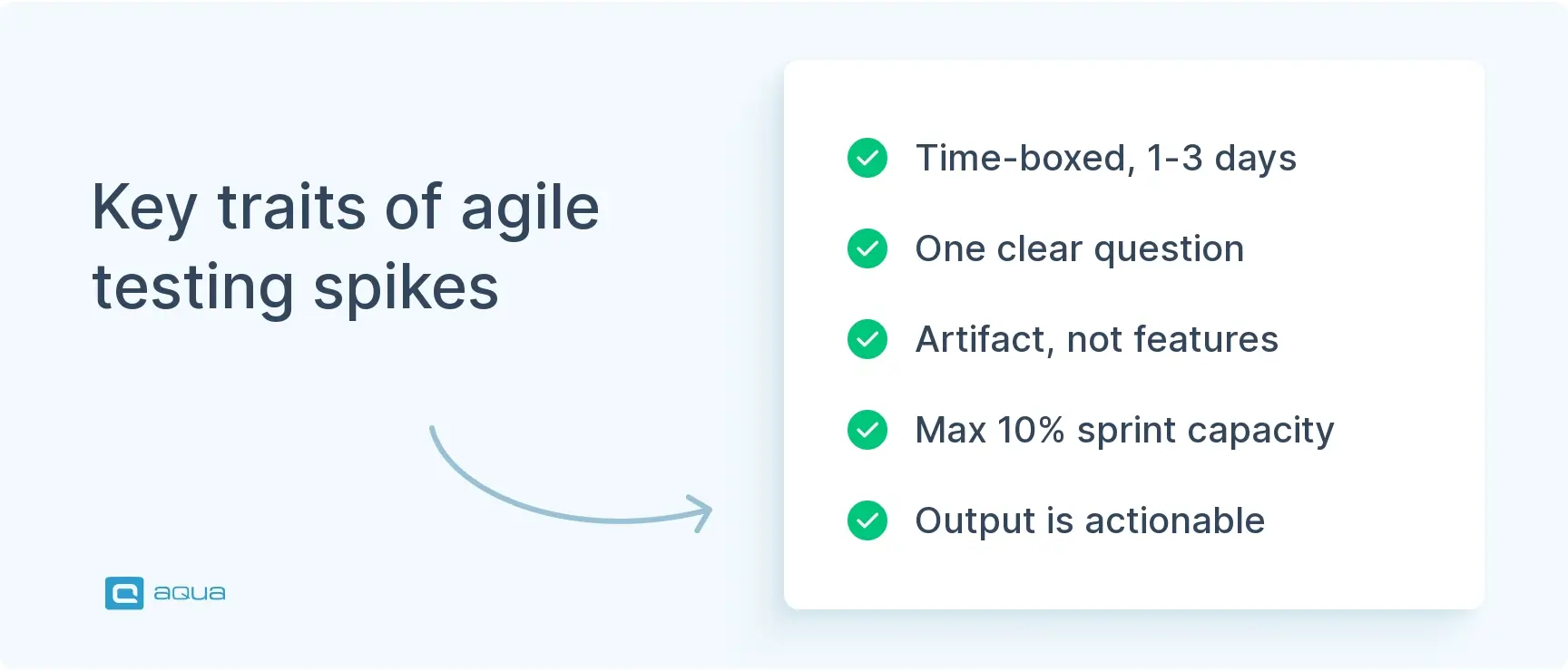
Key characteristics that define spikes in Agile:
Learning-driven, not feature-driven. Spikes exist to produce decision-grade evidence like recommendations and baseline metrics, not shippable code.
Time-boxed by design. A spike has an explicit start and end date, typically 1 to 3 days. When time runs out, work stops regardless of where you are.
Tied to a specific question. Every spike starts with a single, answerable question: Can we automate this checkout flow reliably? What’s the p95 latency baseline for search?
Backlog items with a learning goal. Structurally, spikes are Product Backlog Items (PBIs). They live on your board, get assigned, and have a Definition of Done, but that DoD is about producing an artifact, not shipping a feature.
Sized by capacity, not complexity. Unlike user stories measured in story points, spikes are allocated a fixed time budget, often capped at 10% of sprint capacity.
Direct output: a decision artifact. The deliverable is always something actionable: a one-page decision record, a throwaway prototype, or a session-based test report that shapes what happens next.
The concept traces back to Extreme Programming’s Spike Solutions, which were small, deliberately incomplete prototypes built to learn enough to proceed safely. Scaled Agile Framework (SAFe) later formalized this as exploration Enabler Stories. What makes a spike a testing spike specifically is that the learning goal ties directly to quality risk and verification approach. It validates whether your UI tests will be unsatisfactory, or determines what test harness a new microservice needs. For CTOs and engineering directors, this matters because testing spikes are where your team’s technical judgment gets applied before budget is committed.
Handling uncertainty in Agile projects can be overwhelming, especially when your team deals with unproven assumptions or experiments. aqua cloud, as an AI-driven test and requirement management platform, gives Agile teams an all-in-one environment to manage test activities, whether they’re planned stories or exploratory spikes. With its Agile Board and Sprint Board features, you can plan, track, and time-box testing spikes right alongside regular work items. When uncertainty strikes, aqua’s AI Copilot can instantly generate relevant test cases from your requirements, reducing a task that might take hours down to seconds. This domain-trained AI learns from your project’s own documentation, making every suggestion deeply context-aware. aqua’s real-time dashboards provide immediate visibility into test progress, helping teams identify risks and make evidence-based decisions without waiting for sprint ceremonies. And with 12+ out-of-the-box integrations including Jira, Azure DevOps, Jenkins, and Confluence, aqua keeps your spike findings connected to every tool your team already uses.
Spikes exist to buy down risk when uncertainty costs more than investigation. In Agile testing, that uncertainty usually shows up around testability and automation feasibility, plus quality-attribute risks like performance or security. Running a spike means accepting that some questions can’t be answered in refinement meetings. Your team needs hands-on proof, and your business needs confidence that the next sprint won’t produce expensive surprises.
Primary purposes of testing spikes:
Decision support. A well-run spike produces an artifact that directly informs what happens next. If it reveals that stable test IDs don’t exist in the UI layer, your team can pivot to API-level checks instead of burning a sprint on brittle Selenium scripts.
Risk reduction before commitment. Spikes surface blockers and tooling gaps early. Environment constraints come to light too, well before they become mid-sprint fires that your engineering manager has to explain to stakeholders.
Feasibility validation. When nobody knows whether a tool or data strategy will work in your stack, a spike gives you proof without full implementation cost.
Secondary purposes:
Improving estimation reliability. Spikes clarify what done looks like, replacing fuzzy scope with concrete acceptance criteria and a credible estimate. SAFe explicitly calls spikes mechanisms to increase estimate reliability, which means more predictable delivery for your product owners and project sponsors.
Fostering a culture of learning. Spikes give your team permission to experiment and openly document what doesn’t work. That converts uncertainty into a structured learning loop rather than a planning blocker.
Both primary and secondary purposes only materialize when spikes are kept disciplined, time-boxed, and outcome-focused. With that in mind, it helps to understand how they differ from the stories sitting next to them in your backlog.
Spike / viability investigation (try a couple different approaches) to see whether the test or tests can be reasonably automated
How Do You Differentiate Spikes from Regular User Stories?
User stories deliver shippable value; spikes deliver knowledge. A user story has acceptance criteria that define a working feature, while a spike has a clear question and a time limit. When the clock runs out, you ship a recommendation or report, not code. Spikes written in user story format are a sign your team hasn’t defined what they’re actually trying to learn.
Sizing differs, too. The Agile Alliance notes that sizing spikes with story points can become a vanity metric, since your team may inflate point values to hit velocity targets. A better practice is to time-box spikes as fixed-duration tasks (1 to 2 days) or allocate capacity (up to 10% of sprint capacity) without assigning points. A spike’s scope is defined by how long it runs, full stop.
Prioritization follows a different logic as well. User stories get ordered by business value, while Agile spikes get prioritized by risk and blocking potential. If a spike unblocks several high-value stories, it jumps the queue even though it delivers zero customer-facing features. For a VP of Engineering or a CTO reviewing sprint commitments, this is the key framing: spikes are a risk management investment.
Aspect
User Story
Spike
Primary goal
Deliver shippable value
Reduce uncertainty / enable decision
Acceptance criteria
Functional + testable behavior
Question answered + artifact produced
Sizing
Story points (relative complexity)
Time-boxed (days/hours) or capacity allocation
Output
Working software + automated tests
Decision record, prototype, metrics, or report
Prioritization
Business value + dependencies
Risk + blocking potential
Definition of Done
Code shipped, tests passing, docs updated
Recommendation stated, follow-up backlog created
One important nuance: some spikes produce code that does ship, but only after a deliberate harden and integrate task. All spike artifacts should be marked experimental unless your team explicitly promotes them via a separate backlog item. Good managing agile requirements practices help keep that boundary clear across your team.
Writing and Implementing Effective Spike Stories
Here’s the step-by-step process for writing and running a spike story:
Write a one-sentence question. State the uncertainty blocking your team, e.g., Can we generate GDPR-compliant test datasets for EU users? If it takes more than one sentence, it’s two spikes.
Set a strict timebox. An explicit start/end date works best, with a max of 1 to 3 days. Your board should track it the same way it tracks any sprint commitment.
Define success criteria upfront. Decide what artifact proves the spike is done, whether that’s a decision record, prototype, or baseline metrics, before any work starts.
Identify constraints early. Environment access, data privacy rules, tooling licenses, compliance requirements. These shape which experiments are even possible.
Run minimal experiments. The smallest possible proof is enough: one test script, one load test, one exploratory session. Over-engineering at this stage defeats the purpose.
Capture observations in real time. Waiting until the timebox expires to document is a mistake. A shared doc or wiki page works well for capturing notes as you go.
Produce a concrete artifact. Decision record (one page), throwaway prototype, test script, or session-based test charter report.
Create follow-up backlog items. Acceptance criteria should be updated and the test approach defined to reduce estimation uncertainty for the next sprint. When follow-up items never get created, the spike’s value evaporates.
One practical test for done: if your team can’t summarize findings and next steps on one page, you haven’t finished spiking. You’ve started building. For product directors and delivery managers who need to explain spike value up the chain, that one-pager is also the artifact that justifies the time investment. For guidance on what good outputs look like, writing effective test cases is a useful reference when structuring spike deliverables.
Integrating Spike Stories into Agile Sprints
Your sprint backlog should treat spikes like any other PBI, but because they don’t deliver shippable features, capacity allocation needs deliberate management. Up to 10% of sprint capacity is a sensible ceiling for spikes, and running them early is non-negotiable. A spike completed on day nine of a ten-day sprint gives your team knowledge too late to act on, and from a delivery standpoint, that’s the same as not spiking at all.
Beyond timing, think carefully about who you assign spikes to. The tester who knows your CI setup or the dev who’s touched that API will produce findings that are far more credible and actionable than whoever happens to be free.
To integrate spike stories into Agile sprints using aqua cloud:
Create the spike as a backlog item in aqua. aqua’s Agile Board lets you add the spike alongside regular stories. The item type should be set to distinguish it from feature work, with the one-sentence question as the title.
Set the timebox in the Sprint Board. Assign the spike to the current sprint with explicit start and end dates. aqua’s Sprint Board gives your team a real-time view of all sprint items, keeping the spike visible alongside feature stories.
Link the spike to related requirements and stories. aqua’s traceability features connect the spike to the implementation stories it unblocks. When the spike completes, the dependency chain is already visible.
Use aqua’s AI Copilot during the spike. As findings emerge, the Copilot can generate draft test cases grounded in your project’s own documentation, converting raw spike observations into structured test assets.
Document the artifact directly in aqua. Your decision record, prototype notes, or baseline metrics can be saved as attachments linked to the spike item. Nothing gets lost between tools this way.
Create follow-up stories from the spike findings. aqua’s backlog makes it easy to spin up new items with updated acceptance criteria before the sprint review. aqua’s two-way Jira and Azure DevOps sync ensures these follow-up items are immediately visible to your developers working in their own tools.
Share spike outcomes in the sprint review. aqua’s real-time dashboards let you show stakeholders what was learned and how it shapes the next sprint, without requiring a demo-able feature.
Including spike summaries in sprint reviews as a what we learned segment stops the velocity questions before they start. For engineering directors and product managers reviewing sprint health, this visibility is exactly what builds trust in the process.
Benefits of Using Spike Stories in Agile Environments
Spikes prevent waste before it compounds. Two days spiking instead of ten days building the wrong solution saves eight days of rework, and in testing, that payoff is immediate. Your team stops committing to brittle UI test suites or tools that can’t integrate with CI, because the spike surfaces those blockers first. Estimation reliability follows the same pattern: vague stories attract vague estimates, while spikes replace guesswork with evidence, tightening velocity and making sprint commitments credible to stakeholders. For a CTO or engineering VP, that predictability is worth far more than the 10% capacity investment it costs.
Additional benefits worth calling out:
Faster tool decisions. Instead of debating Playwright vs. Cypress for weeks, spike both with a real test suite and CI integration. Two days later, your team has a decision record and a working proof of concept. This is what good test automation in agile looks like in practice.
Better test strategy alignment. A spike exploring agile testing trends and testing quadrants for a new epic produces a one-page test strategy instead of ad-hoc coverage.
Early performance and security visibility. A quick performance baseline spike or a risk-based testing spike identifies the highest-likelihood quality risks before production firefighting begins. Business owners and compliance leads benefit directly from this shift.
Reduced flakiness risk. Automation feasibility spikes catch missing test IDs and race conditions before your team has written hundreds of brittle tests, often pointing toward API-level checks or upstream testability improvements instead.
Your team builds institutional knowledge about what works in your context when you spike regularly. Spike artifacts document those lessons so your next project cycle doesn’t repeat the same mistakes.
Challenges in Implementing Spike Stories in Agile Projects
Spikes fail when they become hiding places for poorly defined work — and the warning signs are easy to miss. Here’s how to spot and fix the most common failure modes.
Challenge 1. Vague scope with no clear output
No defined question, no decision owner, no tangible deliverable. Your team burns two days on vague research, then shows up to standup with nothing concrete to show for it.
Solution: A decision record should be the Definition of Done. If your team can’t produce one page summarizing the question and experiments run, plus clear next steps, the spike wasn’t completed.
Challenge 2. Timebox overrun
Spikes expand to fill available time. A two-day spike stretches to four because someone is almost done proving a point.
Solution: The timebox should be treated as fixed. When it expires, work stops, even mid-experiment. What’s known gets documented and what’s still open becomes a follow-up spike with tighter scope.
Challenge 3. Spiking without a blocking decision
If nobody can name who will use the spike’s answer or what decision depends on it, the spike shouldn’t exist. Proposing a spike to explore a new tool might sound productive, but that’s professional development.
Solution: Before a spike enters the backlog, the requestor should name the decision it enables and the stories it unblocks. That gate eliminates most pointless spikes.
Challenge 4. Spike code drifting into production
Quick-and-dirty spike prototypes become permanent infrastructure when nobody explicitly promotes or discards them.
Solution: All spike artifacts should be marked experimental. Promotion to production should only happen via an explicit hardening task added to your backlog.
Challenge 5. No follow-through on findings
The spike produces a recommendation, but nobody creates follow-up backlog items. The learning evaporates by the next sprint.
Solution: Follow-up backlog items created should be an explicit part of your spike Definition of Done.
Most of these pitfalls share a root cause: insufficient structure around how spikes in Agile testing are defined, tracked, and closed. For engineering leaders and business owners who want predictable delivery, partnering with an experienced provider like aqua makes a real difference. A dedicated test management platform gives your team the guardrails, traceability, and artifact management that keep Agile spikes on track from question to follow-up story.
The easiest way that we overcame this was to basically do a spike against both tools, show what the pros/cons are for each tool and let the team try and agree based on what would benefit them the most.
The following two examples are illustrative scenarios based on common patterns in Agile testing practice. They show the question, experiment, and outcome, which is the core DNA of a spike that works.
Illustrative Example A: E-commerce checkout automation feasibility
Imagine your retail platform’s QA team facing an upcoming checkout UI refactor with no certainty that your existing automation will survive it. The question your team must answer: Can you reliably automate checkout with stable selectors, or do you need API-level fallbacks? Your QA lead writes three critical-path UI tests and runs them 20 times in CI. They fail intermittently due to missing test IDs and dynamic class names. Your spike recommends API-level checks for business logic plus minimal UI smoke tests, with follow-up stories to add data-testid attributes and build an API test suite. Two-day spike, two weeks of rework avoided. IBM’s Systems Sciences Institute has documented this pattern for decades: defects found earlier in the SDLC cost up to 100 times less to fix than those caught in production.
Illustrative Example B: Fintech exploratory testing under low connectivity
Now picture your mobile banking product team releasing a bill-pay feature with clear acceptance criteria but no visibility into how it behaves under degraded networks. The question you need to answer: What breaks in bill-pay with throttled connections and interrupted sessions? Two of your testers run 90-minute exploratory sessions using a predefined charter with network throttling active. They surface a double-charge risk and a payment confirmation lost on reconnect, plus gaps in your acceptance criteria around offline queueing. Your follow-up stories cover offline payment queue handling and ten new automated reconnect-scenario checks. Half-day spike, critical bugs caught before release. As Gartner noted in Innovation Insight: Continuous Quality (Herschmann, Murphy, Scheibmeir, 2023), continuous quality practices including structured pre-release exploration directly improve customer service and operational excellence.
Best Practices for Managing Spikes
Spikes only pay off when they’re managed with the same discipline you’d apply to any sprint commitment. Here are the practices that constitute an effective spikes Agile methodology:
1. Treat spikes as first-class backlog items.
Spikes need the same rigor as user stories: clear success criteria and explicit timeboxes, with visible tracking on your board. Hiding them in a research column that never gets reviewed is how spike value disappears. For executives asking where time is going, a visible spike with a defined question and a due date is far easier to defend than a vague open-ended research task.
2. Know the two spike types.
There are two main types of spikes in Agile: technical and functional. Technical spikes address implementation uncertainties, like which automation tool will work with your CI system. Functional Agile spikes resolve business or requirement questions, like which test approach best validates a complex workflow. Knowing which type your team is running sharpens the question and the success criteria. For engineering managers, this distinction also helps with resourcing: technical spikes need developers, while functional spikes often need QA and product together.
3. Limit work-in-progress.
One or two spikes per sprint is the sweet spot. More than that usually signals deeper issues such as weak refinement or missing engineering practices. The root cause is worth solving rather than normalizing the chaos.
4. Use a lightweight spike template to keep quality consistent.
Here’s a copy-paste version your team can adapt:
Spike Title: Testing Spike: [one-sentence question] Context: Why this matters now (what’s blocked) Decision to make: What choice depends on this spike Timebox: Start-end (max X days) Approach: Minimal experiments you’ll run Constraints: env, data, tools, compliance
A one-page decision record beats a 15-page research report every time. The question, experiments run, key findings, and next steps are all that’s needed. Raw artifacts should be linked for anyone who needs detail, but burying the decision in noise defeats the purpose.
6. Retrospect your spikes.
During sprint retros, check whether your Agile spikes delivered decision-grade evidence on time, whether the timebox was respected, and whether follow-up stories were actually created. If spikes keep overrunning or producing vague outputs, entry criteria need tightening. A defined question and a named decision owner should be required before any spike enters your backlog.
7. Run a pre- and post-spike checklist.
[ ] Question is stated as one clear sentence
[ ] Decision owner identified (who’ll act on the findings)
[ ] Timebox set (1 to 3 days max) with explicit start/end
[ ] Success criteria written (what artifact = done)
[ ] Experiments minimal and focused (smallest possible proof)
[ ] Deliverable produced: decision record, prototype, or report
[ ] Follow-up backlog items created with updated acceptance criteria
[ ] Spike outcome shared in sprint review or team sync
Agile testing spikes are only as effective as the system you use to manage your entire QA. aqua cloud, an AI-driven test and requirement management solution, provides the right environment for Agile teams. Its comprehensive test management capabilities let you organize spike activities right alongside regular test cases. When spikes reveal new test requirements, aqua’s domain-trained AI Copilot generates test cases grounded in your project’s own data, saving test creation time. The platform’s flexible test scenario structure is ideal for documenting exploratory sessions, with nested test cases and the Capture extension making it easy to record and share spike findings. aqua’s traceability and reporting tools transform spike knowledge into actionable insights, ensuring nothing gets lost between sprints. And with REST API integrations across Jira, Azure DevOps, Jenkins, Confluence, and more, aqua connects every spike artifact to the tools your dev and QA teams already deal with.
Agile testing spikes are only as effective as the system you use to manage your entire QA. aqua cloud, an AI-driven test and requirement management solution, provides the right environment for Agile teams. Its comprehensive test management capabilities let you organize spike activities right alongside regular test cases. When spikes reveal new test requirements, aqua’s domain-trained AI Copilot generates test cases grounded in your project’s own data, saving test creation time. The platform’s flexible test scenario structure is ideal for documenting exploratory sessions, with nested test cases and the Capture extension making it easy to record and share spike findings. aqua’s traceability and reporting tools transform spike knowledge into actionable insights, ensuring nothing gets lost between sprints. And with REST API integrations across Jira, Azure DevOps, Jenkins, Confluence, and more, aqua connects every spike artifact to the tools your dev and QA teams already deal with.
Reduce test creation time by 97% and foster Agile culture
Agile testing spikes are a disciplined answer to uncertainty. For engineering leaders, product owners, and business executives alike, the value is the same: a structured path from not knowing to having a concrete recommendation and a clear next action. When kept tight with a clear question, strict timebox, and concrete artifact, they prevent the kind of rework that pushes out release dates and erodes stakeholder trust. The examples, templates, and best practices in this guide give your team everything needed to run spikes that actually pay off: faster decisions, tighter estimates, and early quality visibility. Some questions can only be answered with hands-on proof, and spikes are how you get it.
A spike in Agile is a time-boxed experiment added to the backlog specifically to reduce uncertainty. Instead of delivering a feature, it delivers knowledge: a recommendation, prototype, or report that helps your team make a confident decision about how to proceed with a story or epic they can’t yet reliably estimate.
How do spikes impact sprint planning and estimation accuracy?
Spikes replace guesswork with evidence. When a story’s test scope or environment setup is unknown, estimates are unreliable at best and wildly wrong at worst. Running a spike before the implementation story enters a sprint gives your team concrete data, including what the test approach will be and what risks remain, making the subsequent estimate credibly grounded rather than hopeful.
What are best practices for documenting spike outcomes in Agile teams?
The most effective spike documentation is a one-page decision record covering the question asked, experiments run, key findings, and follow-up backlog items created. Raw artifacts like scripts and session notes should be linked but not inlined. The goal is to start the next conversation. Your team is far more likely to use spike docs during backlog refinement when they’re kept lean.
How long should an agile testing spike last?
Most testing spikes should be time-boxed to one to three days. One day works for narrow, binary questions, e.g., Does this API return test IDs? Two days covers the majority of automation feasibility and exploratory spikes. Three days is the practical ceiling, suitable for complex activities like performance baselining or threat-modeling sessions. Anything longer is no longer a spike; it’s an implementation task and should be treated as one.
Robert has several years of experience in process optimisation and test management. He is an expert in defining and implementing workflows by adapting aqua to the clients’ processes.
Pavel, a Quality Assurance Consultant and Author, brings deep expertise to solving complex testing challenges. His background in software development has helped organizations transform their QA practices from reactive to proactive. Beyond consulting, Pavel develops best practice guides and case studies for aqua cloud that…
Home » Best practices » Agile Testing Spike: What is It, Purpose, Process and Best Practices
Do you love testing as we do?
Join our community of enthusiastic experts! Get new posts from the aqua blog directly in your inbox. QA trends, community discussion overviews, insightful tips — you’ll love it!
We're committed to your privacy. Aqua uses the information you provide to us to contact you about our relevant content, products, and services. You may unsubscribe from these communications at any time. For more information, check out our Privacy policy.
X
🤖 Exciting new updates to aqua Intelligence are now available! 🎉