Medical Device Requirements Management: Ultimate Guide
Sensitive patients’ data should be handled in a compliant manner. Otherwise, any software defect can potentially trigger a million-dollar recall. No wonder if your priorities here are straight: strong requirements management and risk minimization at every QA phase. This guide walks through a requirements management system built to hold up under FDA scrutiny. You'll get practical frameworks for the full lifecycle, specific tools worth evaluating, and practices with measurable targets that reduce rework.
Medical device requirements management connects clinical needs to technical specifications, with complete traceability demanded by regulators like the FDA and ISO 13485 to ensure patient safety.
Requirements span five key categories, including business, user, technical, engineering, and regulatory specifications that must work together through comprehensive traceability matrices.
Organizations with mature requirements practices report 30-40% shorter regulatory submission review cycles and 60% fewer late-stage design changes compared to companies with poor documentation.
Effective requirements management requires specialized tools like ALM platforms, PLM systems, and QMS solutions that maintain bidirectional traceability and support compliance activities.
See how proper requirements management can accelerate your releases and contribute to your patients’ data safety 👇
Understanding Requirements Management in Medical Devices
Requirements management in medical devices is the systematic process of capturing, organizing, tracking, and maintaining all specifications that define what a device must do, how it must perform, and which standards it must meet. Requirements should become well-traceable throughout the entire product lifecycle, from initial concept through post-market surveillance.
The regulatory considerations make this especially important. ISO 13485, the international standard for quality management systems specific to medical devices, demands documented procedures for requirement control and change management. Risk assessment processes must also be formally documented and controlled. FDA regulations under 21 CFR Part 820 require manufacturers to demonstrate that devices are both safe and effective through validated evidence. Auditors are looking for proof, and requirements management provides that through an auditable trail.
What sets medical device requirements apart is the weight of responsibility. In standard software development, you can iterate quickly and fix bugs in production. In medical device development, requirements must account for failure modes and user errors, alongside environmental conditions across complex integrated systems. That’s exactly why safety must be designed upon based on specifications from day one. Just patching in when compliance gaps appear is absolutely unacceptable for any business operating in a regulated industry.
The process involves multiple stakeholders. Clinicians describe workflows and patient needs, while engineers translate those into technical specifications. Regulatory teams map requirements to compliance obligations, and quality assurance validates that implementations match specifications. Without structured requirements management, these groups work in isolation, creating gaps where critical safety issues may arise.
Medical device requirements management demands precision at every level. The QA system behind it needs to maintain compliance while connecting every requirement to its verification evidence. aqua cloud, an AI-powered test and requirement management solution, provides exactly that for regulated industries. With aqua’s capabilities, your team can establish complete traceability from user needs to test cases, ensuring every specification is properly tested and documented for regulatory submissions. Bidirectional traceability matrices automatically highlight coverage gaps, while revision history and audit trails satisfy FDA 21 CFR Part 11 compliance needs. aqua’s domain-trained AI Copilot generates requirements documents and test cases in seconds. Unlike generic AI tools, aqua’s Copilot understands your specific project documentation and terminology through RAG-based grounding, so generated content reflects context and meets regulatory expectations. aqua integrates natively with Jira, Jenkins, Azure DevOps, Confluence, JMeter, Oracle Database, REST API, and 10+ other tools, plus Capture.
Achieve 100% requirements traceability while cutting documentation time by 80%
Types of Requirements in Medical Device Development
Medical requirements management includes five categories, each interconnected through traceability matrices. Understanding and acting upon them helps your team structure documentation and assign ownership. Requirements types are as follows:
Business requirements define the commercial and strategic objectives driving development. These cover market positioning and regulatory pathway selection, among other considerations. A business requirement might specify that a diagnostic device must achieve FDA 510(k) clearance within 18 months to capture a specific market window. These requirements shape project scope and resource allocation decisions.
User requirements capture what clinicians, patients, and healthcare staff need in real-world settings. A ventilator’s user requirements might include: “Nurses must be able to adjust oxygen levels without removing sterile gloves.” These requirements drive human factors engineering and clinical workflow analysis, ensuring devices perform reliably in demanding clinical environments.
Technical requirements translate user needs into hardware and software specifications. For an MRI system, these might specify electromagnetic field strength and image resolution parameters. Data transfer rates to PACS systems would be defined separately as interface specifications.
Engineering requirements cover component-level specifications and manufacturing tolerances. For an infusion pump, engineering requirements might detail pump mechanism tolerances and battery capacity specifications, bridging the concept and physical product.
Regulatory requirements map to specific standards, including FDA Design Control under 21 CFR Part 820 and IEC 62304 for software lifecycle processes. ISO 14971 for risk management adds another layer of crucial constraints. All regulatory requirements create boundaries that every other requirement category must respect.
Requirement Type
Primary Focus
Key Stakeholders
Common Standards
Business
Market positioning, compliance strategy
Product management, regulatory affairs
ISO 13485, regional regulations
User
Clinical workflows, safety, usability
Clinicians, patients, human factors engineers
IEC 62366 (usability)
Technical
Hardware/software specifications, integration
Engineers, architects
IEC 62304, HL7, FHIR
Engineering
Component specs, manufacturing
Design engineers, manufacturing
ISO 13485, design controls
Regulatory
Standards compliance, safety evidence
Regulatory affairs, quality
FDA 21 CFR 820, MDR, ISO 14971
We already have approved devices and have passed audits. But we handle the documentation manually across multiple Word documents and don’t have a central place for managing requirements yet.
The Requirements Management Lifecycle in Medical Devices
The requirements lifecycle moves through five structured phases. Each builds on the previous and generates documented evidence regulators expect to see during submissions and audits.
1. Requirements Gathering
This phase collects input from all stakeholders. Clinical workshops reveal workflow pain points, while regulatory analysis determines mandatory standards. Good techniques include observational studies in clinical settings and structured interviews with multiple user personas. Your team should expect hundreds or thousands of raw requirements at this stage. That volume is normal. Refinement comes next.
2. Documentation and Specification
Raw requirements get transformed into formal, testable statements. Each requirement needs a unique identifier and version control. Structured attributes covering priority, rationale, source, and acceptance criteria complete the record.
Vague language creates downstream problems. “The system should be fast” becomes “The device shall display ECG waveforms within 500 milliseconds of signal acquisition with 95% confidence.” Medical device documentation standards demand this rigor because ambiguous requirements lead to interpretation errors during implementation and testing.
3. Analysis and Prioritization
This phase evaluates requirements for feasibility and regulatory impact. Conflicts also emerge here: a user requirement for portability might clash with an engineering requirement for battery life. FMEA (Failure Mode and Effects Analysis) helps your team understand how requirement failures could propagate into patient harm. Addressing tradeoffs here costs far less than discovering them during validation.
4. Verification and Validation
Verification asks: “Did we build it right?” Validation asks: “Did we build the right thing?”
Verification checks that design outputs match requirement inputs through testing and analysis. Validation confirms requirements address actual user needs through clinical evaluation and human factors testing. A Requirements Traceability Matrix (RTM) is essential here. It links each requirement to design elements and test cases, with risk controls mapped in the same view. Auditors scrutinize RTMs to confirm nothing slipped through the gaps.
5. Change Management
Requirement modifications after baseline approval require formal change control. Change control boards evaluate proposed changes and assess regulatory impact before approving documentation updates. Changes generate an audit trail showing who requested it and why. Validation evidence is documented before implementation.
A solid requirements management plan that covers change governance before development begins is far easier to execute than one assembled mid-project. Disciplined change management protects the regulatory clearances your team has already earned.
Challenges in Requirements Management for Medical Devices
Medical device requirements management faces obstacles that compound each other. Here are the most common ones your team will encounter, along with practical mitigations for each.
Regulatory complexity
Medical devices must satisfy multiple overlapping standards, including FDA requirements, EU MDR, and ISO 13485. IEC 62304 and ISO 14971 add further obligations depending on device classification and target markets. A requirement change triggered by new FDA cybersecurity guidance can ripple through hundreds of linked specifications and test cases across your entire documentation set.
Mitigation strategy: Build a regulatory requirements library that maps each standard to your device classification from the start. Tag requirement attributes to specific standards so your team can scope the impact of regulatory updates quickly, without manual cross-referencing across disconnected documents.
Maintaining complete traceability
Modern medical devices integrate hardware, embedded software, cloud platforms, and mobile apps. A single user requirement might trace to 50 technical specifications and 30 test cases. Manual traceability breaks down at that scale. The gaps auditors find during submissions are almost always the ones that were not caught during development.
Mitigation strategy: Use ALM tooling that maintains bidirectional trace links automatically. Set a hard gate: no requirement moves to baseline without at least one linked test case and one linked risk control. Monthly traceability audits during active development catch gaps before reviewers do.
Integration between enterprise systems
Requirements often live across disconnected platforms: PLM for design data and ALM for software development. A design change in PLM might not trigger updates to related test cases in ALM or risk assessments in QMS, creating silent compliance gaps that appear during regulatory reviews.
Mitigation strategy: Define formal integration points between your systems and automate notifications when linked items change. Even lightweight API-based integrations between tools reduce the risk of disconnected updates that create audit findings.
Ambiguous clinical requirements
Clinicians describe needs using medical terminology that engineers misinterpret. A cardiologist requesting “real-time monitoring” might expect millisecond responsiveness, while developers implement five-second refresh intervals. These translation failures appear late during validation, when clinical users reject implementations that technically meet written specs but miss actual intent.
Mitigation strategy: Assign a clinical liaison within your development team who reviews requirements before baseline. Use acceptance criteria templates that force stakeholders to specify measurable thresholds. Showing clinical users working prototypes before requirements are locked prevents far more rework than any review process can.
Resource limitations
Smaller manufacturers often lack access to specialized tools and the trained personnel that proper requirements management demands. The dedicated time requirements management requires is another pressure point. The upfront investment feels like overhead that delays revenue. In practice, poor requirements discipline produces far costlier recalls and submission rejections.
Mitigation strategy: Start with a cloud-based ALM tool to reduce upfront infrastructure costs. Prioritize traceability for your highest-risk requirements first, then scale the process as your team grows. Phased adoption is more sustainable than implementing everything at once.
For teams dealing with frequent specification changes, structured approaches to managing requirements changes address all five of these challenges more systematically.
Benefits of Effective Requirements Management
The advantages of requirements management extend well beyond passing an audit. Here is where disciplined practice shows up in real project outcomes.
Faster regulatory approvals. According to industry benchmarks, mature requirements practices can reduce submission review cycles by 30 to 40%. Complete traceability matrices and clear acceptance criteria answer auditor questions before they’re asked, reducing the back-and-forth that stalls submissions.
Precise impact analysis. When a component supplier announces a discontinuation, your traceability matrices immediately identify affected requirements and design specifications. Test cases and risk controls are flagged for review as well, enabling targeted validation rather than expensive full-system retesting. This same traceability helps teams trace adverse events back to specific requirements, supporting faster root cause analysis.
Better cross-functional collaboration. When requirements serve as the shared language between disciplines, everyone from clinicians to engineers references the same identifiers during discussions. Conflicts get flagged before expensive implementation begins, and your team resolves tradeoffs deliberately.
Higher product quality. Analyzing requirements systematically for completeness and testability catches design flaws before they get embedded in hardware or code. Risk management woven into requirements ensures hazards get addressed through design controls. Products developed with strong requirements management show fewer field failures and lower complaint rates.
Less rework. Clear acceptance criteria make verification testing more predictable. Your team members spend less time debating ambiguous specs and more time building validated solutions. According to industry benchmarks, mature requirements processes reduce late-stage design changes by up to 60%, saving months of schedule time and significant rework costs.
Tools and Technologies Supporting Requirements Management
The right tools for requirements management in medical device contexts share certain characteristics: bidirectional traceability, baseline management, and standards-aligned audit trails. Here are the main categories worth evaluating.
When selecting requirements management software for medical device development, look beyond feature lists. Consider how well the tool integrates with your existing development infrastructure and whether it supports 21 CFR Part 11 compliance. Scalability across your device portfolio complexity matters too.
ALM platforms provide comprehensive environments for managing requirements, design, testing, and defects with built-in traceability. Tools like Jama Connect and Helix ALM target regulated industries with baseline management and electronic signatures built for 21 CFR Part 11 compliance. Approval workflows and audit trails complete the compliance picture. Jama Connect’s live traceability views highlight coverage gaps in real time, helping your team identify untested requirements before validation begins.
PLM systems such as Siemens Teamcenter and PTC Windchill integrate requirements alongside mechanical design files and bills of materials. When a PCB design changes, these systems trace which requirements might be affected, triggering cross-functional reviews automatically.
Dedicated requirements tools like IBM DOORS and Polarion focus exclusively on requirements capture and analysis, with traceability as a core differentiator. DOORS excels at managing thousands of interlinked requirements with complex trace relationships. Polarion offers modern web-based interfaces with strong integration capabilities. Both require more setup and training than general ALM tools, but handle the scale that general platforms cannot.
Integrated QMS platforms like MasterControl and Greenlight Guru connect requirements to complaint handling and CAPA management. Audit workflows are built into the same platform. When a customer complaint arises, your quality team can trace it back to specific requirements, supporting faster root cause analysis.
When medical devices must interface with hospital management systems, the software requirements specification for that integration needs to clearly define data exchange protocols and security requirements. Documenting these interface requirements accurately prevents compatibility issues during implementation and reduces validation effort significantly.
Key features to prioritize when evaluating any tool:
Bidirectional traceability with automatic link maintenance
Baseline management and version control
Electronic signature workflows
Comprehensive audit trails
Standards template libraries (ISO 13485, IEC 62304, ISO 14971)
Risk management integration
Automated traceability report generation
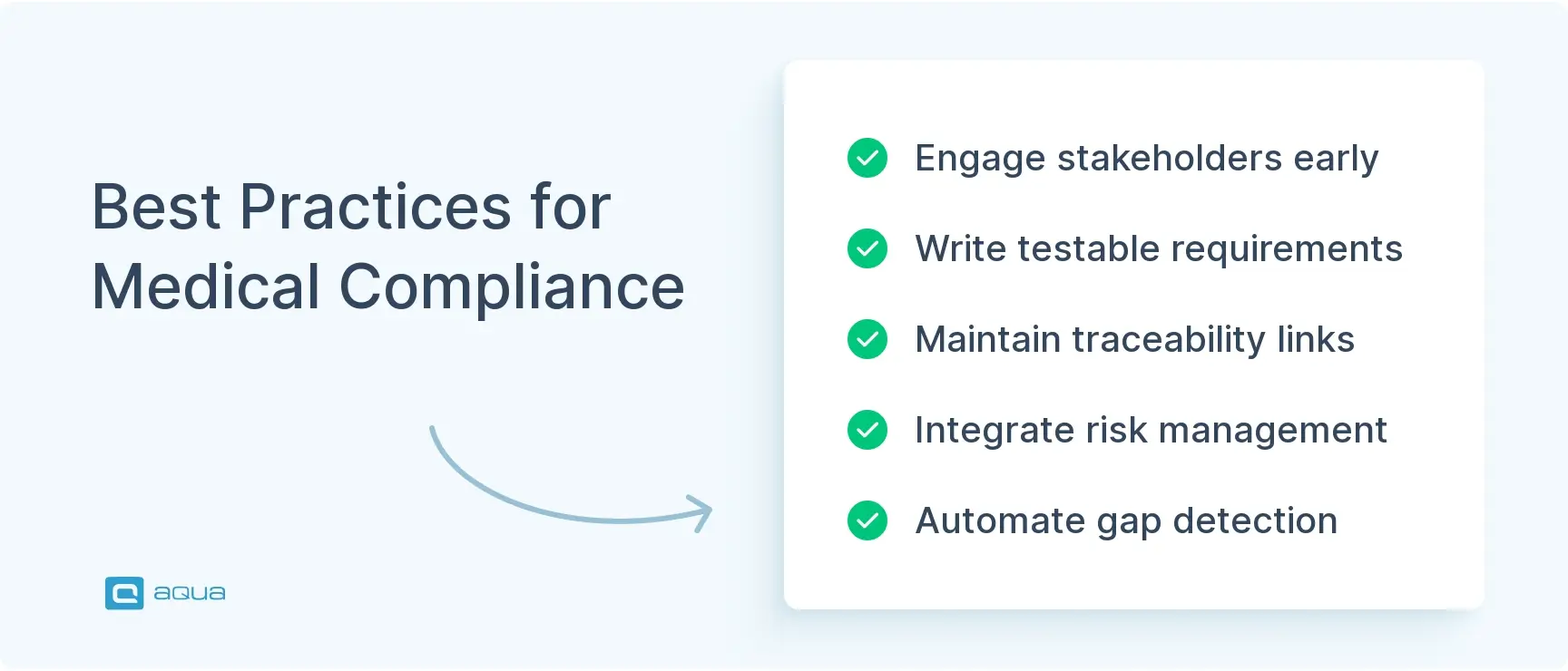
Best Practices for Medical Requirements Management
These practices separate teams that struggle through submissions from those that achieve first-pass approvals. Each includes a measurable target your team can track.
Engage stakeholders early.
Schedule clinical reviews before requirements are baselined and keep those cycles short. The earlier clinical users are involved, the fewer costly interpretation gaps appear during validation. A clinical liaison embedded in your development team translates between medical and engineering terminology before misunderstandings get built into specifications.
Write verifiable requirements.
Requirements must specify measurable acceptance criteria that eliminate interpretation during verification. “The device shall be easy to use” becomes “95% of trained nurses shall successfully program an infusion within 60 seconds without errors or assistance.”
A practical writing formula: [Subject] shall [action] [measurable threshold] under [defined conditions].
Applying this standard consistently reduces verification disputes and eliminates the ambiguous requirements that force rework after review.
Maintain bidirectional traceability.
Set a hard coverage target: every requirement links to at least one test case and one risk control before baseline approval. Use this as a formal gate in your review process.
Coverage rate = (Requirements with linked test cases ÷ Total requirements) × 100
Target: ≥ 95% before entering the validation phase. Coverage below this threshold is a warning sign for submission readiness.
Integrate risk management.
ISO 14971 risk management should be a part of requirements testing procedure. A practical process metric: a requirement with a severity rating above “minor” must have a documented risk control linked in the traceability matrix before design freeze.
Enforce rigorous change control.
Track your change control board’s rejection rate as a process health indicator. A rate below 5% often signals insufficient scrutiny. Use this as a formal trigger: any change affecting more than 10 linked requirements, or invalidating existing validation evidence, requires a full impact assessment before approval.
Automate wherever possible.
Set up automated alerts for orphaned requirements (no linked tests) and overdue review cycles. Automated coverage reporting frees your team members to focus on analysis. The time saved from manual traceability audits compounds significantly across long development cycles.
Define clear ownership.
Assign every requirement a named owner. Track open review actions per person. If more than 15% of requirements carry open actions older than two weeks, your review cadence needs adjustment. Ownership clarity prevents requirements from stalling when questions arise.
Medical device requirements management demands high regulatory compliance and development efficiency. The stakes are high, and the complexity keeps growing. aqua cloud, an AI-powered test and requirement management platform, help address above mentioned challenmhes by creating end-to-end traceability between requirements, test cases, test executions, and defects. This gives your team the complete audit trail regulators demand during submissions. Compliance support covers ISO 13485 and FDA 21 CFR Part 820, as well as IEC 62304, reducing regulatory preparation time significantly. aqua’s domain-trained AI Copilot generates requirements and test cases grounded in your actual project documentation, reflecting your specific medical terminology and compliance needs. Teams using aqua report saving up to 97% of documentation time while achieving more thorough coverage. aqua integrates natively with Jira (bidirectional sync), Jenkins, Azure DevOps, Confluence, JMeter, PowerShell, MSSQL, UnixShell, SoapUI, Ranorex, Oracle Database, REST API, and 10+ automation tools, plus Capture integration.
Boost medical device compliance with aqua's AI-driven requirements management
Medical device requirements management sits at the intersection of patient safety and regulatory compliance, with commercial success tied directly to both. The complexity keeps increasing as connected devices and AI integration raise the bar, with cybersecurity requirements adding further pressure. Companies that build requirements discipline into their development process and invest in cross-functional collaboration will navigate regulatory reviews faster while delivering safer devices. The industry does not reward shortcuts here. Poor requirements practices show up as rejected submissions and costly recalls. Reputations take years to repair.
How can traceability be maintained in medical requirements management?
Use an ALM tool with bidirectional trace links between requirements, design elements, test cases, and risk controls. Set coverage gates before baseline approval and run monthly traceability audits during development. Automated coverage reports catch gaps before regulatory reviewers do.
What tools are commonly used for managing medical device requirements?
The most widely adopted tools include Jama Connect, IBM DOORS, Polarion, PTC Windchill, and Helix ALM. These platforms support regulated industry workflows with features like electronic signatures, audit trails, baseline management, and standards-aligned templates.
What is a Requirements Traceability Matrix (RTM) and why does it matter?
An RTM links each requirement to its source, design elements, test cases, and risk controls. During FDA or ISO 13485 audits, it serves as the primary evidence that specifications were tested and properly controlled throughout development.
How should change control be handled for baselined medical device requirements?
All changes should go through a formal change control board, including regulatory and quality representatives, with engineering input required. That’s why each change should document its rationale and impact assessment before approval. Tracking your board’s rejection rate serves as a useful process health indicator.
How do risk management and requirements management integrate under ISO 14971?
ISO 14971 risk management should be embedded directly into requirements activities. Each requirement with a severity rating above “minor” needs a documented risk control linked in the traceability matrix. Keeping risk assessments separate from requirements creates gaps that consistently appear during audits.
Enhancement of the aqua product is Martin’s main responsibility and biggest mission. His expertise covers ITIL Process Consulting, Change Management, Quality Assurance, Quality Management, and Requirements Management. Martin works in QA services for regulated industries for more than 18 years being an irreplaceable leader at…
Nurlan, a QA Coordinator & Quality Standards Officer, takes pride in orchestrating seamless QA operations. His expertise in coordinating QA-focused projects and integrating QA solutions has consistently yielded top-tier client satisfaction. Aside from a full-time QA coordinator, Nurlan's role involves creating compelling content that educates…
Pavel, a Quality Assurance Consultant and Author, brings deep expertise to solving complex testing challenges. His background in software development has helped organizations transform their QA practices from reactive to proactive. Beyond consulting, Pavel develops best practice guides and case studies for aqua cloud that…
Home » Best practices » Medical Device Requirements Management: Ultimate Guide
Do you love testing as we do?
Join our community of enthusiastic experts! Get new posts from the aqua blog directly in your inbox. QA trends, community discussion overviews, insightful tips — you’ll love it!
We're committed to your privacy. Aqua uses the information you provide to us to contact you about our relevant content, products, and services. You may unsubscribe from these communications at any time. For more information, check out our Privacy policy.
X
🤖 Exciting new updates to aqua Intelligence are now available! 🎉