BrowserStack Alternatives: Find the Right Solution
When QA teams look for BrowserStack alternatives, they usually have different reasons for switching. Some need cheaper parallel sessions, others need real mobile device labs, and a lot are missing test management entirely without realizing it. BrowserStack handles devices and visual regression well, but if pricing, mobile coverage, compliance, or weak reporting is the actual bottleneck, the software doesn't suffice any longer. This guide breaks down the five most common BrowserStack frustrations and covers the specific platforms worth evaluating for each situation.
aqua cloud is the most fitting alternative if you want built-in test management, offering AI test case generation, requirements traceability, and compliance documentation.
TestMu AI (formerly LambdaTest) offers flexible pricing and AI-native testing features, making it a strong cost-reduction option for mid-sized teams and startups.
Kobiton is built specifically for mobile device lab management with real iOS and Android devices, on-premise deployment options, and AI-augmented mobile testing workflows.
TestingBot provides EU-hosted infrastructure with explicit GDPR compliance positioning, making it a solid option for European teams with strict data residency requirements.
Switching device clouds won’t fix flaky tests caused by brittle selectors, shared test data, or poor test design. The real fix often sits in your automation framework, not your execution platform.
Most teams searching for BrowserStack alternatives need test management or better automation. Find out what will work for you 👇
Why Teams Look for BrowserStack Alternatives
Understanding your actual problem before evaluating any platform saves weeks of misdirected proof-of-concepts. Most teams end up in one of five situations, and each one points to a different type of solution.
Pricing Doesn't Match the Usage Pattern
BrowserStack bills around parallel sessions, device minutes, and user seats. That model works well when your team runs steady automation with predictable concurrency. It breaks down when your pipeline scales unevenly, such as ten engineers during sprint weeks and two during planning, or when a small QA team can’t justify enterprise pricing tiers.
The real cost goes beyond the subscription. Concurrency limits during release days, failed sessions that still bill, and add-ons for visual or accessibility testing accumulate fast. Teams in this situation typically need one of three things:
Per-job pricing instead of per-minute billing
Shared device pools with burst capacity
Open-source infrastructure your team controls fully
We've been using BrowserStack for like a half a year. You can automate your test there like a real device if you know how to connect it from VS. Con: You need to pay. It is slow sometimes that you need to call them.
Switching from BrowserStack to Sauce Labs won’t fix flaky tests. Neither will moving to TestMu AI or Kobiton. Brittle selectors, guessed wait times, shared test data, and unisolated app state between runs cause these failures. Execution infrastructure has no bearing on them.
What does change between platforms is how fast your team can debug failures. BrowserStack provides videos, screenshots, console logs, and HAR files. Some alternatives give you less. Others, like HeadSpin, layer on real-world performance telemetry. If your team spends hours rewatching session replays to understand what went wrong, the debugging experience matters more than device catalog size.
The Platform Is Built for Web but Your Team Is Mobile-First
BrowserStack covers mobile testing, but it’s not a mobile-first platform. If your product is a mobile app and the primary risks sit in device fragmentation, OS updates, biometric flows, or push notifications, a platform built around mobile device lab management from the ground up is the right fit.
Kobiton and HeadSpin are well-suited options in this category. Both treat mobile as the core use case, not an add-on feature.
Compliance or Data Residency Is a Hard Blocker
Some teams can’t use BrowserStack because data must stay inside the EU, or the app handles sensitive user data that can’t leave your network. Security reviews may also require on-premise deployment entirely. Three categories of alternatives address this:
EU-hosted infrastructure:TestingBot positions explicitly for GDPR compliance and EU data residency
On-premise deployment:Kobiton and Selenium Grid run entirely within your own infrastructure
Private device clouds: Available from Sauce Labs, Perfecto, and Kobiton for apps handling regulated or sensitive data
Test Management Is Missing from the Stack Entirely
BrowserStack added test management recently, but execution remains the platform’s primary focus. Your team won’t find meaningful support for test case design, requirements traceability, structured defect workflows, or audit trails. If your team runs automated tests but can’t prove which requirements were covered or generate compliance documentation, you need test management software, rather than a different device cloud.
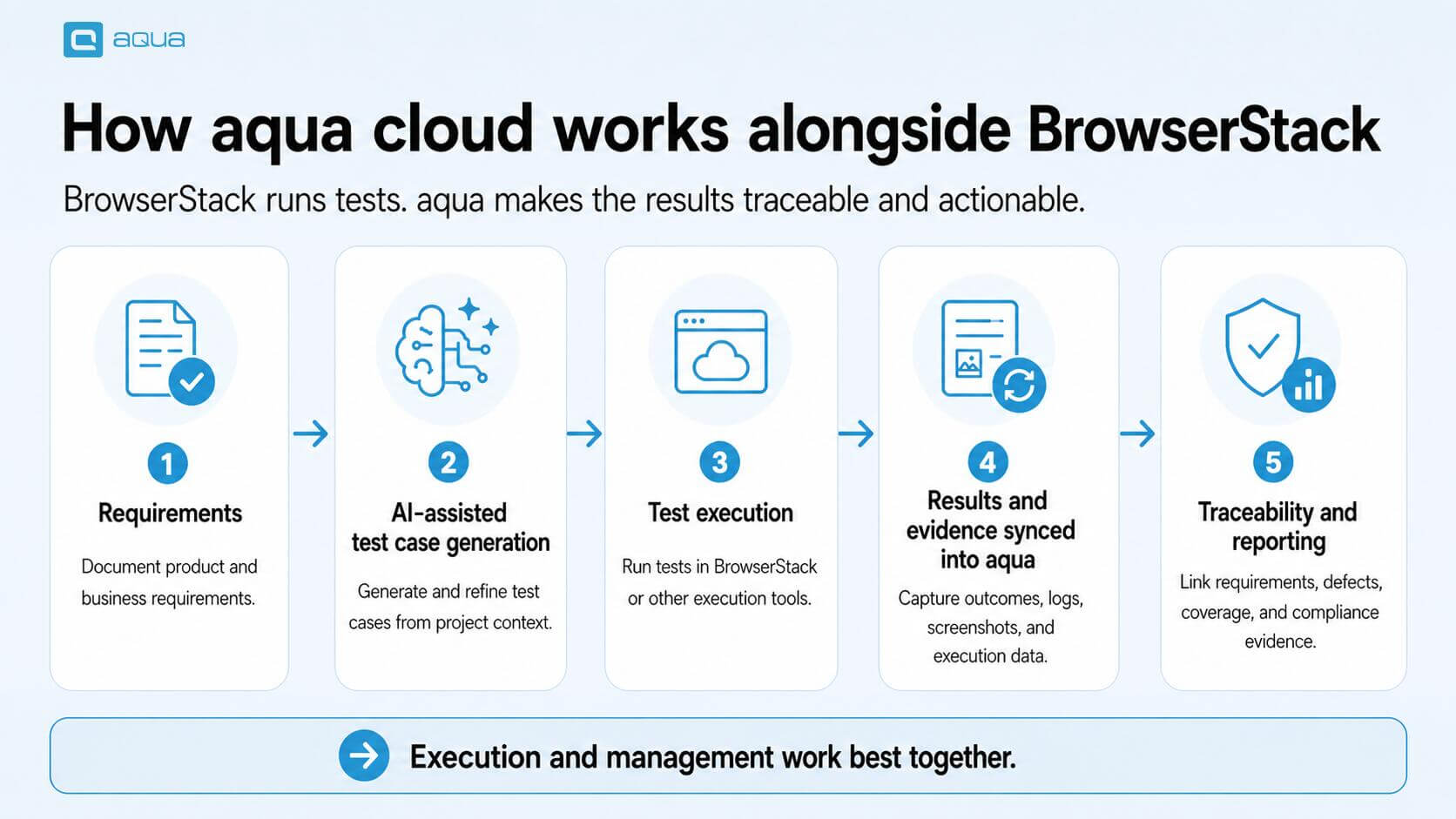
Most BrowserStack teams are missing is the layer that connects results to requirements, coverage reporting, and compliance documentation. aqua cloud, an AI-powered test and requirement management platform, provides exactly that. aqua’s AI Intelligence, trained on project documentation using Retrieval-Augmented Generation, generates test cases grounded in the specific product context. Your team reviews, edits, and approves each suggestion before execution. Coverage metrics update automatically when tests run. Failures link to defect records with session evidence attached. Audit trails log who ran which tests, when, and which requirements got validated, so compliance documentation generates in minutes. Full requirements traceability, real-time coverage dashboards, and compliance-ready reporting are all built into the platform. aqua connects natively with Jira (bidirectional sync), Jenkins, Azure DevOps, Confluence and 12+ other tools that you likely already have in your tech stack.
Boost QA efficiency by 80% and achieve 100% traceability with aqua
Before looking at any specific tool, map your frustration to the right category. The table below covers the most common situations, the signs that point to each one, and the type of solution that actually resolves it.
Frustration
Signs Your Team Has This Problem
Category That Fixes It
What BrowserStack Does Here
What You Actually Need
Too expensive or doesn’t scale
Hitting concurrency limits on release days, paying for failed sessions, large subscription for light usage
How We Evaluated the Best BrowserStack Alternatives
Each platform in this guide was assessed against the same set of criteria, data for which were taken from publicly available information, including tools’ respective websites, customer and expert reviews, research materials, and more. The evaluation covered:
Browser and real-device coverage: Range of supported browsers, OS versions, and physical devices
Framework support: Compatibility with Selenium, Playwright, Cypress, Appium, and other standard automation frameworks
Parallel execution and pricing model: How costs scale with concurrency, and whether pricing fits teams with variable usage
Debugging and reporting: Quality of session recordings, logs, failure evidence, and test result analytics
Deployment and data residency: Cloud and on-premise options for teams with compliance or residency requirements
Security and compliance: GDPR positioning, audit trails, and role-based access control
Test management and AI capabilities: Whether the platform covers test case design, requirements traceability, and AI-assisted test generation
Integrations: Native connections to CI/CD pipelines, issue trackers, and automation frameworks
Pricing figures reflect publicly available information at the time of writing. Enterprise contracts vary by volume and configuration.
aqua cloud: The Best BrowserStack Alternative for Test Management
The most overlooked gap in testing stacks built around BrowserStack is the layer around orchestration and management. Your team can run thousands of tests and still be unable to prove which requirements got covered, where gaps exist, or whether compliance documentation is audit-ready. aqua cloud addresses that gap directly.
aqua is an AI-powered enterprise QA platform designed to connect test planning, execution results, requirements, defects, and compliance reporting into one traceable workflow. Your team keeps running tests on BrowserStack, Sauce Labs, Selenium Grid, or Playwright. aqua sits around that execution layer and makes the results meaningful.
What aqua cloud covers
Requirements traceability
Every test case in aqua maps to a business requirement. When tests run, aqua automatically updates coverage metrics and shows which requirements are validated, which are at risk, and which have gaps. Stakeholders and auditors get full coverage evidence mapped to specific requirements.
aqua’s AI Copilot generates test scenarios directly from your requirements and project documentation using RAG technology. Suggestions are grounded in your actual product context and documentation. Your team reviews, edits, approves, or rejects each suggestion before anything gets executed.
Defect tracking and lifecycle management
When a test fails, aqua links the failure to the affected requirement, creates a defect record, and attaches session evidence. When the fix ships and the test passes, the defect status updates automatically. No manual linking or hand-edited status updates.
Audit trails and compliance documentation
aqua logs who ran which tests, when, which requirements they validated, and which defects were found and resolved. Compliance reports generate automatically. For teams in regulated industries, this removes the documentation effort that typically falls on QA leads before each release.
Capture integration
Records every test execution with video and screenshots, giving your team complete, timestamped evidence for every run without any additional tooling.
Per-user pricing keeps costs predictable for growing teams. The subscription stays flat regardless of test execution volume, removing the per-session billing variability common with device cloud pricing. aqua also offers a free trial so your team can validate the platform against real requirements and test cases before committing.
Best for: Teams that run tests on BrowserStack or any execution platform and need structured test planning, requirements traceability, compliance documentation, and AI-assisted test case generation around those results.
Boost QA efficiency by 80% with aqua Intelligence AI
Other Cloud Testing Platform Alternatives to BrowserStack
If cost, mobile coverage, or compliance requirements are the primary issue, the platforms below are worth evaluating. Each one targets a specific gap in the BrowserStack feature set. Which one fits your team depends on which gap is actually blocking you.
TestMu AI
TestMu AI (formerly LambdaTest) rebranded from LambdaTest in January 2026. Infrastructure, integrations, customer accounts, and the underlying execution engine stayed the same. The rebrand reflects a shift toward AI-native testing workflows, including autonomous test generation, self-healing locators, and AI visual testing.
The platform covers:
Cross-browser testing across 3,000+ real browser and OS combinations
Real iOS and Android device testing
Selenium, Playwright, Cypress, and Appium support
HyperExecute for faster parallel execution with smart test orchestration
120+ integrations with CI/CD tools, test management platforms, and automation frameworks
AI features including natural-language test creation, autonomous debugging, and visual anomaly detection
Pricing is more flexible than BrowserStack’s enterprise tiers, with per-minute and per-session options that suit uneven usage patterns well. When comparing BrowserStack vs LambdaTest on cost at equivalent parallel session scale, TestMu AI consistently comes out more affordable for mid-sized teams and startups. Validate AI features against your actual test suite before committing. Self-healing locators and autonomous debugging add real value when they work on your specific app, but require review to catch incorrect guesses. The proven LambdaTest execution infrastructure reduces adoption risk compared to newer entrants in the AI testing space.
Good for: Teams evaluating a cheaper alternative to BrowserStack with broad device coverage and AI-assisted maintenance features, particularly those running high-volume parallel test execution.
Sauce Labs
Sauce Labs is a widely used BrowserStack alternative for enterprise teams and a direct BrowserStack competitor for large engineering organizations. The platform covers the full continuous testing lifecycle across browsers, devices, and environments.
Your team gets access to:
Browser testing across 2,500+ browser and OS combinations
9,000+ real iOS and Android devices for mobile testing
Virtual devices, emulators, and simulators
Visual testing and AI-assisted debugging workflows
App distribution and mobile error reporting
Enterprise governance features including SSO, audit logs, and role-based access control
Analytics dashboards for tracking test health across teams and pipelines
The platform has processed over 8 billion tests across 300,000 active users. Governance depth is where Sauce Labs tends to differentiate in direct BrowserStack vs Sauce Labs comparisons. SSO, audit logs, compliance documentation, and support responsiveness matter more at enterprise scale. Teams in financial services, healthcare, telecom, and other regulated industries will frequently consider Sauce Labs alongside Perfecto and Kobiton.
Good for: Enterprise QA teams in regulated industries that need compliance features, strong vendor support, and scalable parallel test execution across many products and pipelines.
HeadSpin
HeadSpin is a performance and experience testing platform. The focus goes beyond standard pass/fail results. Testing on real networks, in real locations, and on real devices gives your team behavioral data: startup time, transaction latency, carrier-specific failure patterns, and media playback quality across geographies.
Coverage includes:
Mobile, web, and OTT testing across 50+ global locations
Testing under real network conditions: latency, packet loss, carrier behavior, and network switching
AI-driven insights and KPI analysis alongside standard automation results
Continuous monitoring and comparative performance analysis across geographies
Accessibility testing integrated into existing workflows
Where BrowserStack reports a pass/fail result, HeadSpin surfaces startup time, transaction latency, and media playback quality under real-world carrier conditions. Video streaming apps, fintech apps, ride-hailing products, and telecom services all carry production risk that standard device clouds won’t surface. HeadSpin is more specialized than BrowserStack or Sauce Labs. Basic cross-browser smoke tests fall outside its primary scope, and if your team’s main problem is parallel execution cost, this platform adds complexity without addressing that bottleneck.
Good for: Teams where production-like performance under real network and carrier conditions is the primary test objective, particularly for mobile-heavy, streaming, or location-sensitive products.
Kobiton
Kobiton is built explicitly around mobile device lab management. The platform centers on real-device mobile testing, device lab management, and mobile CI/CD. Mobile is the foundation, with other capabilities built on top.
Your team gets:
Real iOS and Android devices in both cloud and on-premise deployments
Appium, XCUITest, and Espresso support
AI-augmented mobile testing with scriptless validation tools
No-code validations that let non-engineers validate app behavior without writing Appium scripts
Mobile performance testing, accessibility testing, and mobile CI/CD integrations
Physical device lab management including device health tracking and reservation
On-premise deployment for teams with hard data residency requirements
On-premise deployment is a differentiator that matters for regulated industries, government contractors, and teams where session data can’t leave internal infrastructure. If device fragmentation, OS updates, or biometric flows represent your main release risks, Kobiton fits those workflows better than a web-first platform. This is a BrowserStack alternative with on-premise option worth a serious proof-of-concept with your actual mobile app, target devices, and CI/CD pipeline.
Good for: Mobile-first QA teams and enterprises with mobile centers of excellence, particularly those in regulated industries requiring on-premise device labs or granular device lab management.
TestingBot
TestingBot is a practical cross-browser and mobile testing platform with a clear GDPR compliance focus, making it a leading BrowserStack GDPR alternative for European teams.
The platform covers:
6,100+ real browsers and physical iOS and Android devices
Selenium, Appium, Playwright, Cypress, Puppeteer, Espresso, XCUITest, and Maestro support
Parallel execution, video recordings, screenshots, and test logs
CI/CD integrations across major pipeline tools
EU-hosted infrastructure with explicit GDPR compliance documentation
BrowserStack EU data residency alternative positioning for teams with strict data governance requirements
TestingBot is simpler and less enterprise-heavy than Sauce Labs, Perfecto, or Kobiton. That’s an advantage for startups, small QA teams, agencies, and engineering teams that need practical testing infrastructure without heavyweight governance overhead. Validate the analytics and vendor support depth against your team’s specific requirements before committing.
Good for: European teams with data residency requirements and startups that need a pragmatic, GDPR-compliant BrowserStack alternative without enterprise contract overhead.
pCloudy
pCloudy is a cloud-based mobile and web testing platform designed for teams in South and Southeast Asian markets, where regional pricing, local device availability, and local support channels matter more than global enterprise positioning.
Coverage includes:
Real devices, emulators, simulators, and browser coverage
Appium, Selenium, Espresso, and XCUITest support
Manual and automated test execution
CI/CD integrations with Jenkins and other standard tools
Device catalogs focused on handsets common in Indian and Southeast Asian markets
For teams based in those markets, pCloudy offers better device availability for local handsets and more competitive pricing than global vendors. Verify the device catalog against your target user base’s most common devices and OS versions before starting a proof-of-concept.
Good for: Cost-driven QA teams in South or Southeast Asia where regional pricing, local device availability, and local support matter more than global enterprise positioning.
Test Automation Framework Alternatives
Device clouds like BrowserStack run your tests. Automation frameworks determine how well those tests are written, how stable they are, and how much maintenance they require. If your team’s main problem is flaky tests, high maintenance overhead, or poor debugging experience, evaluating a different framework often resolves more than switching execution platforms. These tools work alongside BrowserStack, not as replacements for it.
Selenium Grid
Selenium Grid is the go-to open-source browser automation option and the most proven BrowserStack alternative free from per-execution costs. It runs WebDriver tests on infrastructure your team manages, with no per-minute vendor pricing, full control over browser versions, and direct network access to internal or local apps.
Key characteristics:
Supports parallel execution across multiple remote machines
Compatible with any WebDriver-supported language including Java, Python, C#, and JavaScript
No third-party session recordings by default, though integration with logging and reporting tools is configurable
Browser driver updates, queue management, and infrastructure monitoring all fall on your team
Works across all major browsers and operating systems
Your team controls everything with Selenium Grid. That’s the upside and the trade-off. Selenium Grid makes sense when your team has DevOps capacity and vendor independence is a priority. For teams that need broad device coverage quickly without building and maintaining a device farm, it adds significant operational overhead.
Good for: Teams with DevOps capacity that want a BrowserStack alternative free from per-execution costs and full control over their test infrastructure.
Playwright
Playwright is Microsoft’s open-source browser automation framework. It supports Chrome, Firefox, Safari, and Edge with native auto-waits, parallel test execution across multiple workers, and code generation from recorded browser interactions.
Key characteristics:
Faster and more stable than Selenium for JavaScript-heavy single-page applications
Built-in trace viewer for debugging failed tests without re-running them
Network interception and request mocking out of the box
Support for multiple browser contexts within a single test process
Works on BrowserStack, Sauce Labs, or your own infrastructure without code changes
For teams with flaky tests on React, Vue, or Angular applications, switching to Playwright frequently resolves stability issues more effectively than a platform change. Playwright’s auto-wait mechanics and built-in trace tooling eliminate the timing issues behind most flaky Selenium suites.
Good for: Teams building modern web applications where test stability and maintenance overhead are the primary problems.
Cypress
Cypress runs directly inside the browser through a different architecture than WebDriver-based tools. That gives your team time-travel debugging, automatic waiting without explicit timeout configuration, network stubbing, and a test runner UI that makes authoring and debugging feel native to web development.
Key characteristics:
Well-suited for single-domain JavaScript applications with fast feedback loops
Time-travel debugging: Step through each command after a test run without re-executing
Automatic waiting eliminates most race condition failures
Network interception and response stubbing built in
Primarily Chromium-based; WebKit support is improving but cross-browser coverage is narrower than Playwright or Selenium
Multi-tab scenarios and complex iframe handling require workarounds
Cypress won’t replace BrowserStack for teams needing real Safari on macOS, Firefox across operating systems, or extensive cross-browser testing across dozens of browser and OS combinations. Where it does reduce BrowserStack dependency is for teams testing modern JavaScript apps primarily in Chrome, where Cypress often catches issues faster and with fewer false failures.
Good for: JavaScript teams that want a developer-native authoring experience and test primarily within a single domain.
Katalon
Katalon is a low-code test automation platform covering web, mobile, API, and desktop testing. Built on Selenium and Appium, it adds a visual layer that makes test creation accessible to QA team members without deep scripting experience.
Key characteristics:
Visual test recorder for creating tests without writing code
Keyword-driven and data-driven testing frameworks accessible to non-engineers
AI-assisted test generation and self-healing locators to reduce maintenance overhead
Basic test management, execution orchestration, and analytics built in
Groovy scripting support for complex scenarios that keyword-driven frameworks can’t handle
CI/CD integrations with Jenkins, GitLab, and Azure DevOps
The low-code layer makes Katalon accessible to QA teams with mixed automation skill levels, where manual testers and automation engineers work in the same toolchain. If your team is evaluating an all-in-one platform covering test creation, execution, and lightweight management, Katalon is worth a proof-of-concept. The trade-off: Katalon is another platform to learn and license. If your team already uses Selenium or Playwright and needs better execution infrastructure, Katalon adds tooling complexity without a clear benefit.
Good for: QA teams with mixed automation skill levels that want one platform covering test creation, execution, and lightweight management without assembling separate tools.
Ranorex
Ranorex is a low-code test automation tool covering web, mobile, and Windows desktop applications. For teams that need to test legacy enterprise software or complex Windows desktop UIs alongside web testing, it covers a combination that most frameworks don’t address natively.
Coverage includes:
Visual test recorder with object recognition for web and desktop UI elements
Keyword-driven and data-driven test execution frameworks
Cross-browser web testing via WebDriver integration
Desktop app testing for Windows applications including legacy and enterprise software with complex UI workflows
CI/CD integration with Jenkins and Azure DevOps
Ranorex is a practical fit for teams testing Windows desktop apps, legacy enterprise applications, or mixed environments combining desktop and web testing in a single toolchain. The object repository and recorder reduce manual scripting effort for interfaces that are difficult to automate with standard WebDriver approaches. The trade-off: Ranorex tests run in Ranorex. Migration to Selenium or Playwright later carries significant rework cost, so evaluating the platform’s long-term fit matters before committing.
aqua cloud integrates with Ranorex natively, capturing execution results and linking them to requirements and defect records in aqua.
Good for: Teams testing Windows desktop or legacy enterprise applications that need a low-code approach to test creation and maintenance.
BrowserStack Alternatives: Pricing and Deployment Comparison
Pricing structures and deployment models vary significantly across this category. Per-session billing, per-user subscriptions, and enterprise contracts each carry different implications depending on your team’s usage volume, data residency requirements, and procurement process. The table below covers all commercial platforms discussed in this guide, plus Selenium Grid as the self-hosted benchmark.
Prices reflect publicly available information at the time of writing. Enterprise contracts vary by volume, concurrency requirements, and configuration.
We went down the same path. Started with Confluence and sheets and it turned into a mess fast. Nobody knew what was current, who ran what, or what actually failed last release. We also tried using BrowserStack for management since we were already on it for devices, but it felt expensive for what we really needed and a bit too locked into their ecosystem.
Which BrowserStack Alternative Is Right for Your Team?
The right answer depends on which problem your team is actually solving. Before evaluating any platform, identify whether your bottleneck is cost, mobile coverage, compliance, test design quality, or missing test management. Matching the tool to the right layer of the stack saves months of misdirected evaluation cycles. Here’s how to map your situation to the right solution.
If test management is missing from your stack: aqua cloud is the right addition regardless of which execution platform your team uses. It integrates with BrowserStack, Sauce Labs, Selenium, Playwright, and other tools via native integrations and REST API, adding the planning, traceability, and compliance layer that device clouds don’t provide. A free trial is available to validate the platform before committing.
If cost is the main issue: Start with TestMu AI, TestingBot, AWS Device Farm, Firebase Test Lab, or Selenium Grid. TestMu AI gives your team broad cross-browser and mobile coverage with competitive pricing. TestingBot suits smaller teams with EU data requirements. Selenium Grid eliminates per-minute costs entirely if your team has infrastructure capacity.
If your product is a mobile app: Evaluate Kobiton, HeadSpin, Perfecto, and Sauce Labs. Kobiton is a great fit for mobile-first testing with real-device labs and on-premise deployment. HeadSpin suits teams where real-world network performance under carrier conditions is the primary test objective.
If compliance or data residency is blocking your team: Sauce Labs and Perfecto have deep enterprise governance features. Kobiton supports on-premise deployment for teams with hard data residency requirements. TestingBot provides EU-hosted infrastructure with GDPR compliance documentation for European teams.
If your team needs enterprise-scale testing with analytics and vendor support: Sauce Labs, Perfecto, and Kobiton are well-positioned BrowserStack competitors at that level. Pair any of them with aqua cloud for full test lifecycle coverage from planning through compliance reporting.
The layer most teams are missing sits around execution. Test planning, requirements traceability, and compliance documentation are what makes test results meaningful to stakeholders and auditors. aqua cloud, an AI-driven test and requirement management platform provides that layer regardless of which execution platform your team uses. BrowserStack, Sauce Labs, TestMu AI, Selenium Grid, or any other platform feeds results into aqua’s traceable workflow. Coverage metrics update automatically when tests run. Failures link to defect records. Audit trails log every test, every requirement, every outcome. aqua’s domain-trained AI Copilot generates test cases from project documentation using RAG technology, delivering scenarios specific to the actual product and reviewable before anything runs. aqua’s integration library covers the full toolchain: JMeter, PowerShell, MSSQL databases, UnixShell, SoapUI, Ranorex, Oracle databases, REST APIs, and more than 10 native automation integrations. The Capture integration records every test execution with video and screenshots, giving your team complete evidence for every run.
Save 12.8 hours per week per tester with aqua's Intelligence AI
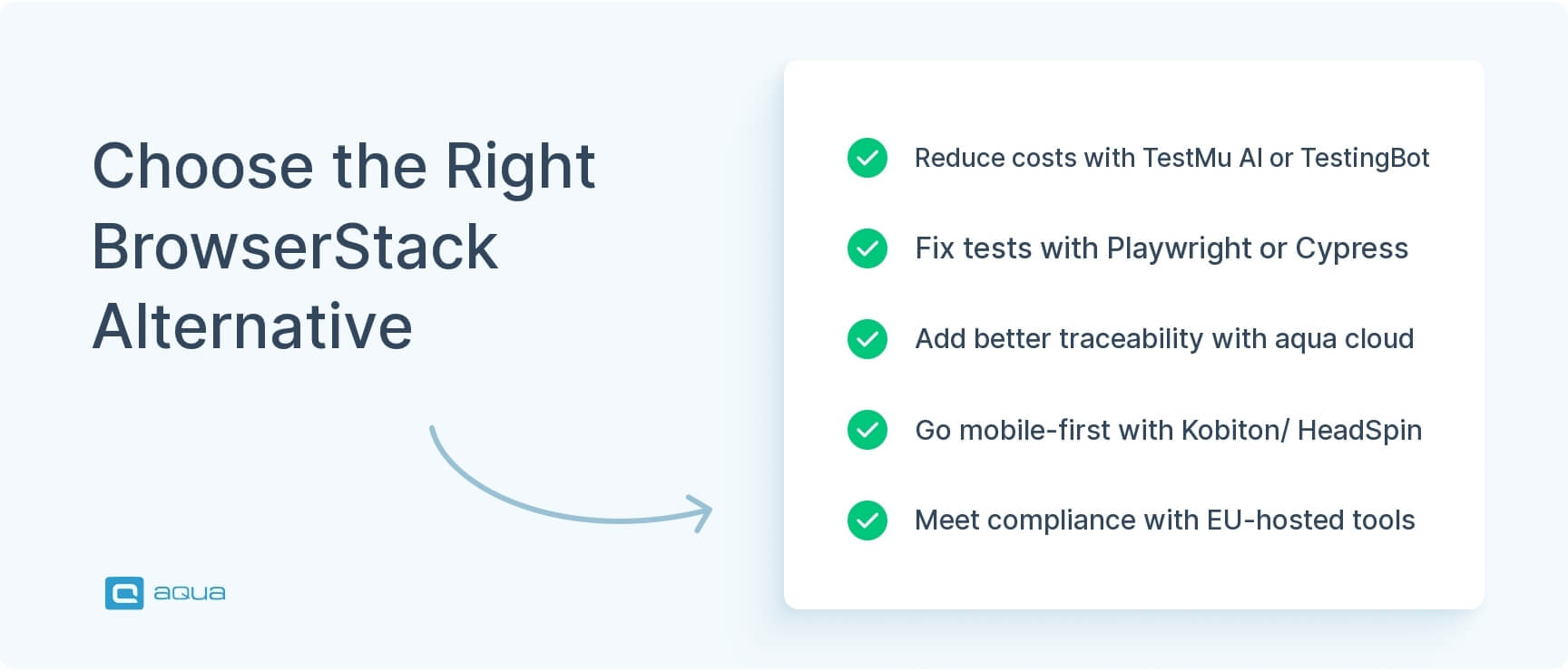
The right BrowserStack alternative depends on which problem your team is solving. Cost issues point to TestMu AI, TestingBot, or Selenium Grid. Mobile-first gaps point to Kobiton or HeadSpin. Compliance blockers point to Sauce Labs, Perfecto, or TestingBot. Missing test management points to aqua cloud. Most teams need execution infrastructure and test management working together. Identify the broken layer first, then pick the tool that fixes it.
Selenium Grid is the only genuinely free execution option. Open-source and self-hosted, it runs on infrastructure your team manages. AWS Device Farm and Firebase Test Lab offer limited free tiers but aren’t full BrowserStack replacements. aqua cloud offers a free trial for test management, so your team can validate requirements traceability and AI test case generation before committing to a paid plan.
What is the cheapest BrowserStack alternative?
TestMu AI and TestingBot are the most cost-effective cloud alternatives with broad browser and device coverage. Selenium Grid has no license cost but requires DevOps investment to maintain. For test management, aqua cloud’s per-user pricing is predictable and avoids the per-session costs that make device cloud pricing unpredictable at scale.
Is LambdaTest better than BrowserStack?
TestMu AI (formerly LambdaTest) is a great fit for cost-sensitive teams and high-speed parallel execution. BrowserStack has greater platform maturity and enterprise governance depth. Which one suits a team better depends on usage volume, concurrency patterns, and how heavily governance features factor into the decision.
Can Sauce Labs replace BrowserStack?
Yes. Sauce Labs is a direct BrowserStack replacement for enterprise continuous testing, covering browser testing, mobile testing, real devices, analytics, governance, and CI/CD integration at comparable scale.
What is the best BrowserStack alternative for mobile testing?
Kobiton is a great fit for mobile-first teams, with real-device labs, device lab management, AI-augmented testing, and mobile CI/CD. HeadSpin is worth evaluating when real-world network performance under carrier conditions is the primary objective. For teams that also need requirements traceability around their mobile test results, pairing either platform with aqua cloud fills that gap.
Does BrowserStack have test management?
BrowserStack added test management recently, but it’s not the platform’s core strength. aqua cloud is the better option for structured test case management, requirements traceability, AI test case generation, and compliance reporting. aqua also offers a free trial so the team can evaluate it against an existing execution setup.
What do I need if test maintenance is the main problem?
Maintenance issues stem from framework or test design decisions. Moving to Playwright often fixes more than switching execution platforms. If test case organization and requirements traceability are missing from the stack, aqua cloud addresses that gap without requiring changes to how tests are executed.
How does aqua cloud work alongside BrowserStack?
BrowserStack runs the tests. aqua captures results via its REST API and native integrations, maps them to requirements, links failures to defect records, and generates coverage and compliance reports. Full traceability is available without changing how or where tests are executed. As a BrowserStack alternative with CI/CD integration and compliance features, aqua adds the management layer around any execution platform the team already uses.
Robert has several years of experience in process optimisation and test management. He is an expert in defining and implementing workflows by adapting aqua to the clients’ processes.
Pavel, a Quality Assurance Consultant and Author, brings deep expertise to solving complex testing challenges. His background in software development has helped organizations transform their QA practices from reactive to proactive. Beyond consulting, Pavel develops best practice guides and case studies for aqua cloud that…
Join our community of enthusiastic experts! Get new posts from the aqua blog directly in your inbox. QA trends, community discussion overviews, insightful tips — you’ll love it!
We're committed to your privacy. Aqua uses the information you provide to us to contact you about our relevant content, products, and services. You may unsubscribe from these communications at any time. For more information, check out our Privacy policy.
X
🤖 Exciting new updates to aqua Intelligence are now available! 🎉