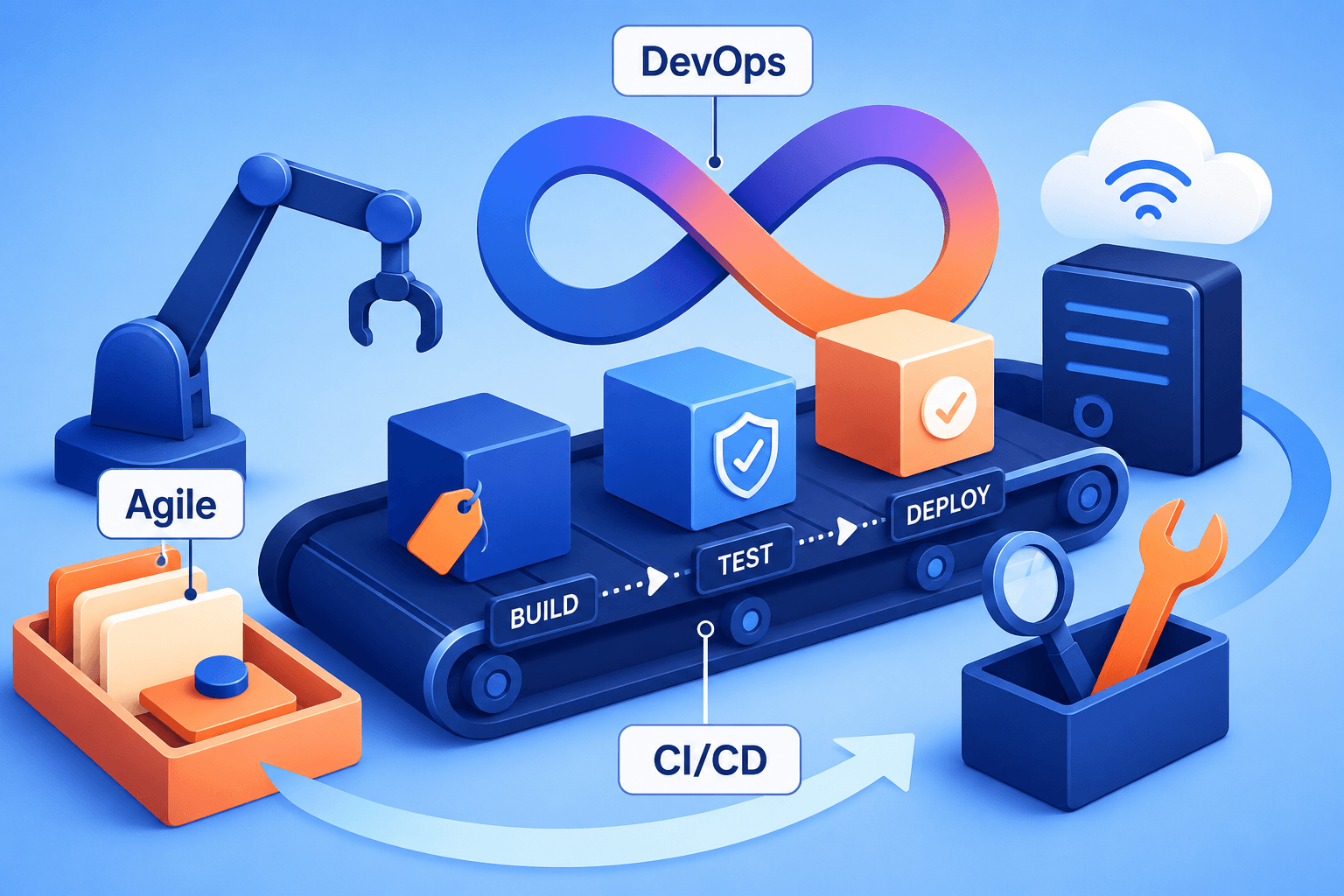
Which one should your team adopt: Agile, DevOps, or CI/CD? All three cover different parts of the same delivery system, so teams that overlook any of them end up with badly planned sprints or deployment workflows nobody can manage. This guide defines each practice and compares them across eight dimensions. It also shows how they all connect to production throughout the pipeline, and demonstrates the order and best practices for combining them.
Agile is a project philosophy for handling changing requirements through short cycles, DevOps is an organizational model that removes the divide between development and operations, and CI/CD is the technical automation for building, testing, and deploying code.
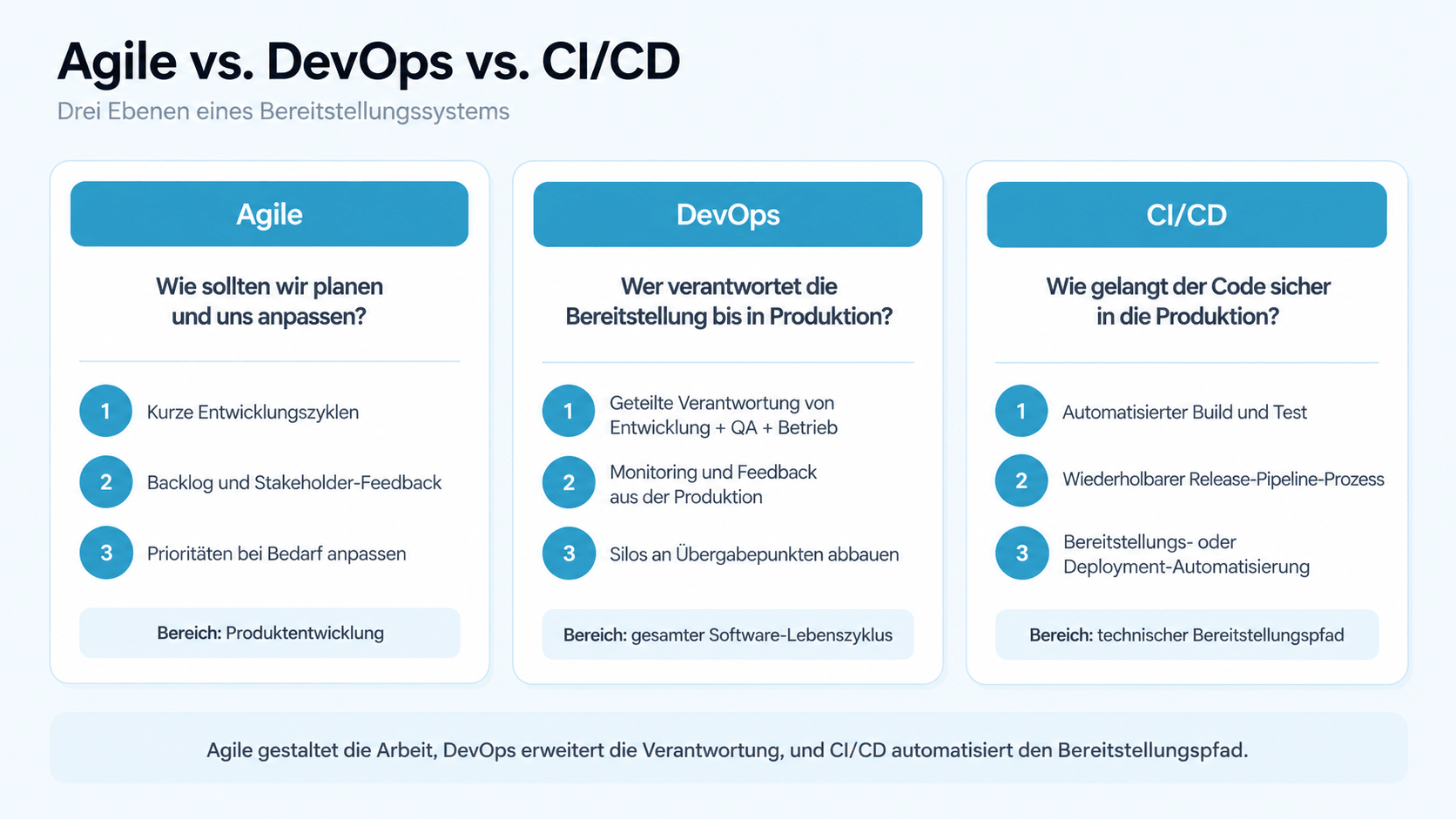
Agile shapes work organization, DevOps extends it across the entire delivery lifecycle, and CI/CD provides the automation underneath.
Continuous delivery keeps software deployable at all times with manual approval, while continuous deployment pushes changes to production automatically.
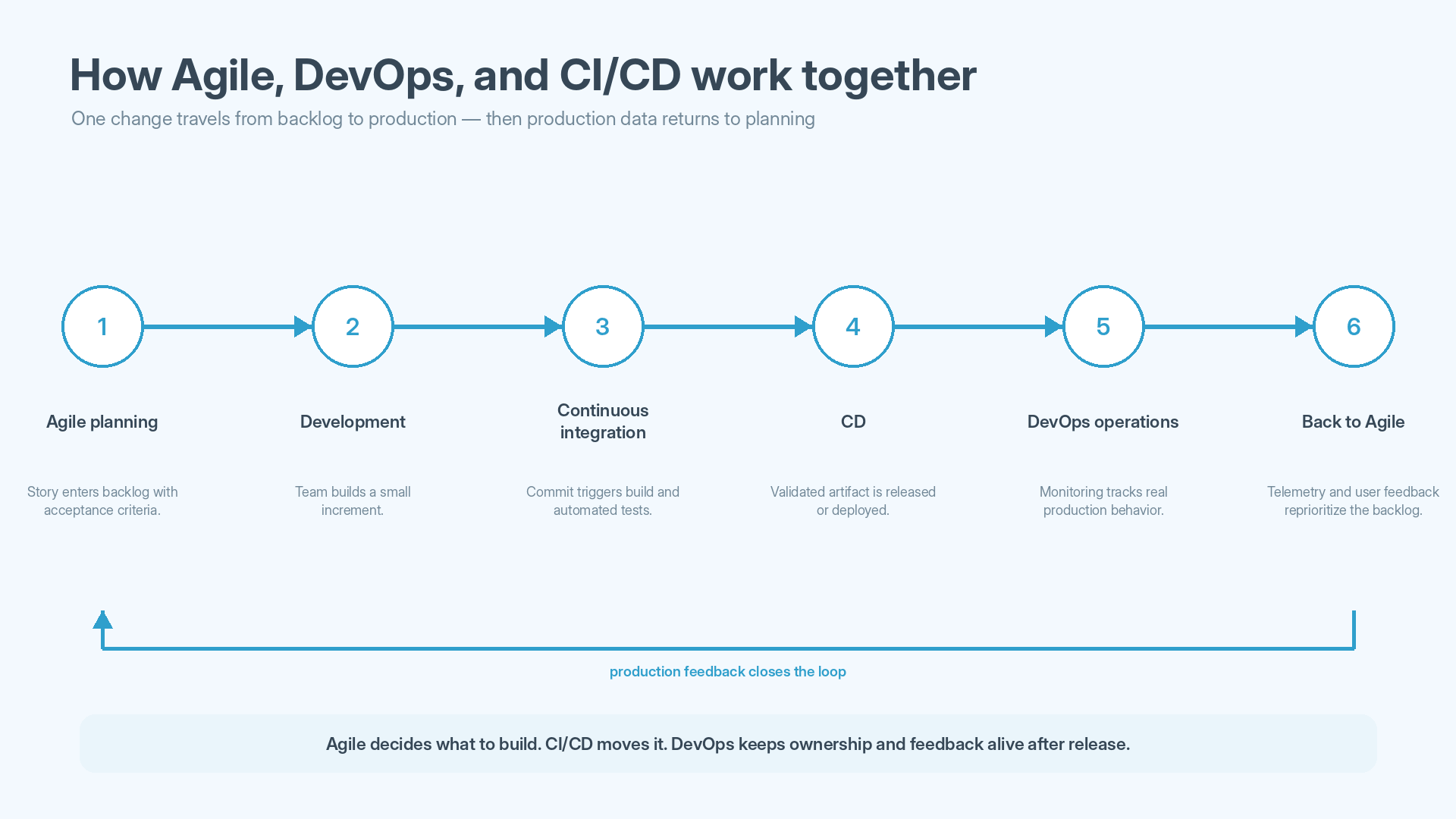
The three methodologies connect in sequence: an Agile backlog item becomes a code increment, CI validates it, CD releases it, and DevOps monitoring returns production data to the next planning session.
What Is Agile?
Agile is an iterative approach to software development, where your team plans, builds, and validates work in cycles measured in weeks. It emerged as a response to long planning phases, where teams spent months building against fixed requirements and found the mismatch too late to correct cheaply. The 2001 Agile Manifesto set out four priorities that define the approach: people over process, working software over documentation, collaboration over contract negotiation, and adaptation over plan adherence.
Agile assumes that long-range software requirements will change. Competitors ship, regulations move, and a specification written in January may be obsolete by June. Short cycles let your team validate assumptions every few weeks.
Agile covers several frameworks. Scrum runs two-week sprints with daily standups, Kanban applies continuous flow with work-in-progress limits, and Extreme Programming contributed pair programming and test-driven development.
Agile Definition and Core Principles
Agile treats requirements as hypotheses your team tests through short cycles. You plan a small increment, build it, show it to real users, gather feedback, and adjust priorities before the next cycle begins. The Manifesto’s twelve principles turn that idea into working guidance, including five that shape daily practice:
Deliver working software frequently, in weeks and not months.
Welcome changing requirements, including late in development.
Build projects around motivated people who communicate directly.
Measure progress by functioning software.
Reflect on the process at regular intervals and adjust.
Each principle describes an outcome and leaves the workflow open, which explains why Agile covers several frameworks. Scrum runs two-week sprints with daily standups, Kanban applies continuous flow with work-in-progress limits, and Extreme Programming contributed pair programming and test-driven development. All three use short feedback cycles in place of detailed long-term planning.
How Agile Works
Agile works by replacing one long delivery sequence with many short ones. Waterfall runs as a chain of handoffs, so when the requirements team misreads something in month one, your team discovers it in month ten. Short cycles reduce that exposure, since each iteration produces something usable and stakeholders evaluate it while changes remain cheap. Product backlogs hold ideas and priorities, and your team pulls high-value items into each iteration.
Agile planning and CI/CD automation both depend on test management that keeps up with them. aqua cloud, an AI-driven test and requirement management solution, stores manual and automated test cases in a single repository, links each one to the requirement or user story behind it, and schedules automated runs in advance. When Jenkins workflow ends, the result gets compared against the matching test case with logs attached, so your sprint review works from execution data and not from a separate spreadsheet. aqua Intelligence adds domain-trained AI grounded in your project documentation through RAG, which keeps generated test cases tied to real requirements as those requirements change. aqua cloud also syncs bidirectionally with Jira, connects to Jenkins and Azure DevOps for pipeline triggering, and pulls specifications directly from Confluence. 12+ other native integrations are supported.
Connect your sprints, pipelines, and test results with aqua cloud
Key Agile Practices
Three practices carry Agile in daily work: cross-functional teams, short coordination rituals, and iterative planning against user stories. Developers, testers, designers, and product owners work together throughout the sprint, so questions get answered in conversation and never become ticket threads.
Coordination stays light on process. Short standups surface blockers early, while retrospectives at the end of each cycle create time to improve the process itself. On the QA side, an Agile testing tool keeps test cases linked to the stories they validate, so coverage moves at the same cadence as development. Planning then refines priorities against the latest information, with acceptance criteria defining completion before work starts and finished work demonstrated to stakeholders for direct feedback.
What Is DevOps?
DevOps is an operating model where one team owns software from planning through production operations. It addresses a broader problem than Agile: the organizational divide between development and operations. Development teams optimize for shipping features quickly, while operations teams optimize for production stability, and those goals conflict. Developers finish a release and hand it to operations, which inherits software it did not build and lacks context on its behavior under load.
An agile DevOps approach makes delivery and operations a shared responsibility, so the work runs from planning through development, delivery, deployment, and operations, with production feedback returning to planning. Five elements make that model work:
Shared ownership across development, QA, security, and operations throughout the software lifecycle.
Automation of repetitive manual work, particularly builds, tests, deployments, and infrastructure management.
Continuous feedback from production into development through monitoring, logging, and observability.
Cultural change built on transparency and collective accountability for delivery speed and system reliability.
Technical practices including version control, infrastructure as code, automated testing, continuous integration, and continuous delivery.
Shared ownership without automation gives your team shared manual work, which is why the technical practices carry the other four elements.
DevOps Definition and Core Principles
Both Microsoft and AWS describe DevOps as more than a tooling model. Microsoft frames it as the combination of development and operations across planning, development, delivery, and operations, coordinated through people, process, and technology. AWS calls it the cultural philosophies, practices, and tools that increase an organization’s ability to deliver applications and services at high velocity.
Installing Jenkins does not produce DevOps, because the model requires that the people who build software also care how it runs in production, while the people managing infrastructure participate in development decisions. Teams share on-call rotations, production incidents feed sprint planning, and architecture decisions account for operational impact from the start.
The core principles follow from that arrangement: automate wherever it applies, manage infrastructure as versioned code, build quality and security into the process, and keep production feedback close to planning. A working devops testing strategy puts QA inside that flow, so testing runs with delivery and never after it.
How DevOps Works
DevOps works as a continuous lifecycle where the work continues past deployment. Planning feeds development, development feeds testing and integration, integration feeds deployment, and deployment feeds production operations. Monitoring and user feedback then return to planning.
In practice, a team might open a sprint by reviewing production metrics. Customer complaints spiked after the last release, so that work moves to the top of the backlog. Developers implement fixes through automated testing pipelines, changes deploy through continuous delivery workflows, and observability tools track the effect. Because the same team owns every stage, there is no handoff to a separate deployment group, and developers who write code also deploy it, monitor it, and respond when it fails at night. That arrangement changes design decisions, since operational pain arrives at the desk of the person who can prevent it.
Key DevOps Practices
Four practices implement the model: version control for everything, continuous integration and delivery, monitoring and observability, and security built into the pipeline. Version control underpins the rest, from application code to infrastructure configuration held in Git repositories, which creates audit trails and makes rollbacks routine. Infrastructure as code extends that, so your entire environment gets provisioned through scripts with no manual work in a console.
On top of that base, continuous integration keeps changes flowing into the shared codebase multiple times daily, while continuous delivery keeps software releasable at any moment. Monitoring and observability give your team real-time insight into production through logging, metrics, distributed tracing, and alerting. Security enters the same pipeline through automated scanning, policy checks, and vulnerability management, so it stops being a separate phase that delays releases. Incident management completes the model with blameless postmortems that produce concrete follow-up work.
What Is CI/CD?
CI/CD is the automation that moves code changes through integration, validation, and delivery. It is more concrete than Agile or DevOps, since it names specific technical practices with specific tooling behind them. The abbreviation hides one important detail: CI stands for continuous integration, while CD stands for either continuous delivery or continuous deployment, and those two differ in a way that affects your release process.
CI CD DevOps automation implements the DevOps position on frequent, safe releases. Without it, your team can adopt DevOps culturally and still ship unreliably, since manual testing takes too long, deployments require cross-team coordination, and rollbacks carry risk. Understanding the common CI/CD challenges helps here, because most of them surface once build, test, and release processes become repeatable pipelines.
Continuous Integration vs Continuous Delivery vs Continuous Deployment
Continuous integration validates every merge, continuous delivery keeps a release candidate ready at all times, and continuous deployment releases that candidate without approval. The three build on each other in that order, and the practical distinction between the last two is who authorizes a production release.
Practice
What it automates
Where a person steps in
Continuous integration
Merging into the shared codebase, plus an automated build and test cycle after every commit
Fixing a broken build before other work continues
Continuous delivery
Packaging artifacts, deploying to staging, and validating a release candidate
Approving the production deployment
Continuous deployment
Everything through the production release, once automated checks pass
Monitoring the release and deciding on rollback
Continuous integration prevents the merge conflicts that appear when several developers work in isolation for weeks. Continuous delivery keeps deployment available on demand, while continuous deployment removes the approval step entirely. That final step suits teams with extensive automated testing and monitoring, since the quality bar moves from manual gates into automated validation.
How CI/CD Pipelines Work
A pipeline runs five stages between a developer’s commit and a live release, with automation covering each one. Every stage validates a different property of the change, and a failure stops the sequence before the next stage begins.
Commit and integration. A developer pushes code, the change merges with the mainline branch, and an automated build starts. The build compiles the code, runs unit tests, and performs static analysis, then notifies the developer on any failure.
Packaging. The software gets packaged into deployable artifacts, whether Docker containers, application bundles, or another format your deployment target requires.
Validation. Artifacts deploy to test environments, where integration tests, API tests, end-to-end tests, security scans, and performance checks each validate a different quality attribute.
Release decision. Under continuous delivery, the artifact waits for approval. Under continuous deployment, it proceeds without one.
Deployment. The release itself runs through automation, with no manual steps and no environment-specific tribal knowledge.
A pipeline built this way completes in minutes to hours, and that speed supports the short feedback cycles the other two practices depend on.
Agile vs DevOps vs CI/CD: Key Differences
AI-generated image.
The core difference is scope. Agile covers how your team plans and builds increments, DevOps covers who owns software from planning through production, and CI/CD covers the automation that moves each change into release. Comparing them directly means comparing a project philosophy, an organizational model, and a technical practice, so the table below separates them across eight dimensions.
The pairwise comparisons below cover the distinctions your team runs into most often.
DevOps and Agile are absolutely complimentary. Agile is about work management and flow along with communication between developers and the business/customers... DevOps brings together Dev and Ops (and also security).
Agile governs how your team plans and builds product increments, while DevOps governs how those increments reach users and behave afterward. Agile completes at working software delivered to stakeholders, and DevOps continues through deployment, monitoring, and incident response.
Collaboration works differently in each. An Agile team pairs developers, testers, designers, and a product owner around a backlog. A DevOps team adds operations and security to that group and gives everyone shared responsibility for uptime, which changes what people argue about in planning.
The feedback also comes from different sources. Agile collects it from stakeholders and users reviewing an increment, so it answers whether your team built the right feature. DevOps collects it from production telemetry, error rates, and incidents, so it answers whether the feature holds under real traffic. Teams running Agile without DevOps often ship correct features on a two-week cadence into a release process that still takes a month.
DevOps vs CI/CD
Consider an organization that runs Jenkins on every repository, with builds, tests, and deployments fully automated. Development and operations still report to different directors, and operations still receives releases it had no part in designing. That organization has CI/CD without DevOps.
DevOps covers planning through operations, while CI/CD is limited to the automated delivery path. AWS treats CI/CD as a core DevOps practice, and IBM describes the CI/CD pipeline as an automated DevOps workflow, so the relationship runs one way: DevOps includes CI/CD, and CI/CD alone does not produce DevOps.
The question your team asks reveals which one applies. Who responds at 2 AM is a DevOps question, since it concerns ownership and on-call structure. Why the build takes 40 minutes is a CI/CD question, since it concerns pipeline configuration.
Agile vs CI/CD
Sprint cadence and deployment cadence do not have to match, which surprises teams new to CI/CD Agile delivery. A two-week sprint defines when your team plans and reviews work. With continuous deployment, individual changes reach production several times a day inside that same sprint.
Agile organizes planning, iteration, and customer feedback. CI/CD automates integration, testing, and deployment. Separating the two cadences lets planning stay on a fixed rhythm while releases run whenever validation passes, which removes a common source of delay in Agile processes.
How Agile, DevOps, and CI/CD Work Together
AI-generated image.
A single change passes through all three practices between the backlog and production. Agile decides what gets built, CI/CD moves it into production, and DevOps returns operational data to the next planning session. The six stages below follow that path.
Agile planning. A user story enters the backlog, gets estimated, and moves into a sprint with acceptance criteria attached.
Development. Your team builds a small increment against those criteria, sized to merge within a day or two.
Continuous integration. That commit merges to the mainline, where an automated build with unit and integration tests validates it. A failure at this point stops the change within minutes.
Continuous delivery or deployment. Once validation passes, the artifact becomes a release candidate, and it either waits for approval or reaches production directly.
DevOps operations. After release, monitoring, logging, and alerting track the change in production, and your team responds to whatever the telemetry shows.
Back to the Agile backlog. Production behavior and customer feedback then reprioritize the next sprint.
One feature through all three practices
A payments team picks up a story for saved payment methods. The product owner writes acceptance criteria covering card storage, deletion, and PCI constraints, and QA links test cases to that story before development starts.
A developer implements card storage and commits twice on the first day. Each commit triggers the pipeline, where unit tests, the API suite, and a security scan run against the change. The second commit fails on a validation test, and the developer fixes it in twenty minutes because the failure arrived while the code was still open.
Two days later, the completed increment passes the full suite and deploys behind a feature flag. Operations watches error rates and latency on the new endpoints for 48 hours. Latency on card deletion sits higher than expected, so that finding enters the backlog as a defect with production data attached, and the next sprint starts with evidence.
aqua cloud connects the requirements, test cases, and execution results used across these stages, so the acceptance criteria written in planning, the automated results from the pipeline, and the production defect all reference the same story.
Benefits of Combining Agile, DevOps, and CI/CD
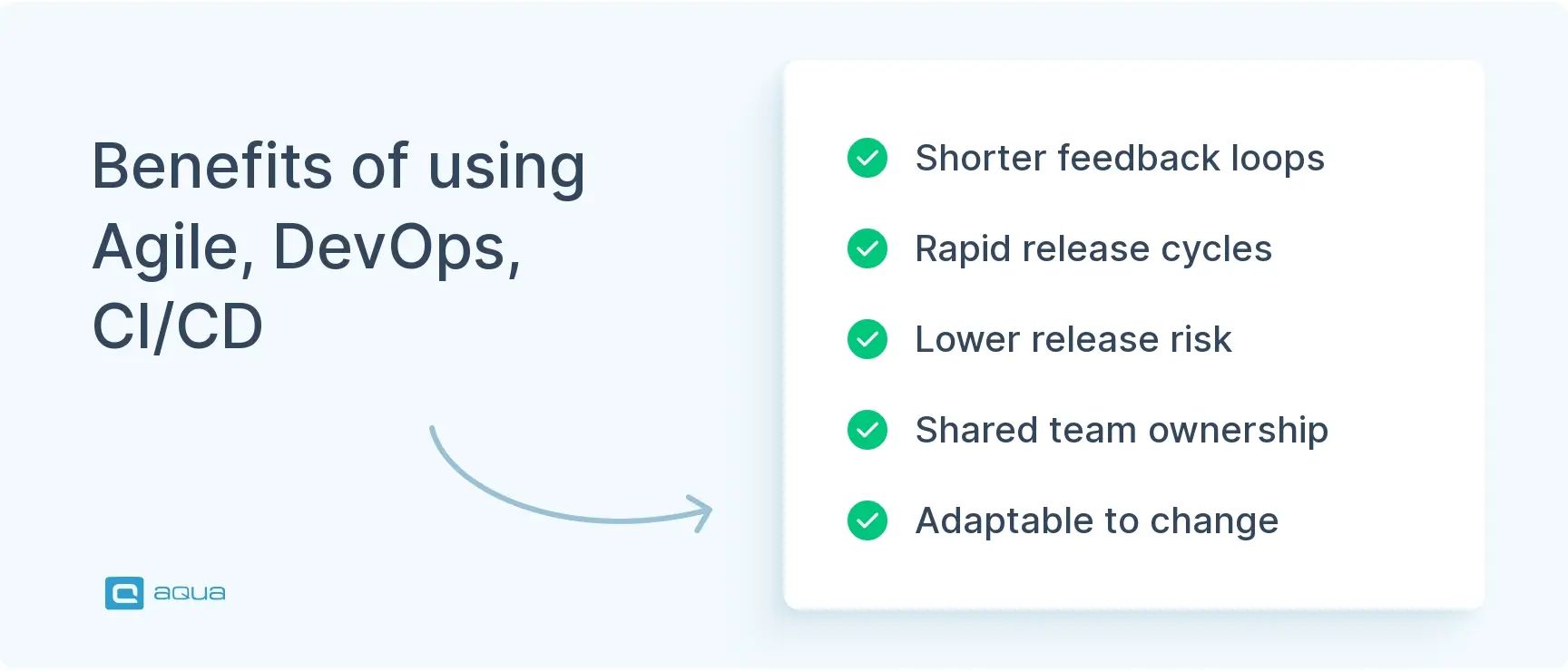
Running an agile CI/CD DevOps model produces five benefits your team can measure, and each practice contributes something different to each one.
Benefit
Agile contribution
DevOps contribution
CI/CD contribution
Shorter feedback cycles
Stakeholder feedback on each increment
Production telemetry returned to planning
Build and test results within minutes of a commit
Faster release cycles
Work sliced into small increments
Shared ownership removes handoff queues
Automated build, test, and deployment stages
Lower release risk
Smaller scope per change
Monitoring and rollback capability in production
Automated validation before every release
Shared delivery ownership
Cross-functional teams around one backlog
Responsibility extended through operations
One pipeline every role can read and trigger
Response to changing requirements
Backlog reprioritized each iteration
Operational findings enter planning as work items
Short lead time from decision to release
Teams that adopt one practice and expect the full result usually conclude the practice failed, when the other two were missing.
Best Practices for Combining Agile, DevOps, and CI/CD
Agile DevOps CI/CD adoption works in one order: start with continuous integration, then extend automated testing, then move ownership into production. Deployment automation added before the integration process is stable will ship broken releases faster than the manual process it replaced. The nine steps below follow the sequence your team can implement without rework.
Establish continuous integration first. Get developers committing to a shared trunk or mainline branch multiple times daily, then set up automated builds and test suites that run after each commit. Treat a broken build as work that stops other work.
Extend automated test coverage. Once CI is stable, add integration, API, security, and end-to-end scenarios. Your test suite becomes the basis for frequent releases, and teams relying on manual validation stay in slower release cycles regardless of their sprint cadence.
Move infrastructure into code. Provision test, staging, and production infrastructure through version-controlled scripts, so environments become repeatable and auditable. Your infrastructure then evolves through the same review process as application code.
Bring production data into sprint planning. When monitoring shows checkout failures climbing, that work enters the sprint with high priority. When error rates dropped after the last release, record what caused the improvement.
Extend retrospectives past development velocity. Cover deployment success rates, incident response times, and production stability alongside story points, so planning accounts for operational reality.
Give developers production observability. Logs, metrics, traces, and error rates from live code change design decisions. Observability also shortens incident response, because your team diagnoses issues from real data.
Share on-call and incident response. Developers who handle their own incidents write better error handling, logging, and graceful degradation into the next release.
Keep pipeline feedback under 15 minutes. A two-hour test suite pushes developers to batch commits, which defeats the point of frequent integration. Parallelize tests, cache dependencies, and quarantine flaky tests as they appear.
Run this as continuous improvement. Try trunk-based development, feature flags, and blue-green deployments as experiments, then keep what measurably works.
I would say that they're different things, but you can notice some points where devops directly contributes to an Agile environment. For instance, automated CI/CD helps you keep your code deployable at all times.
Where the bottlenecks between commit and production are
Change failure rate
Whether release quality holds as frequency increases
Recovery time after a failed deployment
How quickly your team restores service
Reliability
Whether the service meets the expectations your users have
Review the metrics together. Deployment frequency alone cannot show whether faster releases are increasing failure rates, and a long lead time with a healthy failure rate usually indicates manual approval steps in the release path.
Common Integration Challenges
Four obstacles come up repeatedly when teams combine the three practices, and each one blocks a different part of the work:
Cultural silos. Development and operations keep separate reporting lines and conflicting targets, so shared ownership never reaches daily work. Shared on-call rotations and joint incident reviews change the incentive before any tool does.
Slow or unreliable automated tests. A suite that takes an hour or fails at random pushes developers back to batched commits. Track flaky tests separately, quarantine repeat offenders, and treat pipeline duration as a maintained metric.
Disconnected toolchains. Requirements live in one system, test cases in a second, and pipeline results in a third, which makes release status a manual assembly job.
Sprint cadence disconnected from release cadence. Your team plans in two-week increments while releases wait for a monthly window, so completed work sits in a queue.
Connecting requirements, test execution, and pipeline results in one platform gives your team the release confidence that shorter cycles depend on.
Combining Agile, DevOps, and CI/CD puts pressure on the testing work between them. Manual test coordination limits deployment frequency, and test cases disconnected from requirements weaken Agile feedback. aqua cloud, an AI-driven test and requirement management solution, handles all workflows as per these three methodologies with one repository for manual and automated assets. It also adds scheduled execution, full run history per release, and automated traceability from user story through production. aqua Intelligence grounds test generation in your own project documentation with RAG, so coverage stays aligned as scope shifts between sprints. Teams on aqua cloud save 12+ hours per week per user and accelerate releases by 60%. Execution connects through 10+ native automation integrations, covering JMeter, SoapUI, Ranorex, REST API, PowerShell, UnixShell, and MSSQL and Oracle databases. Capture records for each session with video and screenshots, which gives your incident reviews the evidence they need.
Achieve 100% traceability and boost QA testing efficiency with aqua’s AI
Agile, DevOps, and CI/CD solve different problems inside the same delivery system. Agile organizes work around feedback and changing priorities, DevOps extends that thinking from planning through production operations, and CI/CD supplies the automation that makes frequent releases workable. Teams shipping multiple times daily with high stability combine all three, and they start with continuous integration before adding deployment automation on top. Measure the result with deployment frequency, lead time, change failure rate, and recovery time, then address whatever those numbers expose.
What is the difference between Agile, DevOps, and CI/CD?
Agile organizes development work into short cycles that respond to changing requirements. DevOps extends that thinking across delivery and operations under shared ownership. CI/CD is the automation that builds, tests, and releases each change through a repeatable pipeline.
Can Agile, DevOps, and CI/CD be used together?
Yes, and most experienced teams run all three at once. Agile shapes how work gets planned, while DevOps defines who owns it through production. CI/CD then executes the delivery, covering the ground the other two practices leave open.
Is CI/CD part of DevOps?
CI/CD is the technical implementation of DevOps delivery practices. Your team can adopt DevOps culture without pipelines, though releases stay slow and manual. CI/CD supplies the automation that keeps production feedback close to development.
Which is better: Agile, DevOps, or CI/CD?
The comparison has no winner, since the three cover different ground. A more useful question is what currently limits delivery for your team: unclear requirements, slow handoffs between departments, or manual release steps.
What is the difference between continuous delivery and continuous deployment?
Continuous delivery keeps software deployable at all times, with a person approving each production release. Continuous deployment removes that approval, so any change passing automated checks reaches production directly, which requires extensive test coverage and monitoring.
Which should your team implement first?
Continuous integration comes first. Frequent commits to a shared branch with automated builds and tests create the discipline that everything else depends on. Deployment automation added before stable CI accelerates broken releases.
Where does QA fit in an agile DevOps CI/CD model?
QA moves into the delivery pipeline and stops following it. Testers work inside cross-functional teams, automated suites run on every commit, and test results feed sprint planning alongside production metrics from monitoring tools.
Pavel, a Quality Assurance Consultant and Author, brings deep expertise to solving complex testing challenges. His background in software development has helped organizations transform their QA practices from reactive to proactive. Beyond consulting, Pavel develops best practice guides and case studies for aqua cloud that…
Nurlan, a QA Coordinator & Quality Standards Officer, takes pride in orchestrating seamless QA operations. His expertise in coordinating QA-focused projects and integrating QA solutions has consistently yielded top-tier client satisfaction. Aside from a full-time QA coordinator, Nurlan's role involves creating compelling content that educates…
Enhancement of the aqua product is Martin’s main responsibility and biggest mission. His expertise covers ITIL Process Consulting, Change Management, Quality Assurance, Quality Management, and Requirements Management. Martin works in QA services for regulated industries for more than 18 years being an irreplaceable leader at…
Join our community of enthusiastic experts! Get new posts from the aqua blog directly in your inbox. QA trends, community discussion overviews, insightful tips — you’ll love it!
We're committed to your privacy. Aqua uses the information you provide to us to contact you about our relevant content, products, and services. You may unsubscribe from these communications at any time. For more information, check out our Privacy policy.
X
🤖 Exciting new updates to aqua Intelligence are now available! 🎉