Key Takeaways
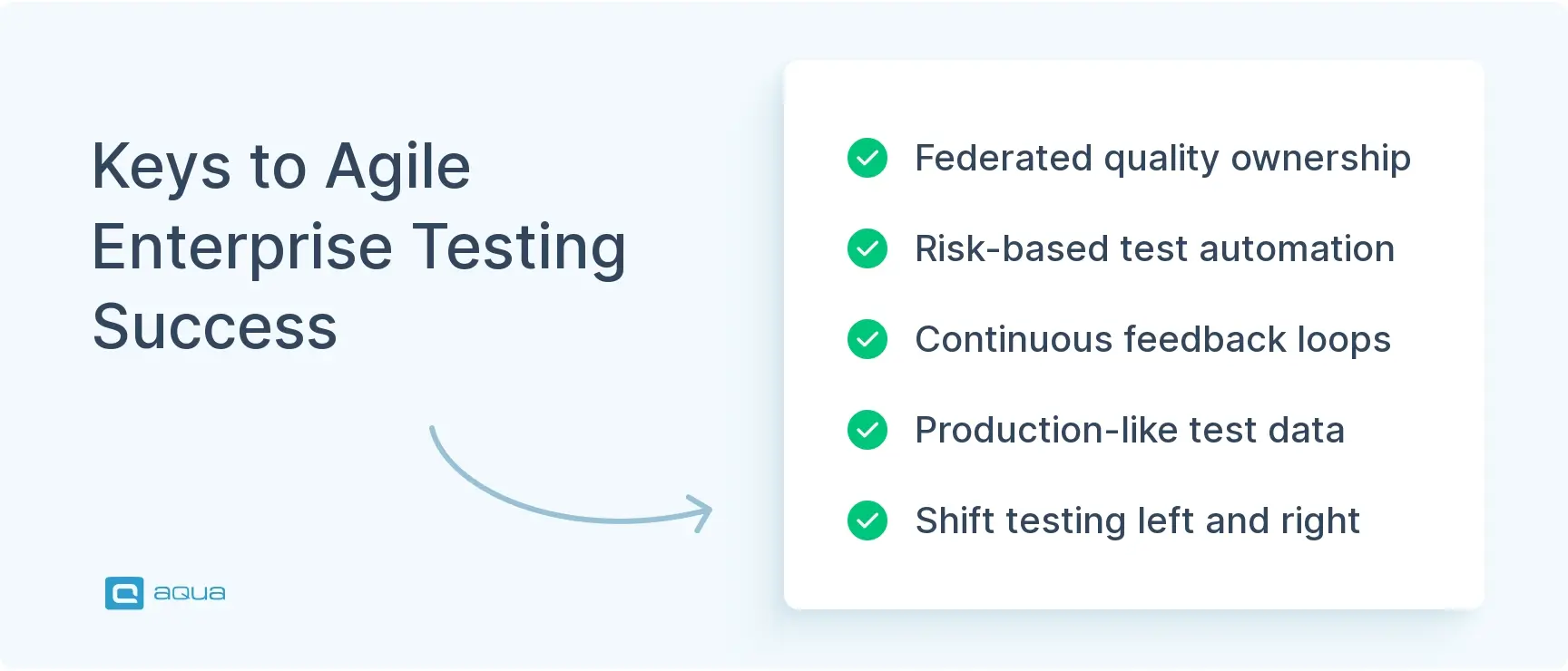
- Agile enterprise testing embeds continuous quality validation across large-scale delivery systems, distributing quality ownership to development, operations, security, and business teams instead of treating QA as a separate phase.
- The test automation pyramid should be heavy on fast unit tests, moderate on API and integration tests, and light on slow end-to-end UI tests. Many enterprises accidentally invert this, creating slow, brittle automation that can’t keep up with Agile delivery.
- Teams that nail Agile enterprise testing reduce change failure rates while increasing deployment frequency. Quality and speed become partners, not enemies.
- Without reliable, compliant, production-like test data that teams can quickly access, automation is stuck around 25% coverage.
See how to fix your testing architecture and scale quality engineering across enterprise teams 👇
What Is Agile Enterprise Testing?
Agile enterprise testing is embedding continuous quality validation throughout large-scale software delivery. It distributes quality ownership across development, operations, security, and business teams. The goal is faster releases without turning production into a test environment.
Traditional Agile testing works for small teams building new applications. Enterprise environments are different. Your team is dealing with mainframes, dozens of interconnected systems, documented compliance requirements, and multiple Agile teams working on the same platform. Agile enterprise testing handles this by combining automated feedback loops, risk-based test prioritization, and collaborative quality practices across the full delivery pipeline.
The core idea: embed quality into a continuous control system. For example, your payment processing flow should get validated through unit tests during development, API contract tests during integration, automated regression checks before deployment, and synthetic monitoring after release. Layers of QA detect different risks at varying speeds and costs.
The Role of Testing in Agile Enterprise Environments
In an ideal CI/CD process, you'd do the build on the merge request, running the unit tests and checking code coverage and other code quality metrics. Then you'd run the test suite, checking the results. If it fails, then you kick out the merge.
Testing in enterprise Agile is distributed and continuous. Each role owns a specific quality layer, and when they all connect properly, delivery gets faster with fewer production fires.
- Developers own code-level quality. Your team writes unit tests for business logic, runs automated checks before committing, and fixes defects while context is fresh. When AI coding assistants are part of the workflow, validation matters even more since generated code isn’t always correct.
- QA engineers become quality architects. Instead of manually executing hundreds of test cases per sprint, your team designs test strategies, builds automation frameworks, and focuses human effort on exploratory testing where judgment beats scripts. This also prevents your test pyramid from inverting into an ice cream cone: heavy on brittle UI tests and light on fast unit tests.
- Product owners define testable acceptance criteria. Vague requirements create expensive rework. Strong product owners collaborate with QA during story refinement to clarify business rules and edge cases before development starts.
- Security specialists shift left. AppSec teams integrate vulnerability scanning, dependency checks, and secrets detection into development workflows, detecting issues early without blocking deployments.
- Site reliability engineers close the feedback loop. Production monitoring and observability tools show whether your testing actually protected customer journeys.
- Business stakeholders validate real-world scenarios. In complex domains like insurance, banking, or healthcare, business users often detect logic gaps that technical testing misses.
The goal is federated quality engineering. Your teams own day-to-day quality decisions, while a central function provides standards, tooling, and governance. This avoids both extremes: centralized QA as a bottleneck and every team building its own incompatible testing approach.
Building quality engineering that scales with enterprise Agile delivery requires a sufficient solution. aqua cloud, an AI-powered test and requirement management platform, brings together centralized test orchestration and CI/CD pipeline support. What makes aqua particularly effective for enterprises is its domain-trained AI Copilot with RAG grounding. It learns from your actual project documentation to create test scenarios that match your specific business logic, terminology, and workflows. It helps to switch from hours of manual test case creation to precise, project-specific coverage while maintaining the audit trails that regulated enterprises require. Whether you’re managing legacy system complexity or coordinating across dozens of Agile teams, aqua provides the federated quality operating model that keeps teams moving fast while central functions maintain governance. It connects natively with Jira (bidirectional sync), Jenkins, Azure DevOps, Confluence, and JMeter, keeping distributed teams aligned without coordination overhead.
Achieve enterprise-scale Agile testing with the RAG-driven AI
Key Principles of Agile Enterprise Testing
Agile methodology comes with its principles and rules already. See how they should be integrated into enterprise testing practices:
- Shift testing left, but don’t stop there. Detect defects during development through unit tests and automated checks, but complete the picture with production monitoring and post-release analytics.
- Automate by risk rather than volume. Focus automation on business-critical journeys: payment flows, onboarding, checkout, account changes. Lower-risk features can use lighter validation.
- Test continuously. Unit tests run at commit. Integration tests run during build, and security scans happen automatically in CI/CD. Each layer provides fast feedback without waiting for full end-to-end suites.
- Keep quality ownership close to development. Embedded testers understand context, detect issues early, and help developers build testability into their work from day one.
- Prioritize test maintenance like production code. Flaky tests kill trust. When automation fails randomly, real defects hide in the noise. Treat test code with clear ownership, code reviews, and regular refactoring.
- Build testing around user journeys. Testing one component in isolation might show green while the full customer experience is broken. Organize critical tests around end-to-end business scenarios that span multiple systems.
- Use production feedback to improve testing. When defects are let into production, treat such instances as coverage gaps. Build regression tests, adjust your risk model, and strengthen automation around similar scenarios.
Agile Testing Quadrants in the Enterprise
The Agile Testing Quadrants organize your testing strategy around two dimensions: business-facing vs. technology-facing, and supporting development vs. critiquing the product.
Q1: Technology-facing tests that support development.
This includes unit tests, component tests, and API tests. They run fast, provide immediate feedback, and form the foundation of your test automation pyramid. High coverage here is the cheapest place to detect defects. Teams that skip unit testing and rely only on UI automation end up with slow, fragile test suites that can’t keep up with delivery speed.
Q2: Business-facing tests that support development.
Acceptance tests, behavior-driven tests, and automated user journey validation. These answer: did your team build what the business actually needs? Q2 tests often use tools that let product owners or QA engineers write tests in natural language, bridging the gap between technical implementation and business intent.
Q3: Business-facing tests that critique the product.
Exploratory testing, usability testing, user acceptance testing, and beta feedback. These rely on human judgment and domain expertise, finding edge cases, confusing UX, and business logic gaps that scripted tests miss. In regulated enterprises, Q3 also covers compliance validation and audit preparation.
Q4: Technology-facing tests that critique the product.
Performance, security, reliability, scalability, load testing, and chaos engineering. These answer questions like: can the system handle peak traffic? What happens if this database cluster fails? Not run on every commit, but critical before major releases or architectural changes.
Teams that over-invest in one quadrant create gaps. All four need to work together, with automation handling repeatable validation in Q1, Q2, and parts of Q4, while humans focus on judgment-driven critique in Q3.
Types of Testing in Agile Enterprise Projects
Usually, distinct detection strategies are utilized to match different risks. Here’s what each test type in Agile testing actually covers:
- Unit testing validates individual functions or components in isolation. Fast, cheap, and essential for complex business rules like insurance underwriting or loan calculations.
- Integration testing checks how components or services work together. Contract testing validates that services honor their API agreements, detecting breaking changes before production.
- API testing validates endpoints, authentication, and error handling. Faster than UI tests, it’s your team’s first line of defense for mobile apps, partner integrations, and headless services.
- End-to-end testing walks through complete business scenarios across systems. Valuable for high-revenue flows like checkout or claims submission, but keep the suite focused. These tests become fragile and slow when overused.
- Exploratory testing lets human testers actively investigate the application. This finds usability problems, unexpected edge cases, and business logic gaps that scripted tests miss.
- Regression testing re-runs existing tests to ensure new code didn’t break previously working features. Automated regression suites let your team release confidently without manual retesting marathons.
- Performance testing validates response times and system behavior under load. Load tests simulate expected traffic. Stress tests push systems past their limits to find breaking points.
- Security testing identifies vulnerabilities, compliance gaps, and attack vectors. With AI-generated code expanding the attack surface, security testing needs to run continuously in CI/CD pipelines.
- Accessibility testing ensures applications work for users with disabilities. Automated tools detect many issues, but manual testing with assistive technology provides real validation.
Build a risk-based approach: heavy automation for critical paths, lighter validation for lower-risk changes, and tune the mix based on where defects actually occur.
You should be doing automated unit testing, integration testing, end-to-end functional testing, regression testing and performance testing several times a day. These test scripts should be written by your developers with guidance from your test specialists.
Building an Agile Testing Strategy for the Enterprise
A testing strategy is your team’s shared agreement on how QA is approached and who is responsible for it. Here’s what a practical enterprise version covers:
- 1. Map business-critical journeys first. Identify the 10-15 workflows that directly impact revenue, customer experience, or compliance: payment processing, account creation, checkout, claims handling. Every testing decision should prioritize these paths.
- 2. Build a test pyramid. Automation should be heavy at the base with fast unit and component tests, moderate in the middle with API and integration tests, and light at the top with slow end-to-end UI tests. Many enterprises accidentally invert this, building hundreds of brittle UI scripts while skipping unit tests. Fix the pyramid before scaling.
- 3. Establish quality gates in CI/CD. Define what must pass before code moves forward: unit test thresholds, security scans, code coverage minimums, smoke tests after deployment. Make gates risk-based so a minor copy fix doesn’t require the same validation as a payment system rewrite.
- 4. Create a federated quality model. Product teams own day-to-day testing. A central quality engineering team provides frameworks, tools, and governance. The center enables teams; it doesn’t control them.
- 5. Invest in test data management early. Test data is the hidden constraint that kills automation. Your team can’t test payment flows without realistic customer and transaction data, but production data carries privacy and compliance issues. The solution requires investment in test data tools: masking, synthetic generation, on-demand provisioning, and compliance controls. This is what separates teams at 40% automation coverage from teams at 80%.
- 6. Report what business stakeholders actually care about. Stop reporting how many test cases your team executed. Report change failure rates, deployment frequency, mean time to recovery, and missed defects by business journey. Connect quality metrics to business outcomes.
- 7. Make test maintenance a first-class activity. Flaky tests destroy confidence. Outdated tests create false security. Your strategy needs ownership models for test suites, stability metrics, regular refactoring, and a clear process for retiring tests that no longer add value.
- 8. Build feedback loops from production. Synthetic monitoring, error tracking, and incident data show where testing missed real-world issues. When defects get omitted, treat them as coverage gaps and build regression protection. Organizations implementing enterprise agile test management understand this becomes the foundation for scaling quality engineering across multiple teams.
The Agile Enterprise Testing Process
- Quality starts in refinement. Before any code is written, product owners, developers, and QA collaborate during backlog refinement. They clarify requirements, define acceptance criteria, identify edge cases, and surface integration dependencies. Getting clarity here prevents the expensive rework that comes from building the wrong thing correctly.
- Developers test during development. As code is written, developers run unit tests locally, write new tests for their changes, and verify existing tests still pass. Pre-commit hooks check code quality and test integrity. When your team uses AI coding assistants, generated code needs extra scrutiny since AI doesn’t always produce secure or correct logic.
- Automated tests run in CI/CD. Every code commit triggers a pipeline. Unit tests run first for fast feedback, followed by integration tests that validate component interactions. Security scans and contract testing then confirm API compatibility is intact. If tests fail, the pipeline stops and developers get immediate alerts.
- Testers focus on what automation misses. While automation handles repeatable validation, QA engineers run exploratory testing, usability validation, and complex workflow testing. They work in parallel with development, detecting issues while context is fresh and fixes are cheap.
- Regression suites validate before release. When a release candidate is ready, automated regression suites run against staging environments. Critical path smoke tests run first. If they pass, broader regression suites cover secondary flows, and performance and security regression checks follow.
- Release validation happens in production. After deployment, smoke tests verify core functionality. Synthetic monitoring validates critical journeys continuously. Feature flags let your team gradually roll out changes while monitoring error rates. If problems surface, features can be disabled quickly without full rollbacks.
- Post-release feedback drives improvement. Production incidents, user feedback, and missed defects get analyzed in retrospectives. Ask: why did testing miss this, and what coverage gaps does it reveal? Each production issue strengthens future testing.
Test Automation in Agile Enterprise Testing
Automation frees your team from repetitive validation so they can focus on work that requires judgment. Enterprise automation comes with real constraints though. You’re dealing with legacy systems, integration complexity, regulatory requirements, and test suites that need to stay stable as hundreds of developers push changes daily.
Not everything should be automated. Manual testing still matters for exploratory work, usability validation, and complex business logic that changes frequently. The test automation pyramid guides smart investment: heavy automation at the unit level where tests run in milliseconds, moderate automation for API and integration tests, and selective automation for end-to-end UI flows. Enterprises that invert this pyramid end up with slow, fragile test suites that fail randomly and undermine release confidence.
Where to Start With Automation
Focus first on business-critical journeys. Payment processing, customer onboarding, checkout, and booking flows protect revenue and customer experience. Once critical paths have stable automation, expand to secondary features based on risk.
Tool selection at enterprise scale requires different criteria than picking a framework for a single product team. Your tools need to integrate with existing CI/CD and project management systems, support role-based access and audit trails for compliance, and produce reporting that communicates risk to business stakeholders.
AI-Assisted Testing: Real Value, Real Caveats
Generative AI helps with test case creation, test data generation, self-healing UI automation, and automated test maintenance. Around 76% of QA teams now use AI-powered testing tools. But generated tests need human review for correctness, and audit trails still need maintenance. The teams getting real value treat AI as an accelerator for human expertise.
Autonomous testing platforms take this further by combining AI and intelligent agents to create self-healing tests and no-code test creation. These work best when requirements, test data, environments, and CI/CD infrastructure are already reasonably mature.
How Test Data Interferes with Automation
Your team can have strong frameworks and good coverage targets, but if you can’t quickly access reliable, compliant, production-like test data, automation stays limited. Banking, insurance, and healthcare systems especially struggle here. Research shows traditional automation often plateaus around 25% coverage due to maintenance overhead and test data constraints. The fix requires real investment: data masking, synthetic generation, on-demand provisioning, and compliance controls.
Keeping Automation Trustworthy
When developers start ignoring test failures because those tests are always unreliable, real defects hide in the noise. Track flakiness rates, quarantine unstable tests, improve test isolation, and assign clear ownership for each test suite. Treat test code reviews and refactoring as core development activities.
Security automation is also mandatory. Static analysis, dependency scanning, secrets detection, and API security checks need to run automatically in CI/CD. Gates should be severity-based: critical findings block deployment, medium findings get tracked for the next sprint.
Mature teams track the following set of metrics that signal whether the system is actually working:
- Flakiness rate below 2-3%. Above this threshold, developers stop trusting the suite. Once trust breaks, real failures get ignored alongside the noise.
- Critical path execution under 10 minutes. Long CI feedback loops push developers to commit without running tests locally first.
- Defect detection efficiency above 85%. This measures how many total defects your team catches before production versus after. Most teams don’t track it; the ones that do find and fix coverage gaps faster.
- Escaped defects tracked by business journey. Count production bugs per critical flow, such as checkout, onboarding, or payments. This pinpoints exactly where automation coverage is failing.
- Change failure rate below 15%. The clearest signal that test coverage is aligned with actual production risk.
Shipping confidently at Agile speed requires both good strategy and appropriate tech stack. aqua cloud, an AI-powered test and requirements management platform, combines comprehensive test management, intelligent automation, and enterprise-grade integrations into one platform. From requirements traceability and sprint planning to automated regression suites and production feedback loops, aqua centralizes quality engineering practices. This allows enterprises to release multiple times per sprint without sacrificing stability. The AI Copilot generates project-specific test cases grounded in your own documentation through RAG-enhanced domain training, producing context-aware scenarios that reflect your actual business rules and edge cases. Enterprises using aqua achieve up to 97% time savings in testing activities while maintaining the compliance documentation and cross-team coordination that complex delivery systems demand. Your team gets deep integration with 12+ tools like Jira or Ranorex that are already in your stack.
Save 12.8 hours per tester per week with aqua’s test orchestration capabilities
Conclusion
Quality engineering works when it stops being a phase and becomes a system. The teams shipping confidently at speed have embedded testing into every layer of delivery, automated repeatable validation, and built feedback loops that actually close. Getting the balance right between speed and stability, automation and human judgment is where Agile transformation starts delivering real business outcomes. The path to mature quality engineering takes time, but the alternative is releasing faster while hoping nothing breaks. Hope isn’t a testing strategy.