Key Takeaways
- The global AI and automation in banking market reached USD 42.64 billion in 2025, with projections placing it at USD 239.64 billion by 2033.
- AI systems used in credit scoring and risk assessment are classified as high-risk under the EU AI Act, requiring audit trails, bias testing, and governance documentation.
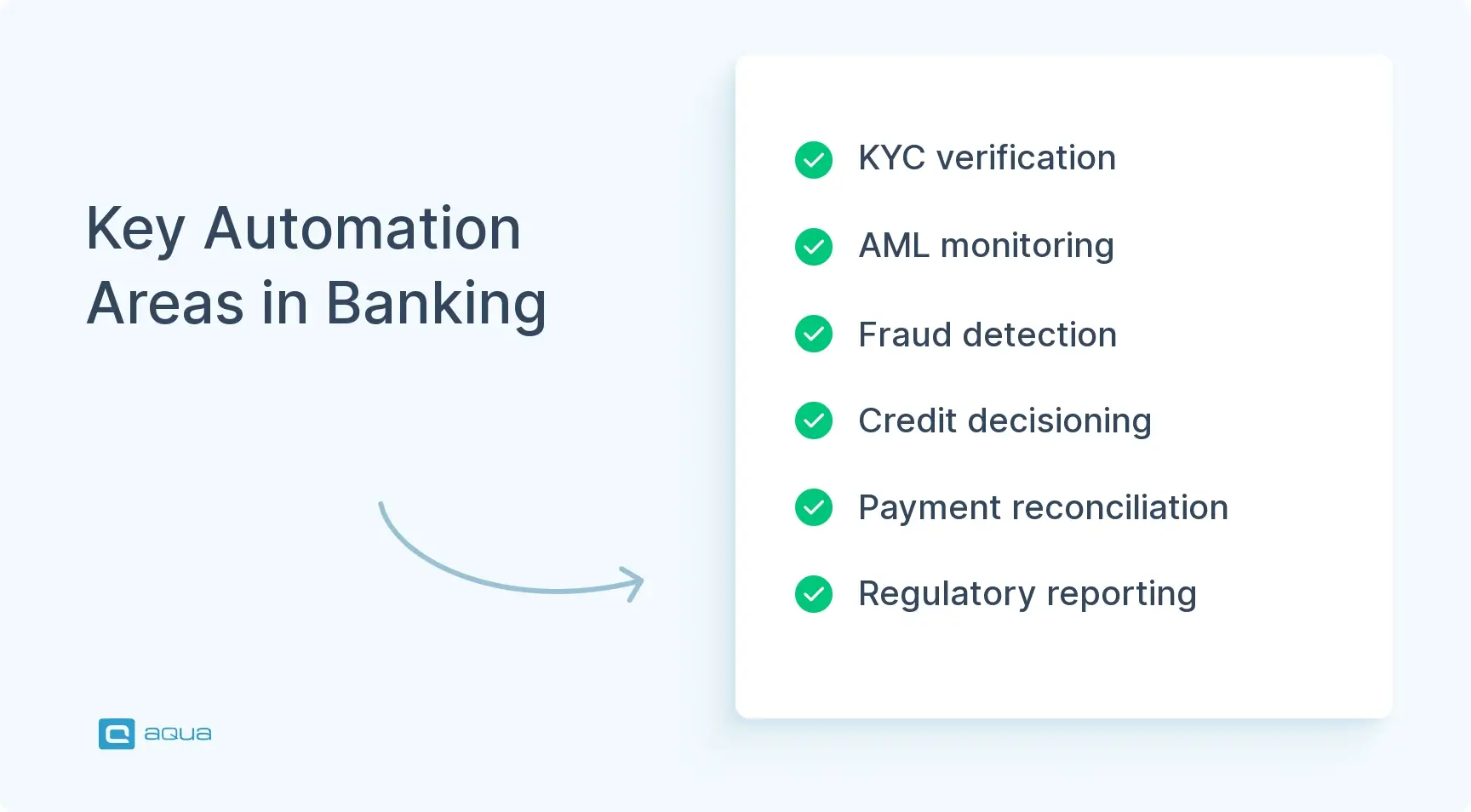
- The strongest automation ROI in banking typically comes from KYC, AML monitoring, fraud detection, and payment reconciliation workflows.
- Governance should come before scaling: clear ownership, access controls, audit logging, and change management processes are foundational requirements.
- Banks using aqua cloud save 12+ hours per week per QA team member while maintaining 100% traceability and full audit readiness.
Test automation in banking comes with real complexity. This guide covers how to build an approach that holds up 👇
What Is Test Automation Management in Banking & Finance?
Test automation management is the practice of coordinating, governing, and improving automated testing across complex financial systems. It acts as the control layer that keeps your test suites running consistently while staying aligned with regulatory requirements, security standards, and business goals. In practice, it spans three core areas:
- Governance — who owns which test suite, who approves changes, and what audit evidence gets produced
- Asset management — reusable scripts, datasets, and validation rules stored centrally for your team
- Regulatory alignment — traceability from requirements to test results, and compliance documentation that satisfies auditors
According to Grand View Research, the global AI and automation in banking market reached USD 42.64 billion in 2025, with projections placing it at USD 239.64 billion by 2033. That level of investment makes proper governance of automation a strategic priority, not an IT side project.
Banks operate across layered technology stacks. A core banking platform carries different testing requirements from a payment gateway, which has different requirements from a mobile application. That issue continues across legacy mainframes and cloud services, extending further with every third-party integration in your stack. Without a management layer, these systems each become their own testing island with no shared visibility. The European Banking Authority notes that AI systems used in credit scoring and risk assessment are classified as high-risk under the EU AI Act, meaning banks need governance frameworks specifically designed for testing these functions.
The practical distinction matters for your team. A single test script covering one system is automation. Managing hundreds of test suites across multiple environments, each with version control and coordinated governance, is a different discipline entirely. Banks that build that discipline can scale safely. Those that approach it loosely accumulate technical debt and compliance issues that become costly to clear.
Building a centralized test asset repository with proper governance does not have to take months. aqua cloud, an AI-powered test and requirement management platform that helps orchestrate automated test suites with role-based access control, full audit trails, and traceability from requirements to defects. The AI Copilot, trained on your team’s own documentation and compliance requirements through RAG grounding, generates test cases that reflect your bank’s regulatory context and business logic. You get reusable components, version control, and the compliance evidence auditors expect, without piecing together multiple tools or maintaining spreadsheets. aqua connects natively with Jira (bidirectional sync), Jenkins, Azure DevOps, and Confluence, plus Capture integration that records every test session with video and screenshots to maintain complete evidence trails. Integrations with 12+ other tools from your stack are available, making aqua cloud ideal as a core of your software system for QA.
Centralize, govern, and scale your banking test automation with aqua
Why Banks and Financial Institutions Need Test Automation Management
Banks face mounting cost pressure and regulatory scrutiny while fraud threats evolve and customers expect reliable digital services. Manual testing cannot keep pace with that combination. Speed matters, and precision matters equally. Test automation management for financial services delivers both, when structured correctly.
Here is why financial institutions like yours are investing in it:
- Cost pressure and operational efficiency: Banks need to lower cost-to-income ratios without cutting compliance or service quality. Automation reduces the repetitive grind of regression testing and compliance validation. Real savings come from catching defects early and eliminating rework. The bigger wins come from avoiding the expensive incident fixes that production failures trigger.
- Regulatory compliance demands: Financial institutions operate under frameworks like the EU AI Act, DORA, Basel guidelines, and AML regulations. Testing gives regulators documented proof that your systems are secure and auditable, with resilience evidence to match. Test management solutions for banking generate the audit trails and control documentation that pass regulatory reviews.
- Fraud and financial crime pressure: Real-time fraud systems process millions of transactions continuously. Automated testing validates these systems after every rule change or model update your team deploys. Faster testing means your team can ship updated fraud defenses sooner.
- AI model governance: Banks are moving AI from pilots to production. Testing AI models for bias and explainability requires tracking model versions and validation datasets systematically. Manual tracking at any meaningful scale is not feasible for your team.
- Operational resilience under DORA: DORA formalizes requirements around ICT risk and incident management. Your team must test failure scenarios and manual fallback processes as a regular part of the testing cycle. Automation management ensures these resilience tests run consistently and that results are documented ahead of audits.
Testing Challenges in the Banking & Financial Sector
Banking software testing carries a different weight than most industries. The systems tend to be older and the integrations are deeper than most environments your team works with. Your margin for error is close to zero. These challenges explain why test automation management becomes necessary, not optional:
- Legacy system complexity: Many banks still run on mainframes built long before APIs or test automation existed. Connecting modern automation to these systems means working around interfaces that were never built for it. The result is brittle test configurations that break with every system change. Solution: Use API gateways or service virtualization to insulate your test suites from interface volatility, and prioritize automation on stable, well-defined system boundaries first.
- Data quality and availability: Automated tests need realistic data, but banking data is sensitive, regulated, and often incomplete in test environments. Poor data quality produces unreliable test results and AI models that behave unexpectedly in production. Solution: Implement test data management tools that use data masking and synthetic generation to create compliant, realistic datasets without touching live customer records.
- Fragmented architecture: A single customer transaction can cross a core banking system and a fraud detection engine, then pass through compliance screening before it completes. Testing these integrations requires coordinated environments and careful dependency management. Solution: Apply service virtualization for unstable dependencies and establish shared environment management protocols across your team.
- Regulatory uncertainty: The EU AI Act, DORA, and sector-specific banking rules overlap and evolve continuously. Without structure, keeping test coverage aligned with regulatory obligations becomes a manual, error-prone process for your team. Solution: Use a test management platform that supports requirement traceability, so regulatory changes show up as coverage issues in your reporting automatically.
- Cybersecurity exposure: Automation widens the security perimeter. Test credentials and API keys are common attack vectors, as are third-party integration points in your automation setup. The ECB’s focus on AI-related cyber resilience reflects this concern directly. Solution: Apply vault-based secret management and role-based access controls across all automation components. Automated activity monitoring and regular credential rotation add another layer of protection.
- High-volume, low-latency requirements: Payment systems and fraud detection platforms operate in real time, with millisecond-level latency constraints your team cannot afford to miss. Trading systems add similar pressure. Performance and load testing become essential, and results must reflect realistic production conditions. Solution: Build dedicated performance test suites that simulate peak-load conditions. Integrating them into your CI/CD pipeline ensures latency regressions are caught before deployment.
Part of the issue is that banking is so heavily regulated. Take AI underwriting as an example- we are expected to be able to demonstrate that any given underwriting decision made by the AI is reproducible by our human analysts given the same set of criteria and data.
Core Components of Test Automation Management for Financial Services
Effective test automation management requires more than assembling tools. The components below form the operational backbone of your test automation framework. Each one has to work together for the whole system to hold up under banking-level pressure.
Test Orchestration Layer
The orchestration layer coordinates test execution across distributed environments by resolving dependency graphs, managing parallelism, and routing results to downstream consumers. In banking architectures, where a single end-to-end workflow may span core systems, payment rails, fraud engines, and compliance APIs, orchestration handles sequencing, environment allocation, and failure propagation logic that pipeline-native tools alone cannot manage.
- Dependency graph execution: downstream suites trigger only when upstream prerequisites pass
- Parallel execution across multiple environments to compress end-to-end cycle time
- Retry logic with flake detection to separate genuine failures from infrastructure noise
- Automated escalation to incident management systems when critical suite thresholds are breached
- Cross-environment result aggregation with unified reporting for your team’s dashboards
Test Asset Repository
A governed store for all test artifacts, including parameterized test cases, service mocks, schema definitions, test data contracts, and validation rules. In a regulated environment, the repository enforces version control, ownership metadata, and traceability links so that every asset can be traced to the requirement, control, or regulatory obligation it validates. Without this structure, audit readiness collapses under the weight of distributed, informally maintained scripts.
- Version-controlled artifacts with branching strategies aligned to your release pipeline
- Tagging and filtering by domain, risk tier, regulatory obligation, or test type
- Parameterized dataset management with access controls enforced at the dataset level
- Impact analysis: automatic identification of which tests are affected when a component changes
- Immutable ownership and change history logs per asset for regulatory traceability
Governance and Access Control
Governance in test automation management covers accountability structures for test authoring, review, and sign-off that mirror the control frameworks regulators audit. Under DORA and the EU AI Act, financial institutions must demonstrate that automated testing of high-risk functions follows documented approval chains, separation of duties, and change management controls. Role-based permissions, immutable audit logs, and identity provider integration are the operational implementation of those requirements.
- Role-based permissions across test authoring, execution, and sign-off functions
- Approval gates tied to change management workflows before production-bound suites execute
- Separation of duties enforcement so test authors cannot approve their own changes
- Immutable audit logs capturing every change with user, timestamp, and approval chain
- Identity provider integration via Active Directory or SAML-based SSO for centralized user management
Environment Management
Environment management in banking starts at the very basic level, which is stable infrastructure. On top of that, it requires deterministic configuration management, where environment state is codified, versioned, and reproducible on demand. Service virtualization is often mandatory where third-party dependencies are rate-limited, unavailable in non-production tiers, or contractually restricted from test traffic. Data residency rules under GDPR and sector-specific regulations constrain where environments can run and what data can transit them, adding complexity that most generic tooling does not address.
- Infrastructure-as-code provisioning for repeatable, auditable environment builds
- Service virtualization for third-party APIs that are rate-limited or unavailable in non-production tiers
- Data refresh orchestration scheduled around test windows without manual intervention
- Environment health checks before execution to prevent test runs on degraded infrastructure
- Multi-region environment support for data residency requirements under GDPR and sector-specific regulations
Continuous Monitoring and Observability
Observability in test automation management means treating execution telemetry as operational data, not just pass/fail logs. Your team needs trend analysis on test stability, flakiness scoring per case, coverage mapping against regulatory obligation registers, and correlation of test failures with infrastructure events from APM tools. In high-change banking environments where model updates, rule changes, and API versions shift frequently, observability is what separates a managed automation program from one that generates noise.
- Trend analysis on test stability over time to identify systemic degradation before it escalates
- Flakiness scoring per test case with configurable quarantine thresholds to reduce noise
- Coverage mapping against regulatory obligation registers and risk control frameworks
- SLA breach alerting with configurable thresholds per suite or environment
- APM integration for correlating test failures with infrastructure events in real time
CI/CD Pipeline Integration
Integrating test automation into banking CI/CD pipelines requires more than triggering a suite on commit. Quality gates need to enforce risk-based promotion criteria, where different failure thresholds apply to payment processing tests versus UI smoke tests. Change impact analysis reduces unnecessary execution by selecting only the tests affected by a given change set. Artifact pinning ensures tests execute against the precise build under review, which regulators require for traceability between test evidence and production releases.
- Risk-based quality gates with different promotion thresholds per system criticality level
- Change impact analysis for targeted test selection, reducing unnecessary execution on unaffected code
- Pipeline-native test reporting so your team stays in existing tools without context switching
- Artifact pinning to guarantee tests run against the exact build version under review
- Webhook support for triggering suites from external events such as model deployments or configuration changes
Exception and Incident Management
In complex banking test environments, undifferentiated failure noise is as damaging as no testing at all. Exception management requires automated triage that distinguishes genuine defects from environment instability, test script errors, and data quality issues. Severity-based routing ensures production-impacting failures reach your team immediately, while lower-priority issues queue without interrupting sprint velocity. Post-incident analysis workflows capture contributing test factors, feeding directly into the audit evidence regulators expect after any incident.
- Automated failure triage using historical patterns to classify root causes on first occurrence
- Severity-based routing with priority queues for failures impacting production systems
- Zero-touch defect ticket creation with full context passed to your tracking system
- SLA timers per failure category with escalation paths when resolution deadlines slip
- Post-incident analysis workflows that capture contributing test factors for audit evidence
Key Areas to Automate in Banking & Financial Software Testing
Not every banking workflow can be fully automated. For example, high-judgment decisions and unstable processes often produce better results with human oversight, particularly when the workflow is too rare to justify the investment. The strongest candidates are high-volume, rule-based, repetitive workflows where automation produces measurable ROI and reduces compliance risk.
Here is where banks see the clearest returns:
- Customer onboarding and KYC: Identity verification, document extraction, and sanctions screening all suit automation well. Intelligent document processing combined with workflow coordination can cut onboarding times from days to hours for your team, while maintaining AML compliance.
- Loan origination and credit decisioning: Application intake and risk scoring benefit clearly from automation. Credit bureau integration and affordability checks follow the same pattern. The EBA notes that AI systems evaluating creditworthiness are high-risk under the EU AI Act, so your testing must include explainability validation, bias detection, and defined human oversight.
- AML and transaction monitoring: Anti-money laundering operations generate large volumes of alerts, most of which are false positives. Automation can triage alerts and prioritize cases, with investigation summaries prepared automatically. Investigators retain final decision authority throughout.
- Fraud detection and response: Real-time fraud systems need continuous testing to validate scoring models and authentication integrations. Regular testing ensures your team’s updates do not introduce vulnerabilities or block legitimate transactions.
- Customer service systems: Chatbots, agent assist tools, and knowledge retrieval systems all depend on automation. Testing these requires validating response accuracy and handling edge cases carefully. Monitoring for outputs that could mislead customers is equally important.
- Payments and reconciliation: Payment repair, sanctions screening, nostro reconciliation, and settlement exception handling are high-volume, rule-based processes that suit deterministic automation.
- Regulatory reporting: Automation handles obligation mapping and report preparation, reducing the manual burden on your compliance team. McKinsey notes that manual compliance systems frequently fulfill only a fraction of their obligations, increasing regulatory exposure.
From what I’ve seen, it’s a perfect storm of old tech and legacy systems, fragmented data, edge cases piling up, and compliance.
Beneficial-Panda-640
Posted in
Reddit
Building a Test Automation Management Strategy for Banks and Financial Firms
A test automation strategy is an operating model, not a one-time project. Financial institutions that treat automation as a managed capability adapt faster to regulatory changes and deliver software more reliably. Here is how to build it:
- Start with process discovery: Before automating anything, map your high-volume workflows. Measure cycle time and error rates for each, and note where regulatory exposure sits highest. Process mining tools reveal how workflows actually operate, compared to how they are documented.
- Classify use cases by risk and ROI: High-volume, stable workflows with clear inputs and measurable outcomes are the strongest candidates. For high-risk decisions such as credit scoring, your team needs stronger governance frameworks and defined human oversight points.
- Build governance foundations first: Define automation ownership and approval workflows before scaling. Audit logging and risk classification standards complete the governance foundation your team needs. Issues here create operational risk that compounds as your portfolio grows.
- Pilot with measurable use cases: Start with one or two workflows where your team can demonstrate value quickly. KYC document checks or reconciliation exception handling are strong starting points. Each pilot needs a business owner and clear success criteria, along with baseline metrics to measure against.
- Build reusable components: After pilots succeed, develop shared services such as a common document extraction service and a centralized workflow coordination layer. Reusable components reduce duplication and make controls easier to maintain across your team.
- Scale with continuous monitoring: Track automation success rates and exception rates alongside SLA adherence. Manual override rates and control failures round out what your team needs to monitor. Review workflows regularly because products and regulations change over time, and fraud patterns shift with them.
Best Tools for Test Automation Management in Banking & Finance
The right tool for your team integrates with your existing systems and scales with your automation goals. Regulatory fit matters just as much as feature coverage. Banks typically need a combination of platforms working together.
Here is an overview of the key categories:
- Test management platforms: aqua cloud and platforms like Tricentis and SmartBear sit above individual test tools and tie the full testing lifecycle together. They handle test case ownership, execution scheduling, and traceability from requirements to defects. More than that, they provide test orchestration and CI/CD integration as well as the audit evidence banking teams need when regulators come calling.
aqua cloud stands out for banking teams because of its ISO 27001 certification and AI Copilot with RAG grounding. Native integrations with Jira and Azure DevOps, along with your broader toolchain, mean full traceability from requirements to defects without stitching together separate systems. Banks using aqua save 12+ hours per QA team member per week while maintaining audit readiness.
aqua cloud stands out for banking teams because of its ISO 27001 certification and AI Copilot with RAG grounding. Native integrations with Jira and Azure DevOps, along with your broader toolchain, mean full traceability from requirements to defects without stitching together separate systems. Banks using aqua save 12+ hours per QA team member per week while maintaining audit readiness.
Boost efficiency of automation management for banking by 80%
- RPA platforms: Tools like UiPath and Automation Anywhere are useful where banks rely on legacy systems without APIs. RPA works best for stable, rule-based processes with low exception rates. Heavy reliance on screen scraping against unstable interfaces creates maintenance overhead that grows quickly.
- Workflow orchestration: Platforms like Camunda and Pega coordinate end-to-end processes and manage SLAs. Work assignment and exception tracking come built in. This coordination is essential in banking because most workflows cross multiple business units and system boundaries.
- Intelligent document processing: Tools such as ABBYY and Hyperscience handle document extraction and classification, with built-in validation to catch errors before data moves downstream. This category typically delivers some of the fastest reductions in operational workload, particularly in onboarding and compliance functions.
- Process mining: Celonis and UiPath Process Mining discover how workflows actually run by analyzing event logs. Banks use these tools to identify automation candidates and measure cycle time. Detecting compliance deviations is another valuable use for your team.
- AI and ML platforms: Platforms like Databricks and Azure ML support classification and anomaly detection for banking use cases such as fraud detection and AML alert scoring. Credit risk modeling is another major application your team can address with these tools. For teams running on Azure DevOps, aqua’s native Azure integration connects your test management layer directly to pipelines and work items.
- Generative AI systems: Enterprise LLM platforms support policy review and document summarization, along with compliance research tasks your team would otherwise handle manually. Retrieval-augmented generation grounds outputs in approved internal sources, which is important for regulatory accuracy.
Test automation management for banking is about building a governed testing capability that scales with regulatory and business demands. aqua cloud, an AI-driven test and requirement management solution, brings this to life with centralized test orchestration. It offers AI-powered test case generation and integrations that interconnect your QA from requirements through execution to defect tracking and regulatory reporting. The AI Copilot with RAG grounding turns your internal documentation into actionable intelligence, generating project-specific test cases aligned with DORA, the EU AI Act, and Basel guidelines. With ISO 27001 certification, full audit trails, role-based permissions, and support for both manual and automated workflows, aqua gives your team the control your automation strategy requires. Banks using aqua save considerable time on manual QA while maintaining 100% traceability. The platform connects to your existing toolchain through native integrations with JMeter, SoapUI, Ranorex, REST API, PowerShell, UnixShell, Database MSSQL, and Database Oracle, giving your team access to 10+ automation integrations out of the box.
Scale AI-enabled banking QA with governance, speed, and full regulatory compliance
Conclusion
Test automation management for banking is the governance layer that makes reliable software delivery possible in a regulated environment. The strongest opportunities are in onboarding automation and fraud detection, with AML monitoring and compliance reporting following closely. The most common failure points are poor governance and data quality issues. AI adoption without adequate controls adds a third risk your team needs to plan for. Banks that build structured automation portfolios with clear ownership and continuous monitoring will handle regulatory frameworks with less disruption. DORA and the EU AI Act become much easier to navigate with that foundation in place.