Key takeaways
- Enterprise requirements management connects business goals to delivered features through structured documentation and continuous validation, preventing scope creep and costly rework.
- Agile requirements management treats requirements as documents that adapt through iterative cycles, leading to less rework compared to fixed upfront specifications.
- User stories need clear acceptance criteria and testability reviews to prevent QA from guessing what “improve performance” or “make the UI better” requirements imply.
- Poor requirements cause project failures through weak specification, untracked changes, and missing impact analysis, leading to massive integration issues.
See how to build traceability in enterprise requirements management with Agile 👇
Understanding Requirements and Their Management
Before getting into Agile approaches, it’s worth being precise about what requirements actually are and why managing them at enterprise scale gets genuinely complicated.
A requirement is a documented commitment about what your system needs to do, how it should behave, or what constraints it must consider. In enterprise projects, these commitments stack up fast. In other terms, business requirements define objectives behind a project.
Requirements management covers the full lifecycle from initial idea through approval, implementation, testing, and eventual retirement. Your team needs to know which requirement maps to which code, which test validates it, and which compliance rule it satisfies. This becomes especially important when you observe situations where minor tweaks undermine architecture as well as planned testing.
Organizations often connect requirements management to several adjacent disciplines, which together form a connected approach to managing what gets built and how it gets validated:
- Enterprise content management handles document control and version governance.
- Enterprise mobility management coordinates device policies and access controls across delivery environments.
- Enterprise service management links requirements directly to IT service delivery processes.
Agile requirements management only works when requirements stay connected to validation. aqua cloud, an AI-powered test and requirement management platform, integrates requirements directly to test coverage. This helps to cut out the manual work and increase traceability. Test cases can be generated from requirements in seconds using aqua’s domain-trained AI Copilot, which uses RAG grounding to pull context from your actual project documentation. The result is test cases built around your specific terminology, architecture, and risks. Every requirement links bidirectionally to test cases and defects, so when a change request comes in, the downstream impact is immediately visible. Your requirements stay documented, validated, traceable, and ready for audits. aqua integrates with Jira (bidirectional sync), Azure DevOps, Jenkins, Confluence, JMeter, PowerShell, Microsoft SQL Server, Unix Shell, SoapUI, Ranorex, Oracle Database, and REST API, plus 10+ native automation integrations and Capture, which records test execution with video and screenshots.
Achieve full requirements traceability and automated test coverage with aqua
The Benefits of Agile Requirements Management
Agile requirements management keeps requirements closer to the work. Your team defines what’s needed for the next sprint or two in detail, while keeping higher-level goals flexible enough to respond to feedback. When users engage with version one and report what’s missing, your team can incorporate that information without reconstructing the entire spec.
When a business analyst and a QA engineer work together during sprint planning, misunderstandings get addressed before they become defects. Research on managing requirements in Agile environments shows fewer defects, faster delivery cycles, and stronger alignment between what gets built and what customers actually need.
What Agile brings to requirements management in practice:
- Prioritization based on value. Decisions about what to build are grounded in business impact, supported by data.
- Validation through working software. Assumptions get tested against real user behavior, so your team surfaces gaps earlier and at lower cost.
- Visible traceability. Tools like Jira Product Discovery and Azure DevOps link discovery decisions directly to delivery work, so the connection between “what we want” and “what we’re building” stays visible throughout.
- Continuous feedback loops. The plan-build-test-review cycle keeps requirements grounded. When something doesn’t deliver value, your team adjusts before the problem compounds.
Agile requirements management applies discipline at the right moment, on the right level of detail, which is where the real efficiency comes from.
Core Principles of Agile Requirements Management
Agile requirements management principles highlight that change is normal and that delayed feedback is expensive. When a requirement changes, that represents new information. To make it work, changes need to be visible, their impact assessed, and the right approvals secured before they disrupt your team’s delivery schedule.
One concept worth adopting is Set-Based Design, borrowed from lean thinking. Instead of committing to one detailed solution early, your team explores multiple options and narrows down based on real evidence. Requirements stay high-level for strategic decisions and get detailed just before development starts. This prevents over-committing to specifics that won’t survive contact with real users.
Key practices that make this work day-to-day:
- Writing requirements at multiple levels. Epics for strategic goals, features for major capabilities, user stories for specific functionality, and acceptance criteria for test validation — each level serves a different audience and a different decision.
- Prioritizing with data. Frameworks like MoSCoW (Must, Should, Could, Won’t) or weighted scoring that factors in business value, risk, cost, and urgency give prioritization a defensible basis.
- Maintaining traceability. Every requirement should link back to a business objective and forward to implementation and tests. Bidirectional traceability makes impact analysis fast when change requests arrive.
- Defining done precisely. Each requirement needs acceptance criteria specific enough that QA can validate without guessing. Vague criteria produce vague coverage.
- Reviewing before approval. A review by a developer and a tester catches ambiguity before it turns into rework. This step costs minutes and regularly saves days.
The balance your team is aiming for: requirements lightweight enough to adapt, but specific enough that everyone knows what they’re building and can prove it works.
You need to pick ONE central tool, ban PMs from creating new random projects, and force everyone to put ALL requirements in this single hub with a simple structure like "App Name > Current Features > Planned Features > Test Cases.
Repulsive-Western380
Posted in
Reddit
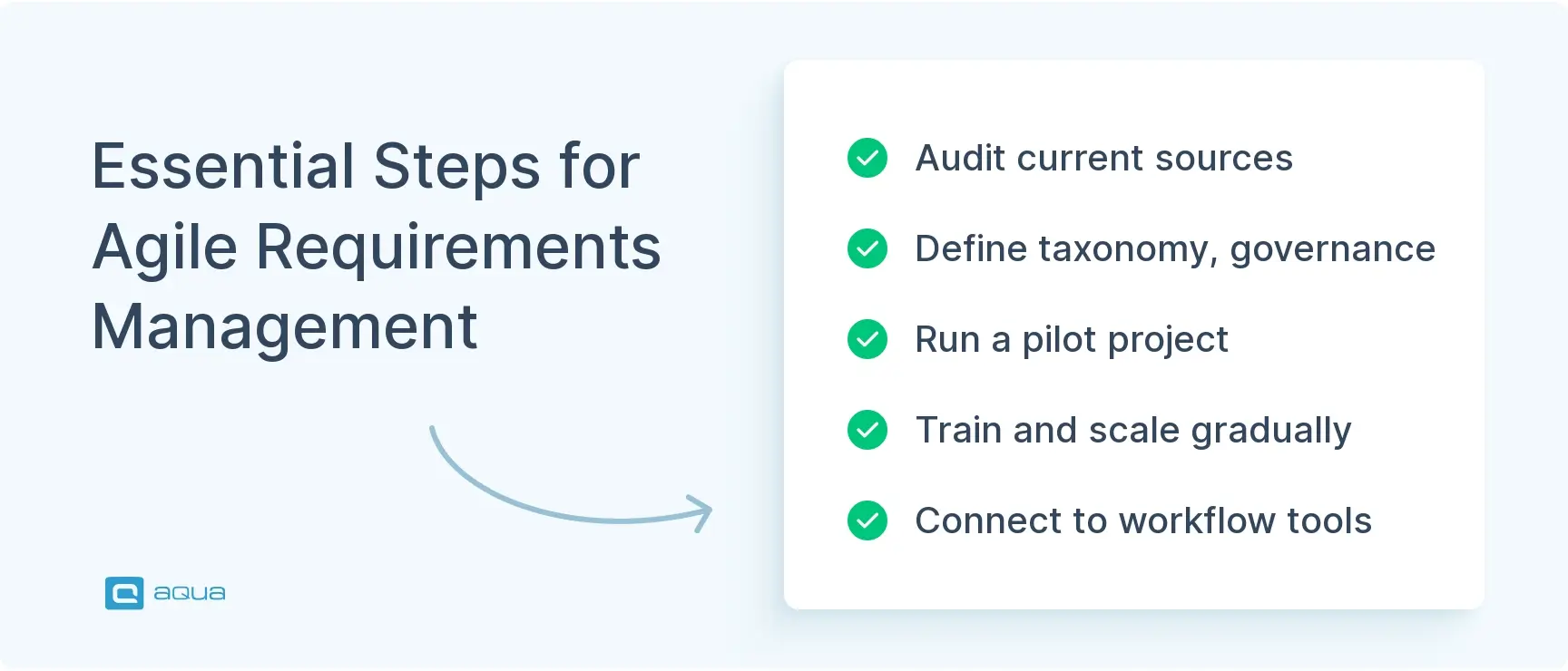
Implementing Agile Requirements Management: Step-By-Step
Step 1: Map Where Your Requirements Live Today
Before changing anything, the starting point is an audit of the current state. Ask yourself: “Where do requirements actually exist in my organization?” Most enterprise teams discover them spread across the following sources:
- Emails
- Chats
- Confluence page
- Jira tickets
- Spreadsheets
- Standalone documents.
Having no single source of truth and no consistent naming is what interferes with proper requirements mapping.
The goal at this stage is to document specific pain points. This audit builds the case for change and helps your team understand what kind of enterprise management system will address the actual gaps. Teams without centralized requirements tracking report longer impact analysis cycles and higher rates of late-stage rework. Both are measurable from the start, which makes them useful baselines for the work ahead.
Step 2: Define Your Taxonomy and Governance Model
Before writing better requirements, the team needs to agree on the structure. Structure is defined as a combination of types of requirements to track. These include, but are not limited to, the following:
- Business requirements
- Functional requirements
- Non-functional requirement
- Compliance requirements
Each of the requirements typically has attributes assigned, such as: Owner, status, priority, risk level, and acceptance criteria. An approval workflow that fits the organization’s context comes next.
A SaaS delivery team might manage with epics, stories, and acceptance criteria. A regulated medical device company needs traceability from regulatory requirement through design, implementation, test, and validation evidence. Connecting requirements management to enterprise information management practices ensures knowledge flows consistently across systems and avoids duplication. The governance model should reflect the actual regulatory environment your team operates in.
Step 3: Choose a Pilot Team and Project
A team that already works in an Agile way is the right starting point, on a project complex enough to prove value but not so high-stakes that any friction causes a crisis. The pilot is an opportunity to apply the requirements model in a real context: structured story writing, clear acceptance criteria, review workflows, and traceability links.
Specific metrics tracked from day one make the pilot meaningful. How often do requirements change during a sprint? How many defects trace back to unclear requirements? How long does impact analysis take when a change request comes in? A well-run pilot typically shows a 20-40% reduction in requirements-related defects within two or three sprint cycles. Those results provide the evidence needed to refine the approach before expanding it further.
Step 4: Train Your Team and Scale Gradually
Once the pilot shows measurable improvement, templates, style guides, and training materials for other teams become the next priority. A full rollout all at once tends to generate resistance. Letting teams adopt the new approach on new projects, and making it the default going forward, produces more durable change.
A requirements champion helps considerably here. This is someone who coaches your team on writing better user stories, establishing traceability in your enterprise management software, and navigating the change management process. Teams that receive ongoing coaching during the first three months of adoption maintain new practices at significantly higher rates. Without that continued support, initial training rarely produces lasting behavioral change.
Step 5: Connect Requirements to Your Toolchain
Agile requirements management produces the most value when it connects to existing delivery systems. For teams on Jira, connecting Product Discovery to delivery boards, linking stories to test cases in Xray or Zephyr, and using dashboards to monitor coverage and readiness keeps the full picture visible.
Azure DevOps users benefit from work items structured with parent-child relationships and linked to test plans and pipelines. In regulated environments, enterprise requirements management tools like Jama Connect or IBM DOORS Next provide deeper traceability and compliance evidence. The goal is a workflow where requirements, development, and testing stay synchronized across the lifecycle.
I think the hardest part is always establishing an effective communication with stakeholders in a project , especially when you have clients involved and you try to make sense of all of your findings for them.
Low-Bother6318
Posted in
Reddit
The Role of Tools and Technology in Requirements Management
A single tool won’t fix the process. What enterprise requirements management tools actually do is make good processes scalable across large teams and complex projects. Here’s how the main options break down, and what each is genuinely suited for.
aqua cloud focuses on requirements documentation, traceability, change management, and validation coverage. It is designed for teams that need requirements to flow directly into test case design, execution, defect tracking, and audit evidence. Every approved requirement can be linked to corresponding tests, test results, defects, and related documentation, which helps teams prove coverage and control changes across the delivery lifecycle. This makes aqua cloud especially useful for requirements-driven QA, regulated software projects, and teams that need stronger governance without the complexity of traditional enterprise ALM suites.
Boost requirement management efficiency by 80% with aqua’s AI
Jira + Confluence + Jira Product Discovery suits Agile software teams already on the Atlassian stack. Jira Product Discovery handles idea capture and prioritization using custom scoring, with direct links to delivery work in Jira. Confluence covers detailed specs, and test management connects through marketplace apps like Xray or Zephyr. The strength is integration within one ecosystem such as aqua cloud. The limitation is that Jira wasn’t built for the deep traceability needs of regulated industries. Teams in those contexts typically supplement it with additional governance processes.
aqua cloud integrates with Jira, so teams can keep delivery work in Jira while managing requirements, tests, and validation evidence in aqua.
Azure DevOps manages requirements through structured work items and parent-child linking, alongside boards, test plans, CI/CD pipelines, and reporting. For enterprises standardized on Microsoft tooling, it provides solid requirements management without adding a separate platform. For regulated industries, dedicated platforms, such as aqaa cloud, an AI-powered test management solution, offer the depth that delivery-focused tools can’t match.
Another great thing about Azure is that it’s integrated with aqua cloud via REST API, so your team can connect development workflows with requirements easily.
IBM DOORS Next is the established standard for doors requirements management in systems engineering. IBM DOORS Next captures, traces, analyzes, and manages requirements changes while maintaining compliance with standards like ISO 26262, DO-178C, and IEC 62304. It integrates with engineering tools, supports baselines and change control, and produces the audit evidence regulators expect. Trained administrators and mature processes are prerequisites for operating it at full effectiveness.
Jama Connect focuses on risk-driven product development. Jama Connect uses AI-powered scoring against INCOSE and EARS standards to flag poorly written requirements. Missing verification coverage and downstream impacts from requirement changes are surfaced automatically. Jama works particularly well for complex products where requirements span hardware, software, and validation across multiple disciplines.
Siemens Polarion ALM combines requirements, development, testing, and release management in one environment. Siemens Polarion ALM is common in automotive and industrial sectors where traceability must connect requirements to risks, tests, defects, and compliance evidence within Agile delivery workflows.
Codebeamer combines requirements, development, testing, and release management for regulated product development. Codebeamer is often used in automotive, medical device, and industrial software contexts where teams need traceability, risk management, test coverage, and release control in one governed ALM environment.
Enterprise Architect offers requirements management with Enterprise Architect by connecting system design models directly to requirements tracing. Enterprise architect requirements management is particularly valuable for systems engineering teams working across hardware and software boundaries. Visibility into how requirements map to architectural decisions is maintained throughout the full delivery lifecycle.
Here’s a requirements management tools comparison across the main platforms:
| Tool |
Best For |
Traceability Depth |
Agile Support |
Compliance Focus |
| aqua cloud |
Requirements-driven QA and validation |
Very high |
Very high |
Very high |
| IBM DOORS Next |
Systems engineering, regulated |
Very high |
Moderate |
Very high |
| Jama Connect |
Risk-driven product development |
Very high |
High |
High |
| Polarion ALM |
Integrated ALM with governance |
High |
High |
High |
| Codebeamer |
Regulated product development |
High |
High |
High |
| Jira + Confluence |
Agile software teams |
Moderate |
Very high |
Moderate |
| Azure DevOps |
Microsoft-centric delivery |
Moderate |
Very high |
Moderate |
| Enterprise Architect |
Architecture-driven modeling |
High |
Moderate |
Moderate |
When selecting from the available enterprise requirements management tools, integration capabilities, compliance support, user experience, and total cost of ownership all factor into the decision. An Agile SaaS team has fundamentally different needs from a medical device team, and those differences should drive the evaluation.
Common Challenges and Solutions in Agile Requirements Management
Even with the right process and tools, predictable problems appear when teams adopt Agile requirements management. The goal is to make risks visible early, before they turn into rework, missed scope, or audit gaps.
1. User stories get treated as complete requirements
“As a user, I want to log in” does not specify authentication methods, session timeouts, failure handling, or security constraints. When teams assume those details are shared knowledge, gaps appear during development and testing.
Solution: One option is to treat user stories as conversation starters, with clear acceptance criteria and supplemental specs for complex epics.
2. Requirements change without impact analysis
A quick mid-sprint change can affect integrations, existing tests, documentation, training materials, or compliance obligations. If the impact is not checked before approval, the cost often appears later.
Solution: A lightweight change review can help teams check affected design, code, tests, release notes, and compliance evidence before approval.
3. Traceability gets added on top
Teams may build features, write tests, and ship releases without linking work back to requirements. When an audit arrives, or a customer asks whether a specific requirement was implemented, there may be no reliable answer.
Solution: Traceability can be built during delivery by linking stories to epics, tests to stories, and defects to affected requirements.
4. Requirements are too vague to test
Requirements like “improve performance” or “make the UI better” leave too much room for interpretation. QA, development, and business stakeholders may each define success differently.
Solution: A testability review before approval can confirm whether each requirement has measurable validation criteria.
5. Stakeholders resist Agile requirements practices
Business stakeholders may prefer the certainty of a fixed specification. Developers may prefer flexibility with fewer controls. Agile requirements management sits between those expectations, so both sides can see it as either too much process or too little governance.
Solution: Metrics can help show the cost of unclear requirements, late changes, rework, and drift from business goals.
The main challenge in enterprise requirements management is keeping requirements clear and traceable as Agile delivery moves forward. That becomes much easier when requirements management and QA validation work in the same connected flow. aqua cloud, an AI-driven test and requirements management solution, gives teams centralized requirements documentation. It also provides AI-powered test case generation and end-to-end traceability from business objectives through requirements and execution results. Its domain-trained AI Copilot uses RAG grounding to pull from your own documentation and standards, so generated test cases reflect your actual project context. Real-time dashboards help confirm coverage and readiness, while change impact visibility helps teams answer what changed, what it affects, and whether it has been validated. aqua connects with Jira, Azure DevOps, Confluence, CI/CD tools, automation frameworks, databases, and REST API. Capture also adds visual test execution evidence through recorded videos and screenshots.
Save 12.8 hours per tester per week with aqua cloud
Conclusion
Enterprise requirements management in an Agile framework keeps your team connected to what stakeholders actually need. The payoff appears in faster releases, fewer defects, and audits that don’t require emergency document reconstruction. If your team treats requirements as optional or as a waterfall relic, that cost shows up in rework, missed deadlines, and products that don’t land. What’s your team’s biggest requirements challenge right now, and what’s one step you could take this week to address it?