Key Takeaways
- Enterprise-grade automation validates software against business risk, regulatory requirements, and production outcomes, beyond scripted UI paths and happy-path user flows.
- DORA’s 2024 report shows AI-assisted coding boosts productivity but can harm delivery stability if your testing fundamentals are weak, requiring specialized tools to validate AI-generated code.
- Most automation programs fail because teams over-invest in brittle UI tests, skip test data and environment stability work, and measure success by test count instead of business risk coverage.
- A layered test architecture pushes validation down to the fastest, most reliable layers. Unit, API, and contract tests catch logic and integration issues without UI instability.
See how to build an enterprise-level quality system that scales well👇
What Is Enterprise-Grade Automation Testing?
Enterprise-grade automated testing is a quality engineering capability used to validate software against business risk, regulatory requirements, and production outcomes. The defining difference from standard test automation is scope.
At small scale, a handful of Selenium scripts and manual pre-deployment checks can work fine. Enterprise environments run under very different conditions: distributed systems, microservices owned by separate teams, third-party integrations no single team fully controls. Add SLAs tied to uptime, regulatory audits, and customers expecting 24/7 availability, and the demands multiply fast. Beyond functional correctness, the test suite needs to catch security vulnerabilities and performance degradation, plus verify accessibility standards, API contract stability, and deployment rollback triggers.
| Quality Dimension |
What to Test |
| Functional suitability |
Correct behavior across all user flows |
| Reliability |
System behavior under failure conditions |
| Security |
Vulnerability exposure and access controls |
| Performance efficiency |
Response times under realistic load |
| Maintainability |
Test code health and refactorability |
| Compatibility |
Cross-browser, cross-platform behavior |
| Usability |
Accessibility standards, such as WCAG 2.2 |
| Portability |
Deployment across environments |
A test suite that only covers happy-path flows addresses one dimension out of nine. Enterprise automation needs to cover the rest too.
The ISTQB Advanced Level Test Automation Engineering syllabus makes a similar point: test code is a product in its own right, and it needs architecture, maintainability, observability, and version control just like production code. AI testing for enterprise applications belongs in that same infrastructure category as CI/CD pipelines, the feedback loop that lets your team move fast without breaking critical workflows.
A wrong decision on what tech stack to proceed with can turn into technical debt fast. The right platform can consolidate your test management infrastructure while actually accelerating automation maturity. aqua cloud, an AI-powered test and requirement management solution, gives you a unified environment to connect manual testing, automated execution, AI-powered test generation, and real-world production outcomes. aqua Intelligence uses retrieval-augmented generation grounded in your real project documentation, so generated test cases reflect your actual architecture, business rules, and compliance requirements instead of generic assumptions. Native integrations with Jira, Azure DevOps, Jenkins and 12+ other QA solutions connect directly into your existing CI/CD pipeline. Add ISO 27001 certification and full audit trail support, and you get a platform built for federated governance at scale.
100% test coverage and complete traceability to support enterprise-level QA
Why Enterprise Teams Need a Different Approach to Test Automation
Release velocity has outpaced manual testing capacity. Pull requests merge hourly, deployments go out several times a day, and feature flags ship straight to production. Parallel release branches only widen the surface further. Manual regression testing simply wasn’t built for this pace, so automation needs to run continuously across commits, environment promotions, and production deployments without slowing the pipeline down.
AI-assisted development increases quality risk. Here’s the tricky part about AI-generated code: it compiles, passes the shallow checks, and looks done. What it often skips is holding up against edge cases, security expectations, and the domain rules a product actually runs on. DORA’s 2024 report confirms this pattern at scale: AI adoption raises individual productivity, but it can quietly undermine delivery stability wherever testing fundamentals are weak. Enterprise AI testing software addresses that by checking AI-generated code against business rules, security standards, and real production behavior. A green build alone no longer proves quality.
Your attack surface is large. An enterprise app is usually wired into identity providers, payment gateways, CRM platforms, ERPs, and whatever legacy system nobody wants to touch. So automation needs to cover API contracts, simulate service mocks, and account for dependency failures. Timeout handling and rollback scenarios matter just as much, since real integrations fail in ways the sunny-day path never shows you.
Compliance requires documented evidence. NIST’s Secure Software Development Framework recommends weaving secure development practices into every SDLC phase. OWASP’s Web Security Testing Guide adds a structured security testing baseline, and WCAG 2.2 defines testable accessibility criteria on top. If your team works in healthcare, finance, or government, the test suite doubles as audit evidence. That’s exactly why it needs traceability, reproducibility, and proof that quality gates actually ran.
Unreliable tests destroy pipeline credibility. At enterprise scale, tests that pass and fail inconsistently turn automation into noise, and developers stop trusting CI results. Google’s Testing Blog calls test instability one of the biggest automation challenges out there, since inconsistent signals slow delivery and erode confidence across the whole system.
Test data becomes a structural blocker. Production-like datasets need privacy controls, while synthetic data fills the edge cases real data can’t reach. Environment-specific seed data enables parallel runs, and automated reset mechanisms keep tests from polluting each other. Skip governed test data, and automation either fails from missing data or leaks sensitive information into logs.
Software testing for enterprise business demands a genuinely different operating model, built on strategy, architecture, governance, and observability. Quality becomes shared infrastructure through federated ownership, spread across every team involved in delivery.
We do a massive amount of manual regression testing. Significantly less than 10% is automated. Management has been saying they want more automation coverage and agrees it's really useful but they won't hire more QA people or give the existing QA people much time to write tests. It's infuriating to me and I am on the development side.
ObsessiveAboutCats
Posted in
Reddit
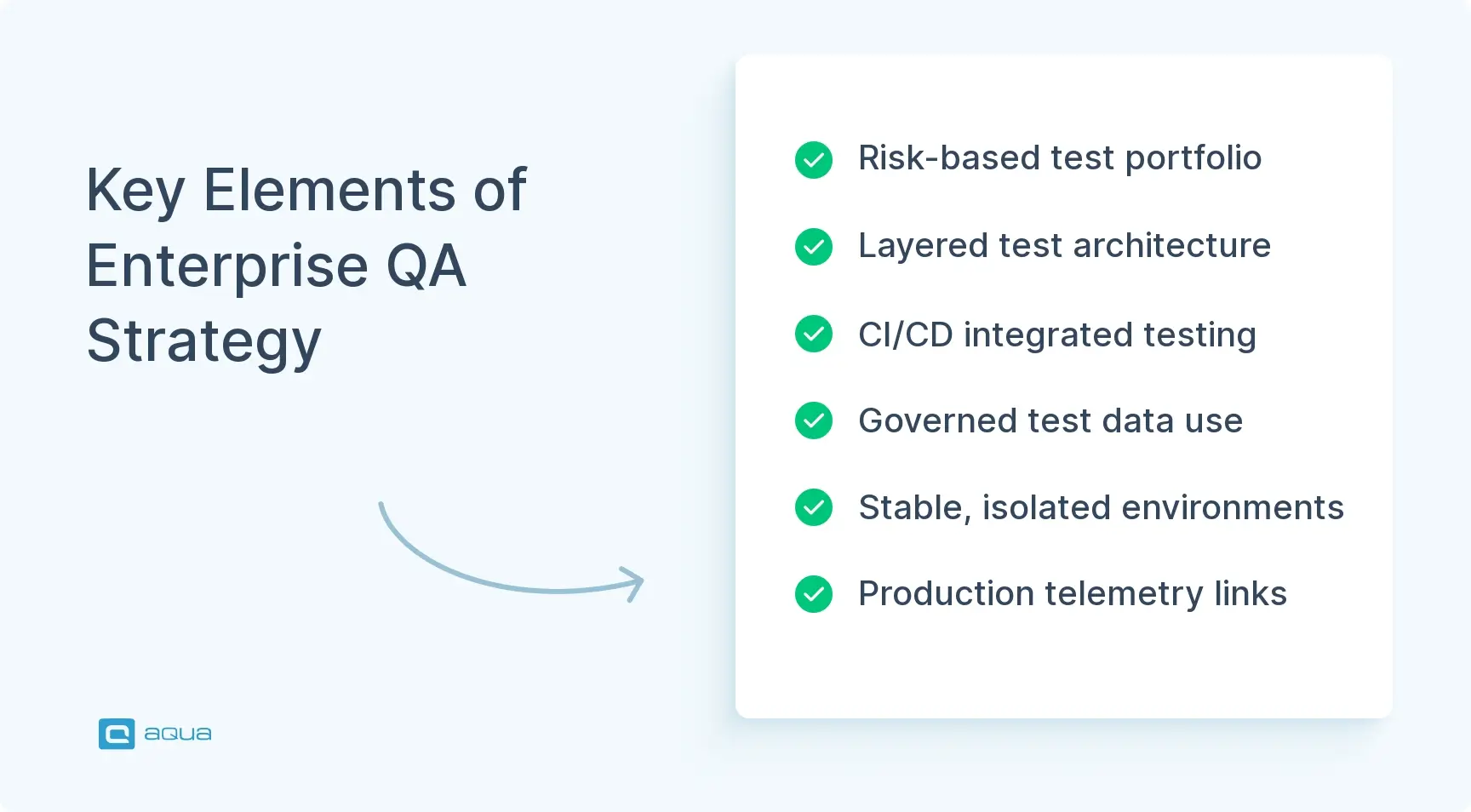
Core Components of an Enterprise Automation Testing Strategy
Building enterprise automation from scratch, or fixing a broken program, means getting these foundational elements right. Miss one, and a scaling problem shows up within six months.
Risk-Based Test Portfolio Design
Business risk should shape the test portfolio before any tool gets picked. Start by mapping critical user journeys and regulatory requirements, then layer in high-change modules, historical defect patterns, and performance risks. The portfolio should track actual release risk rather than backlog size or feature count. If automation covers low-risk flows while high-risk integrations go untested, the suite ends up creating false confidence.
Layered Test Architecture
Push validation down to the fastest, most reliable test layers available. The principle is simple: don’t duplicate coverage across layers. If an API test already validates a business rule, the UI test doesn’t need to check it again.
| Layer |
Purpose |
Speed |
| Unit tests |
Logic errors at the function level |
Seconds |
| Component tests |
Module validation in isolation |
Seconds |
| API tests |
Contract stability, business rules |
Minutes |
| Contract tests |
Service boundary verification |
Minutes |
| Integration tests |
Dependency behavior combined |
Minutes |
| UI end-to-end |
Critical workflow protection |
Longer |
CI/CD Integration at Every Stage
Tests need to run where decisions actually happen. Running the right tests at the right stage is what prevents bottlenecks:
| Stage |
Test Types |
Purpose |
| Pre-commit |
Linting, unit tests |
Catch obvious breaks before review |
| Pull request |
Unit, API, contract |
Fast feedback on change impact |
| CI build |
SAST, security scans, component tests |
Block regressions from merging |
| Nightly |
Regression, performance, compatibility |
Deeper validation without blocking PRs |
| Pre-release |
Full regression, accessibility |
Gate high-risk changes |
| Post-deployment |
Smoke tests, synthetic monitoring |
Catch production issues early |
Governed Test Data Management
The World Quality Report 2025-26 ties automation readiness directly to data strategy. You’ll need:
- Data masking for production-like datasets
- Synthetic data generation for edge cases
- Automated reset mechanisms between test runs
- Role-based access controls on sensitive data
- Environment-specific isolation to prevent cross-contamination
- Audit logs for any use of sensitive datasets
Skip this, and automation either fails from missing data or leaks sensitive information into test logs.
Stable, Predictable Environments
Test instability often comes down to unreliable environments more than broken codebases. Enterprise teams need:
- Ephemeral test environments for branches and pull requests
- Containerized services for consistency across runs
- Service virtualization or mocks for unavailable dependencies
- Infrastructure-as-code validation before environment promotion
- Environment parity between staging and production
Observability and Production Telemetry Integration
Modern testing connects pre-production results with real-world outcomes. OpenTelemetry provides a vendor-neutral framework for traces, metrics, and logs to make that possible. This layer plugs straight into the test strategy, showing which tests protect high-risk production paths and which failures are just infrastructure noise. It also flags which unstable tests are actively damaging release confidence. Over time, production incidents turn into better test coverage, and test results become genuine release readiness signals.
Federated Governance Model
Two failure modes tend to show up in enterprise test ownership: full centralization that slows everyone down, and full decentralization that produces inconsistent frameworks. A practical split looks like this:
| Team |
Owns |
| Central quality platform |
Standards, templates, CI stages, reporting, tool evaluation |
| Product engineering |
Unit, component, API, and contract tests per service |
| QA / quality engineering |
E2E strategy, exploratory testing, regression design, release readiness |
| DevOps / SRE |
Pipeline reliability, environments, synthetic monitoring, performance gates |
| Security / compliance |
SAST/DAST/SCA integration, audit requirements, privacy controls |
This model works because quality becomes infrastructure shared across every team, with no single group left holding full ownership.
It's not the tests that "you can never fully trust" though. Write better tests. If your tests miss problems, you need to have a more thorough understanding of your code and what tests to write. The tests aren't missing anything, you just didn't write a test for that context.
Enterprise Automation Testing Tool Categories
Enterprise testing stacks combine multiple tool types. Here’s how the landscape breaks down when evaluating tooling for enterprise software testing.
1. Test Orchestration and Management: aqua cloud
Before picking individual testing tools, something needs to sit above all of them and tie the results together. A test orchestration platform plays that role, a different job from actually running tests. It manages what gets tested and tracks whether it passed, so when a release manager or auditor later asks for proof, that platform holds the evidence.
aqua cloud fills exactly that role. It sits on top of your unit, API, UI, mobile, and performance tools, pulling results from each into one traceability chain that links back to requirements. Instead of checking five dashboards to answer “are we ready to ship,” you check one. aqua also covers the manual testing side that pure automation tools tend to skip, so exploratory sessions, UAT sign-off, and scripted test cases live in the same system as your automated runs.
Most of the tools listed in the categories below plug directly into aqua, including Jenkins, Azure DevOps, JMeter, and REST API-based frameworks. Results from each layer roll up into one release-readiness view instead of staying scattered across separate systems.
Consolidate automated testing into the best enterprise-grade QA management platform
2. Unit and Component Testing
JUnit, pytest, Jest, and NUnit run fast, deterministic checks at the code level, forming the foundation of the test pyramid. If unit test coverage is weak, no amount of UI automation will make up for it.
3. API and Contract Testing
REST Assured, Postman/Newman, Pact, Spring Cloud Contract, and Karate validate service behavior without spinning up a full UI. That matters because API tests run faster and stay more stable than UI tests, and contract testing keeps producers and consumers aligned even when your teams deploy independently. Postman and REST Assured both support REST API workflows, one of the areas where aqua connects directly for automated result reporting.
4. UI and End-to-End Testing
Selenium WebDriver, Playwright, Cypress, and Puppeteer handle browser automation. These tools protect critical user journeys well, but they run slow and turn brittle when overused. Keep UI coverage focused on workflows and edge cases that lower layers simply can’t test.
5. Mobile Testing
Appium, Espresso, XCUITest, and Detox support native mobile app automation. If your team ships iOS or Android apps, these tools belong in the stack, though mobile test maintenance tends to be demanding. Prioritize smoke tests and critical flows over exhaustive regression.
6. Performance and Load Testing
JMeter, Gatling, k6, and Locust validate response times, throughput, and system behavior under load. Run lightweight performance checks in CI early, then scale up for dedicated load tests before production. Since JMeter is one of aqua’s native integrations, performance results feed directly into the same release dashboard as your functional test results.
7. Security Testing and Static Analysis
OWASP ZAP, Burp Suite, Snyk, SonarQube, Checkmarx, and Veracode automate vulnerability detection, dependency scanning, and code quality checks. NIST’s Secure Software Development Framework and OWASP’s Web Security Testing Guide both recommend weaving security testing into every SDLC phase, treating it as a continuous checkpoint rather than a one-off audit.
8. Accessibility Testing
Axe, Pa11y, Lighthouse, and WAVE validate WCAG 2.2 compliance. Automated accessibility checks are good at catching low-hanging fruit: missing alt text, color contrast issues, keyboard navigation defects.
9. AI-Augmented Testing Platforms
Tricentis Tosca, mabl, Testim, Sauce Labs, BrowserStack, and Functionize offer AI-assisted test generation and self-healing UI locators. Several also handle test impact analysis and enterprise application testing for SAP, Salesforce, ServiceNow, and similar platforms. Gartner’s 2025 Market Guide points to growing demand here, largely because enterprises need higher release cadence and coverage while still managing complex compliance requirements.
10. Test Data and Service Virtualization
Delphix, GenRocket, Mockaroo, and WireMock generate synthetic data, mask production data, and mock unavailable dependencies. Test data management remains one of the biggest constraints in enterprise automation. If tests fail because data’s missing or stale, tooling elsewhere won’t fix that defect.
11. Observability and Monitoring
Datadog, New Relic, Dynatrace, Grafana, and OpenTelemetry-based solutions connect test results with production telemetry. Once observability feeds into the test strategy, automation priorities can follow real incident patterns instead of guesswork.
12. CI/CD and Pipeline Orchestration
Jenkins, GitLab CI, GitHub Actions, Azure DevOps, CircleCI, and TeamCity run your tests at the right pipeline stages. Both Jenkins and Azure DevOps connect natively with aqua, so pipeline results sync automatically into the same reporting layer as manual and other automated test results.
Don’t chase every new platform on the market. Pick enterprise software testing tools that align with your architecture and team skills, and fit your compliance requirements and business risk. Even the best tool won’t save a bad test strategy.
Best Enterprise Automation Testing Tools
If you’re evaluating enterprise testing software, here’s a shortlist of platforms that handle scale, governance, and compliance without collapsing under maintenance cost. This list focuses on what actually works in distributed, regulated, and fast-moving environments.
Test Orchestration
Once the individual tools are in place, results still need somewhere to converge. aqua cloud does this by connecting to most of the tools above, so unit results, API results, UI runs, and performance data all show up in one release-readiness dashboard instead of five disconnected ones. Although aqua cloud is not an automation tool by itself, it serves as a managing environment that can have an automation solution of your choosing directly integrated into.
With aqua, you have an orchestrated platform, enterprise-grade automation provided through a solution of your choosing, and test case generation capabilities on top of it.
Boost QA efficiency by 80% with aqua’s Intelligence
UI and Browser Automation
Selenium WebDriver remains the standard for cross-browser coverage with broad integration support. Playwright and Cypress offer faster feedback loops and a noticeably better developer experience for modern stacks. Selenium makes sense when maximum browser coverage matters most, while Playwright or Cypress work better when stability and speed take priority over breadth.
API and Contract Testing
Postman/Newman handles exploratory checks, collection-based regression suites, and CLI integration. REST Assured offers Java-based fluent syntax for complex API validation. Pact rounds out the picture with consumer-driven contract testing for your microservice teams, catching integration failures before they reach shared environments.
Unit and Component Testing
JUnit, pytest, and Jest are table stakes. If critical module coverage sits below 70%, the program isn’t enterprise-ready yet. Unit tests give the fastest, most reliable quality signal in the stack, and they form the base of every sound test architecture.
Performance Testing
JMeter has broad community support and handles complex load scenarios well. k6 offers modern JavaScript-based scripting with cleaner CI/CD integration. Both handle load generation, response time validation, and distributed execution at scale.
Security and Static Analysis
SonarQube catches code quality issues and security hotspots. Snyk scans dependencies for known vulnerabilities. Both integrate into CI pipelines and provide remediation guidance alongside findings.
AI-Augmented Enterprise App Testing
For SAP, Salesforce, ServiceNow, Oracle, or Workday environments, Tricentis Tosca and mabl accelerate authoring and reduce maintenance. Tosca provides model-based test design and self-healing, while mabl offers low-code creation, auto-healing, and visual regression. Both platforms support large-scale execution, governance, and reporting.
Cloud Device Testing
BrowserStack and Sauce Labs validate behavior across browser/OS combinations and real mobile devices without maintaining a device lab. Both integrate with Selenium, Appium, Playwright, and Cypress.
Observability and Synthetic Monitoring
Datadog and New Relic connect test results with production telemetry, enabling correlation between coverage defects and production incidents. When this layer feeds the test strategy, incident patterns drive automation priorities.
How to Choose the Right Enterprise Testing Tool
Picking the wrong tool gets expensive fast. Months go into onboarding, framework-building, and training, only to discover the tool doesn’t fit the architecture or needs so much maintenance that the QA team ends up running an unofficial framework support desk. Here’s how to make a smarter call.
Match the Tool to Your Architecture
Your stack should guide the decision more than any vendor’s feature list. Consider:
- Are you running microservices or a monolith?
- Is your frontend React, Angular, or Vue?
- Do you need contract testing across many services?
- Are there third-party dependencies that require mocking?
A UI-heavy tool won’t scale for API contract testing across 100 services, and a Selenium-based platform won’t help much with headless service validation either.
Evaluate CI/CD Compatibility
Check for CLI support, container compatibility, parallel execution, and solid test result reporting, plus pipeline failure triggers. Enterprise testing runs in pipelines, so if the tool doesn’t integrate cleanly with your Jenkins, GitLab CI, GitHub Actions, or Azure DevOps setup, it won’t function as delivery infrastructure.
Check Governance and Compliance Features
If your team works in healthcare, finance, or government, these should sit at the top of the evaluation criteria:
- Can the tool log test execution for audits?
- Does it support role-based access controls?
- Can test results trace back to requirements?
- Does it handle sensitive test data securely?
Assess Maintenance Overhead
Self-healing locators and AI-assisted updates need governance. Ask vendors:
- Can you review what the tool auto-fixed?
- Does it log locator changes?
- Can bad auto-updates be reverted?
A tool that silently heals broken tests may keep the suite green while the application is actually broken.
Validate at Scale During the PoC
Before committing, confirm the tool handles real volume. Key thresholds to test:
- 10,000+ tests running in parallel
- Distributed execution across cloud and on-prem environments
- Full regression suite completion within your pipeline time budget
If a full suite takes eight hours to run, daily deployment isn’t realistic, no matter what other capabilities the tool has.
Calculate Total Cost of Ownership
License fees are only one line item. Factor in infrastructure costs, training and ramp-up time, framework development effort, test data tooling, and ongoing maintenance for unstable tests. A free open-source tool can end up costing more than a commercial platform if it needs dedicated engineers just to keep it running.
How to Implement Enterprise Test Automation: A Phased Roadmap
Building enterprise-grade automated testing unfolds across multiple phases over many months. Rush it, and the result is brittle scripts nobody trusts. Here’s a roadmap that balances speed with sustainability.
Phase 1: Assessment and Strategy (4-8 Weeks)
Understand the current state and risk profile before writing a single test.
Map and inventory:
- Current testing process and coverage defects
- Business-critical workflows and their defect history
- Automation coverage rate and test failure consistency
- CI/CD pipeline stages and test execution points
- Compliance, security, and regulatory requirements
Deliverables: Automation maturity assessment, risk-based test strategy, tool and architecture recommendations, KPI baseline, 6-12 month roadmap.
Phase 2: Foundation (8-12 Weeks)
Lay the infrastructure before writing tests. This phase determines whether the program scales or stalls.
Build:
- Coding standards for automated tests
- Reusable framework templates
- CI/CD test stage integration
- Reporting dashboards
- Test data playbook
- Environment stabilization plan
- Test reliability governance policy
Deliverables: Working automation framework, CI test stages, test data playbook, quality dashboard, ownership matrix.
Phase 3: Pilot (12-16 Weeks)
Pick one product, value stream, or critical journey. The pilot should be significant enough to show business value but contained enough to avoid enterprise-wide complexity.
Automate:
- Critical unit, API, contract, and UI tests
- Smoke checks in the deployment pipeline
- Performance baselines for critical paths
- Basic security and accessibility checks
Measure: Defect leakage rate, test execution time, release confidence score.
Deliverables: Working automation suite, release-readiness dashboard, pilot ROI analysis, lessons learned.
Phase 4: Scale (6-12 Months)
Roll out the framework and standards across your teams.
Execute:
- Train developers, QA engineers, and product team members on the framework
- Consolidate overlapping tools across product teams
- Introduce AI-assisted test generation where it adds coverage
- Standardize dashboards across products
- Expand contract testing and service-level validation
- Integrate production telemetry into test prioritization
Deliverables: Enterprise automation platform, standardized governance, portfolio-wide reporting, reusable test assets, risk-based release gates.
Phase 5: Optimize (Ongoing)
Once at scale, the focus shifts to continuous improvement.
Ongoing work:
- Test impact analysis to run only affected tests per change
- Suite runtime reduction
- Improved detection of unreliable tests, with quarantine for repeat offenders
- Synthetic data expansion
- Selective autonomous maintenance
- Quarterly automation ROI reviews
Deliverables: Optimized test portfolio, lower maintenance cost, stronger release confidence, continuous improvement backlog.
You’ve seen the roadmap and now understand why enterprise automation often fails without governance and CI/CD integration. To get started with a proper procedure, you should consider aqua cloud, an AI-driven test and requirement management platform designed for exactly this challenge. aqua gives you centralized test management, AI-powered test case generation that saves authoring time, and real-time traceability across requirements and defects in one unified system. What makes aqua different from generic AI tools? Its Intelligence AI uses RAG grounding with your own project documentation, so every generated test case is contextually accurate and aligned with your domain-specific rules, built from your real project context. You get role-based governance, compliance-ready audit trails (ISO 27001, GDPR, FDA 21 CFR, SOX), seamless Jira and Azure DevOps sync, and a framework that scales across distributed teams well.
Cut 98% of test authoring time with advanced Intelligence AI by aqua
Conclusion
Enterprise-grade test automation functions as delivery infrastructure. Here, solutions that work should utilize layered architecture, CI/CD integration, governed test data, and stable environments. On top of that, security checks and AI-assisted optimization should be built. The foundation underneath is risk-based strategy and federated governance, with metrics tied to real business outcomes. Get that right, and the team ships faster, absorbs AI-generated code more safely, and meets rising expectations for reliability and compliance. Get it wrong, and a green CI dashboard becomes a signal that no longer means what it should.