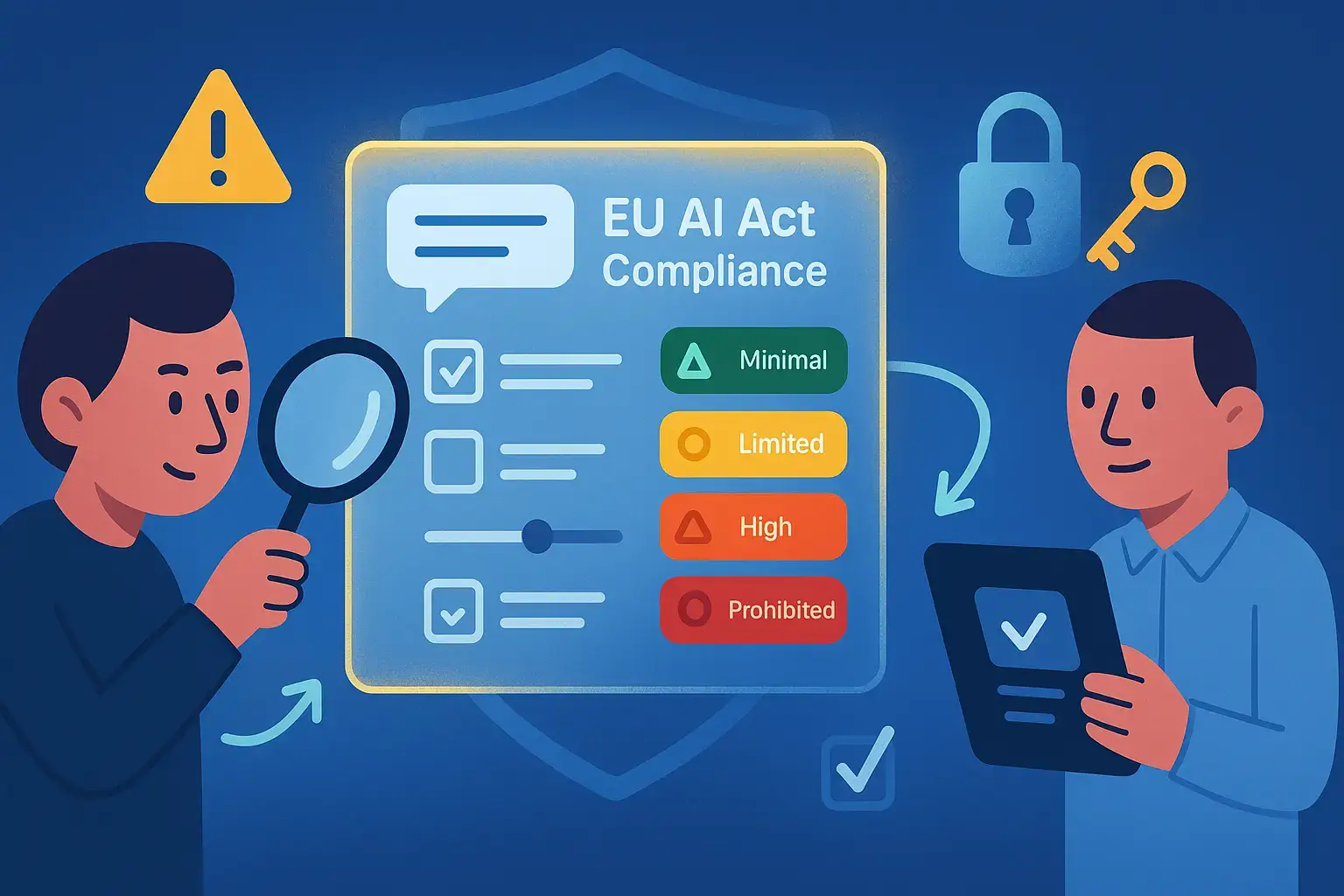
The EU AI Act is in force, and if your team is building or deploying AI systems in Europe, compliance is not optional. But figuring out exactly where your AI sits in the risk spectrum is where most teams get stuck. High-risk? Minimal? Prohibited outright? The stakes are concrete: fines reaching up to €35 million or 7% of global revenue for non-compliance. The EU AI Act Compliance Checker is a free tool designed to help QA teams, developers, and product managers quickly assess whether their systems fall under the Act's regulatory scope. It will not replace legal counsel, but it gives you a defensible starting point and helps you avoid costly missteps early in development.
Having the right testing infrastructure is crucial, and not just for initial assessments but for ongoing compliance management. This is where aqua cloud truly shines as a comprehensive test management platform. While tools like the EU AI Act Compliance Checker provide valuable initial guidance, aqua cloud’s robust traceability between requirements, test cases, and results creates the documentation backbone needed for regulatory evidence. With aqua’s AI Copilot, you can rapidly generate compliance-focused test cases that target specific risk areas identified in your preliminary assessment, saving up to 97% of your testing time while maintaining the audit trails regulators expect. The platform’s custom fields and workflows allow you to incorporate EU AI Act risk classifications directly into your testing strategy, ensuring high-risk AI components receive appropriate coverage and documentation.
Achieve continuous compliance with domain-intelligent testing that adapts to evolving AI regulations
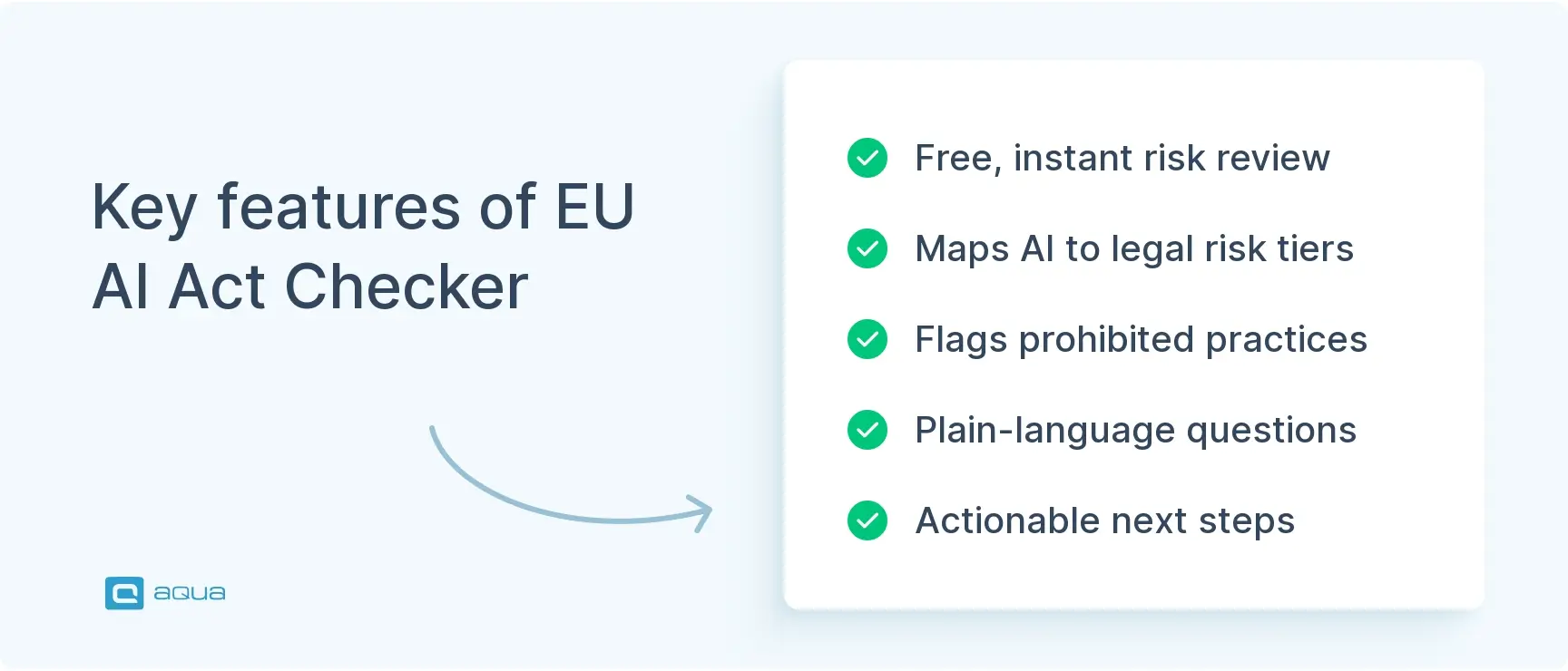
The AI act compliance checker runs your AI system through a structured questionnaire that maps its characteristics against the Act’s risk categories and prohibited practices. You answer targeted questions about your system’s purpose, data inputs, decision-making processes, and deployment context. The tool cross-references your responses with Annex III, which covers high-risk use cases, and Article 5, which defines prohibited practices.
If you are building a recruitment tool that scores candidates, the checker flags it as high-risk because it directly influences employment decisions. If your chatbot applies subliminal techniques to influence user behaviour, it flags that as prohibited under Article 5. The AI act checker translates regulatory language into plain questions. Instead of asking whether your system performs “biometric categorization,” it asks: “Does your AI identify people based on physical traits like face shape or gait?” That translation layer is what makes the tool practical for QA professionals without a legal background.
Feedback is immediate. You get a preliminary risk assessment within minutes alongside recommended next steps. If your system is flagged as high-risk, the checker points toward specific technical documentation requirements, conformity assessment obligations, and quality management controls you will need to address. For teams applying a risk-based testing approach, knowing your classification before test planning begins means you allocate coverage where the regulatory burden actually falls rather than discovering gaps during pre-release.
If your team is building or testing AI systems in Europe, aqua cloud is hosting a free 20-minute session on the five QA requirements the EU AI Act mandates and what auditors will actually ask for: EU AI Act webinar. It covers what audit-ready documentation looks like in practice, straight from aqua’s Chief Growth Officer and legal counsel.
What Does the EU AI Act Compliance Checker Tool Cover?
The EU AI act compliance checker tool focuses on three areas: risk classification, prohibited practices, and transparency obligations.
Risk classification is the foundational output. It determines whether your AI system falls into the minimal-risk category, such as spam filters, the limited-risk category requiring disclosure obligations, the high-risk category covering credit scoring, hiring tools, and law enforcement AI, or the prohibited category covering social scoring by public authorities and real-time biometric surveillance in public spaces. The checker walks through use case scenarios tied directly to the Act’s annexes so you are not left guessing whether your predictive maintenance algorithm counts as high-risk. In most cases it does not, unless it is directly tied to worker safety decisions.
Prohibited practices receive specific scrutiny because violations in this category carry the highest penalties and there is no compliance pathway once a system crosses that line. The checker tests whether your system engages in manipulative techniques, exploits vulnerabilities of specific groups, or deploys untargeted biometric surveillance. An AI that adjusts insurance premiums based on emotion detection from voice analysis, for example, raises conflicts with Article 5’s manipulation prohibitions that the tool will surface immediately.
Transparency obligations round out the assessment. Disclosure requirements for deepfakes, AI-generated content, and emotion recognition systems are evaluated against your system’s outputs. If your chatbot does not reveal it is a bot, that is a compliance gap the EU AI act checker will catch before it becomes a regulatory problem.
Coverage Area
What It Checks
Why It Matters
Risk Classification
Maps your AI to minimal, limited, high-risk, or prohibited categories
Determines your compliance burden and testing requirements
Prohibited Practices
Flags manipulation, exploitation, and biometric surveillance violations
Prevents deployment of illegal AI systems
Transparency Obligations
Identifies disclosure requirements for users interacting with AI
Ensures legal deployment and user trust
Who Is This Tool For?
QA engineers testing AI systems should treat this as a reconnaissance step before building test plans. Knowing whether your system is high-risk tells you whether your regression suites need to include bias detection, explainability checks, or human oversight mechanisms, all of which become mandatory requirements rather than optional quality additions for high-risk systems. Running the assessment before sprint planning begins means test strategy decisions are grounded in regulatory reality from the start.
Product managers benefit during roadmap planning. Discovering your AI is high-risk in month one changes your go-to-market timeline and budget in ways that discovering it in month six does not. The earlier the classification is known, the more options your team has for addressing it.
Developers integrating AI in software testing pipelines and third-party AI components should also run those components through the EU AI act checker. Liability does not stop at vendor contracts. If you are deploying a third-party facial recognition SDK in your application, your organization carries regulatory exposure if it violates the Act regardless of where the component originated.
Legal and compliance teams find the tool valuable as a screening layer before engaging external auditors or notified bodies. It helps prioritize which systems need immediate legal review versus those that can proceed with standard documentation. For startups and SMEs without in-house counsel, the checker provides a preliminary read on compliance risk without requiring expensive legal consultations at the earliest stages of development.
While the EU AI Act Compliance Checker helps identify where your AI system stands within the regulatory framework, sustained compliance requires robust test management processes that aqua cloud delivers seamlessly. With comprehensive requirements traceability, automated documentation, and AI-powered test generation, aqua cloud forms the backbone of an effective compliance strategy. The platform’s unified approach eliminates compliance silos by connecting your test artifacts with regulatory requirements, providing instant visibility into coverage gaps that could pose risk. What truly sets aqua apart is its domain-trained AI Copilot that understands your project context, generating test cases specifically aligned with your risk profile and compliance needs; unlike generic AI tools that lack this grounding in your documentation. For QA teams supporting high-risk AI systems, this means you can demonstrate that appropriate testing was conducted, human oversight was implemented, and technical documentation meets Article 11 requirements—all from a single platform that scales with your regulatory needs.
EU AI Act deadline approaching. See aqua's AI-powered testing in action
The alternative is building toward a regulatory target you cannot see clearly. The EU AI Act is the world’s first comprehensive AI regulation and it is setting the global standard, with similar frameworks already emerging in Canada, Brazil, and China. Penalties are not theoretical. Up to €35 million or 7% of annual global turnover for prohibited AI systems, and up to €15 million or 3% for high-risk violations. In many cases those figures exceed comparable GDPR penalties.
Beyond avoiding fines, there is a competitive dimension. Organizations that demonstrate compliance early build trust with enterprise clients in regulated sectors including healthcare, finance, and public services. EU-based buyers are increasingly requiring proof of Act compliance during vendor procurement. Running systems through the ai act compliance checker and documenting the results demonstrates due diligence at exactly the point in a sales process where it matters.
On the operational side, the checker’s output feeds directly into technical documentation, which is a mandatory requirement for high-risk systems under Article 11. Knowing your classification from the start means documentation work begins at the right scope rather than being retrofitted later. That is what aqua cloud compliance infrastructure is built to support: not just initial assessment, but the ongoing evidence management that regulators will expect to see.
The EU AI act compliance checker uses a guided questionnaire that evaluates your AI system against the Act’s risk framework and prohibited practices list. You provide details about your system’s functionality, data sources, and intended use cases, and the tool maps those characteristics against specific articles and annexes in the legislation. It determines whether your system qualifies as minimal risk, limited risk, high-risk, or prohibited, and identifies any transparency obligations that apply. The output includes a preliminary risk assessment and recommended next steps. It is not a substitute for formal legal review or notified body conformity assessments, but it provides a structured starting point that is immediately actionable for development and QA teams.
Who should use the EU AI Act Compliance Checker?
QA engineers, AI developers, product managers, compliance officers, and startup founders building or deploying AI systems targeting EU markets should all use the ai act checker as a standard part of their development process. It is particularly valuable for teams without dedicated legal resources who need an initial compliance read before commissioning deeper audits. Third-party vendors integrating AI components into larger systems should also run assessments to understand their downstream liability exposure. The tool is designed to be accessible to people without legal training, so any team member involved in scoping, building, or testing AI systems can use it productively without specialized knowledge of the Act’s regulatory text.
Can this tool tell me whether my AI system is considered high-risk under the EU AI Act?
Yes, with an important qualification. The EU AI act compliance checker tool cross-references your system’s characteristics against Annex III high-risk categories, which cover biometric identification, critical infrastructure management, employment decisions, educational assessment, law enforcement tools, access to essential services, and border control. For most systems, the checker provides a clear preliminary classification. Edge cases and novel AI applications that do not map neatly to existing categories may require interpretation by legal experts or notified bodies, particularly for borderline systems where the deployment context is the determining factor rather than the underlying technology. The tool gives you a strong and defensible starting point. Final high-risk determination for complex or ambiguous cases should involve qualified legal counsel familiar with how the Act is being interpreted in your specific EU member state.
Nurlan, a QA Coordinator & Quality Standards Officer, takes pride in orchestrating seamless QA operations. His expertise in coordinating QA-focused projects and integrating QA solutions has consistently yielded top-tier client satisfaction. Aside from a full-time QA coordinator, Nurlan's role involves creating compelling content that educates…
Robert has several years of experience in process optimisation and test management. He is an expert in defining and implementing workflows by adapting aqua to the clients’ processes.
Join our community of enthusiastic experts! Get new posts from the aqua blog directly in your inbox. QA trends, community discussion overviews, insightful tips — you’ll love it!
We're committed to your privacy. Aqua uses the information you provide to us to contact you about our relevant content, products, and services. You may unsubscribe from these communications at any time. For more information, check out our Privacy policy.
X
🤖 Exciting new updates to aqua Intelligence are now available! 🎉