This free Flaky Test Diagnosis Tool walks you through a structured analysis: select your test framework, check off the defects, add optional context, and click “Diagnose”. You get a root cause with a confidence rating, 2-3 probable causes ranked by likelihood with plain-English explanations, a step-by-step fix checklist, and code examples in your framework. No sign-up or installation required.
If flaky tests are disrupting your CI pipeline, detection alone won’t solve the problem. aqua cloud, an AI-powered test and requirements management platform, offers a unified environment where flaky test diagnosis is part of a broader quality strategy. Execution tracking across environments, centralized test results, and aqua’s AI Copilot, trained on your project’s own documentation and test suite, help your team identify failure patterns, generate stable test cases, and flag which existing tests are likely to become problematic. The AI Copilot generates test cases 98% faster than manual methods and saves testers over 12 hours per week, according to aqua’s published benchmarks. The platform connects with Jira, Azure DevOps, Jenkins, Selenium, Confluence, and 12+ other tools from your tech stack, so all results feed into one place for unified stability analysis.
Eliminate flaky tests with aqua's AI-powered test management platform
How Does the Free Flaky Test Diagnosis Tool by aqua Work?
The tool runs entirely in your browser, with no backend calls or account required. It matches your chosen defect profile against a built-in database of flakiness patterns and returns a diagnosis instantly.
Getting started takes three steps:
Select your framework. Choose from Jest, Cypress, Playwright, Pytest, Selenium, JUnit, RSpec, or Other. Code examples in the results match your selection.
Check your symptoms. Options include “Passes locally, fails on CI,” “Fails randomly, no code change,” “Fails in full suite, passes alone,” “Timeouts or very slow runs,” “Element not found / click fails,” “Database or API state issues,” “Async / promise errors,” and “Passes immediately on retry.” Select everything that applies to your situation.
Add optional context. Describe the failing test in your own words to refine the diagnosis.
Five pre-built example scenarios are available if you want to explore results without typing: Cypress login form flakiness, Jest Async race condition, Pytest Database state leaking, Selenium Checkout timeout, and Playwright CI-only failure.
It's kinda like feature development. No one intends to write bugs, and there are ways to mitigate bugs. Same thing with flaky tests, no one intends to write them, and there are ways to mitigate them.
Root cause with confidence rating. The most likely explanation for the symptoms you selected, scored by how well it matches your profile.
“Try this first” quick action. A single recommended starting point before working through the full checklist.
2-3 probable causes ranked by likelihood. Each includes a plain-English explanation, a tickable fix checklist, and before/after code examples in your framework.
Step-by-step fix strategy. A structured path through the diagnosis, ordered by impact.
All diagnosis logic is pre-written expert content matched to your symptom profile. Results appear instantly, with no network dependency. This tool shows you how structured flaky test diagnosis works. Once your team has identified root causes, the next challenge is tracking fixes, retesting, and connecting that work to your broader test coverage.
Flaky tests produce inconsistent results, passing on one run and failing on the next, with no code changes between executions. The failure reflects test instability. A test that fails intermittently without a code change is signaling an environment or timing problem, not a regression. Over time, a suite full of false alarms erodes confidence in your CI pipeline and makes it easier for real defects to slip past unnoticed.
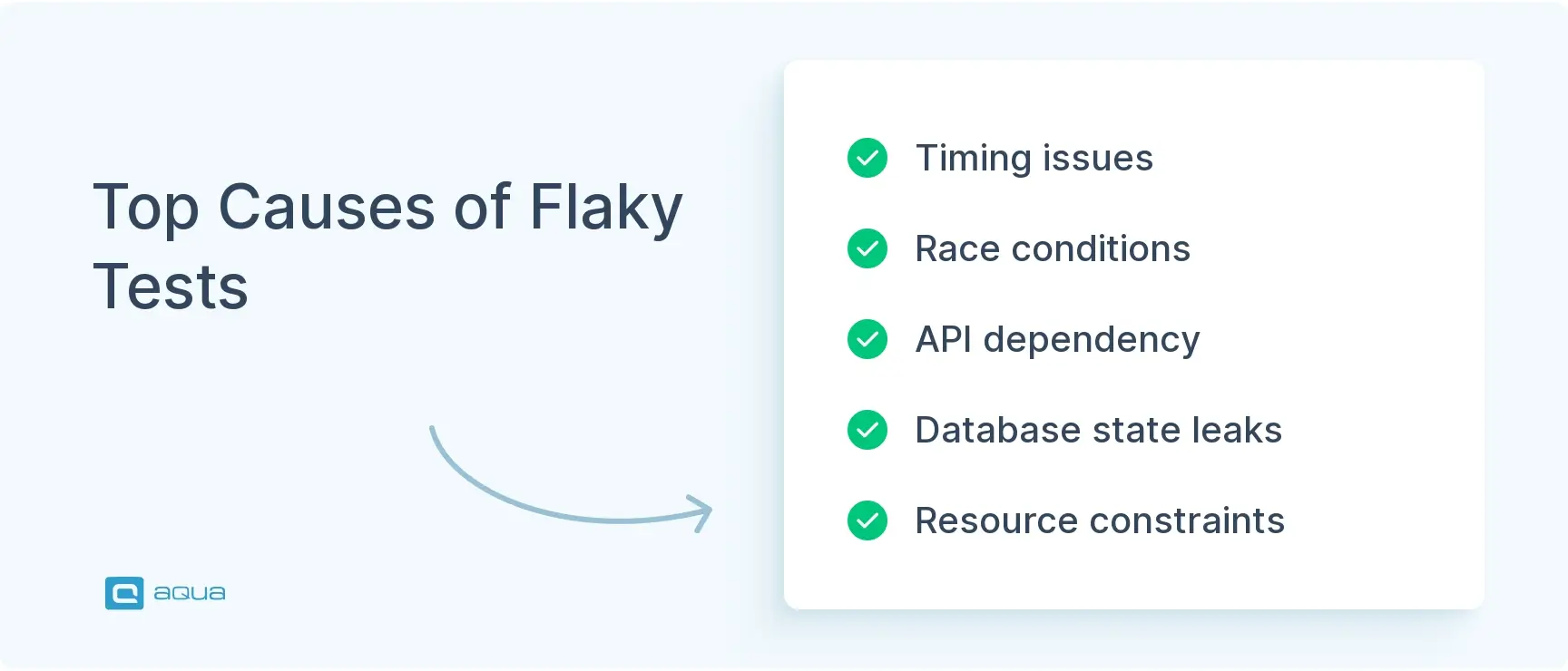
The causes follow predictable patterns:
Timing issues. A test expects an element to load in 2 seconds, but the network occasionally takes 2.1 seconds. The test fails.
Race conditions. Two operations compete for the same resource. The outcome depends on which finishes first.
Environmental dependencies. Tests that rely on external APIs, shared databases, or system states not properly isolated between runs.
Resource constraints. A 2024 IEEE Transactions on Software Engineering study across 52 Java, JavaScript, and Python projects found that 46.5% of flaky tests are resource-affected. In those cases, CPU or memory availability at runtime directly influences whether they pass or fail.
A practical example: You are testing a checkout flow that calls a payment gateway. Your test fires a request, waits 3 seconds, then checks whether the transaction completed. Most of the time it works. Occasionally, the gateway takes 3.2 seconds due to server load. The test fails, the build is flagged as broken, and someone spends 20 minutes confirming the code is fine. A 2024 ICST industry study analyzing five years of CI development history found that time spent dealing with flaky tests represents at least 2.5% of productive developer time. For QA-heavy teams, TestDino’s 2026 benchmark report, citing LambdaTest survey data, puts that figure closer to 8%.
Why Flaky Test Detection Matters
When your CI pipeline shows red, the right response is to stop and investigate. Once half of those failures routinely turn green on retry, teams learn to skip that step. That habit is where real bugs start slipping through. The test suite was supposed to catch problems, and when it produces constant false alarms, it stops being useful.
The financial impact is concrete. At Google’s documented 2% rate, flaky test investigation costs a 50-person team roughly $120,000 annually in lost productivity, per TestDino’s benchmark analysis. The Bitrise Mobile Insights 2025 report, based on over 10 million builds across 3.5 years, found that the share of teams experiencing CI/CD pipeline challenges from test flakiness grew from 10% in 2022 to 26% in 2025. That is a 160% increase in three years. The same report found that teams using monitoring tools experienced 25% fewer flaky reruns, a clear payoff for investing in proper detection tooling.
On top of direct productivity loss, SD Times reported that this rise in flakiness is not happening in isolation. Mobile pipelines have grown over 20% more complex in three years, with teams running broader test suites earlier and more often. Every additional integration point introduces another potential source of instability.
Flaky tests provide a false sense of safety with automatic regression. Flaky tests waste time and resources. As much as I hate to admit it, some manual testing and the practice of doing manual regression had value too.
Flaky tests block CI pipelines and force poor choices. Teams rerun builds constantly, or they implement automatic retries that can mask genuine failures. Neither approach is sustainable.
Over time, this creates a predictable pattern:
Developers skip local test runs.
Reviewers approve code without green checks.
Quality guardrails erode quietly.
Microsoft addressed this directly with a company-wide policy to fix or remove flaky tests within two weeks. The result was an 18% reduction in flakiness in six months and a 2.5% increase in developer productivity, per TestDino’s benchmark report, citing Microsoft’s published findings.
Most teams know they have flaky tests but address them ad hoc, with no systematic record of causes or fixes. A structured diagnosis process gives your team the data to make specific decisions:
Which tests need immediate fixes?
Which can be safely quarantined during investigation?
Which environmental factors are responsible for the most instability?
Startups evaluating their testing stack should factor this in early. Getting a handle on flakiness before it compounds is part of choosing a test tool for your startup that can grow with the codebase.
Detecting flaky tests is necessary, but managing them inside a complete testing ecosystem is what produces lasting reliability. aqua cloud goes beyond identifying unstable tests and provides the infrastructure to address them at their source. The platform integrates with your existing CI/CD pipeline and captures detailed execution histories that reveal patterns behind flaky behavior. aqua’s AI Copilot, trained on your project’s documentation and test context, delivers insights into test stability grounded in your actual codebase. Customizable dashboards visualize failure patterns across environments, helping your QA team prioritize fixes by real impact. All test artifacts live in one system with full versioning and audit trails, so you can trace exactly when and why a test became unstable. And with Capture, aqua’s bug reporting software, every flagged test feeds directly into your defect workflow with video, screenshots, and technical context already attached.
Boost your QA efficiency by 80% by eliminating flaky tests
Using a flaky software test diagnosis tool is a starting point. The patterns you find through structured analysis, whether timing issues, environmental drift, or poorly isolated dependencies, improve your testing approach well past the individual fixes. Use the tool above to work through your current suspect tests. Many intermittent issues have systematic causes with clear, fixable solutions. Managing the results, tracking fixes, and connecting coverage to requirements is where a dedicated test management platform keeps your team organized as the work scales.
Run the same test multiple times without changing code. If it passes sometimes and fails others, that indicates flakiness. Most tools use rerun-based detection, with 5 to 10 executions as a solid baseline, combined with historical CI pipeline analysis. Look for tests with intermittent failures that succeed on retry, or those with high variance in execution time. Statistical methods calculate a flakiness score based on pass/fail patterns over N runs, helping you prioritize which tests to address first.
What is the flaky test rate?
The flaky test rate measures the percentage of your test suite that shows inconsistent behavior. Calculate it as (number of flaky tests / total tests) x 100. Figures vary across teams. The Bitrise Mobile Insights 2025 report found that 26% of teams now experience measurable flakiness. A healthy internal target is below 2%, though zero is the goal.
What metrics are most effective in tracking flaky test occurrence over time?
Tests that flake at predictable times often point to shared resource contention during peak load, while spikes after specific pull requests usually indicate a clearer starting point. Three metrics tend to be most useful: flakiness score, which measures variance in pass/fail results across runs; failure clustering patterns, which group tests sharing a root cause; and retry success rate, which tracks how often a failed test passes on immediate rerun. Tracking all three across your CI history shows whether flakiness is growing, stabilizing, or tied to specific codebase changes.
How can integration of flaky test detection tools improve continuous integration pipelines?
Detection tools let you automatically quarantine flaky tests, preventing them from blocking deployments while the investigation continues. This keeps pipelines reliable without sacrificing test coverage. Modern tools also surface root cause hints, such as timing issues and environmental factors, helping your team address root causes directly.
Can flaky tests cause real bugs to go undetected?
Yes. When teams grow accustomed to ignoring intermittent failures, genuine regressions can get dismissed as noise. A real bug that triggers a pattern resembling known flakiness may never get investigated. Systematic detection and quarantine processes ensure every failure gets categorized correctly, so actual defects do not disappear into the background of unstable tests.
How many test reruns are needed to reliably identify a flaky test?
Five to ten reruns are a practical starting point for most test suites. Tests that flake infrequently, once in twenty runs, for example, require more executions to surface reliably. For high-stakes or high-frequency tests, running 15 to 20 iterations produces a statistically meaningful flakiness score and reduces the risk of misclassifying a consistently failing test as intermittent.
Robert has several years of experience in process optimisation and test management. He is an expert in defining and implementing workflows by adapting aqua to the clients’ processes.
Nurlan, a QA Coordinator & Quality Standards Officer, takes pride in orchestrating seamless QA operations. His expertise in coordinating QA-focused projects and integrating QA solutions has consistently yielded top-tier client satisfaction. Aside from a full-time QA coordinator, Nurlan's role involves creating compelling content that educates…
Pavel, a Quality Assurance Consultant and Author, brings deep expertise to solving complex testing challenges. His background in software development has helped organizations transform their QA practices from reactive to proactive. Beyond consulting, Pavel develops best practice guides and case studies for aqua cloud that…
Join our community of enthusiastic experts! Get new posts from the aqua blog directly in your inbox. QA trends, community discussion overviews, insightful tips — you’ll love it!
We're committed to your privacy. Aqua uses the information you provide to us to contact you about our relevant content, products, and services. You may unsubscribe from these communications at any time. For more information, check out our Privacy policy.
X
🤖 Exciting new updates to aqua Intelligence are now available! 🎉