Test Coverage Gap Analyser: Free Tool for Software Testers
The free Test Coverage Gap Analyser below works in three steps: paste your source code or an existing test file (up to 3,000 characters), click Analyse Coverage, and get an instant breakdown of detected gaps, severity ratings, and generated test stubs matched to your language. Load one of four built-in example scenarios or input your text cases or code. No sign-up or installation required.
Paste your code or existing tests → instant gap analysis with generated test stubs
1
Input
2
Analysis
Zero coverage detection.Counts test function patterns (def test_, @Test, it(), @test). If none are found, all gaps are raised to Critical regardless of source complexity.
Error path coverage.Checks for try/catch, raise, throw, and rescue in source code. Flags as a gap when no matching toThrow, assertRaises, pytest.raises, or assertThrows assertion exists in the test section.
Boundary & null input testing.Detects input validation and null guards (length checks, regex, is None, != null). Flags when no test exercises null, empty, or out-of-range values.
Authentication failure scenarios.Identifies JWT, token, and auth-related code. Flags when no test covers missing, expired, or invalid credentials (no 401/403/unauthorized assertions found).
External dependency mocking.Detects real HTTP calls, database operations, and email sends. Flags when no mock, stub, patch, or intercept is found in the test section, which leads to slow and flaky tests.
Async rejection handling.Flags async/await and Promise-based code when no test asserts rejection, timeout, or error propagation (no rejects, assert_raises async, or CompletableFuture failure found).
Environment variable hardening.Detects process.env, os.environ, ENV[], and getenv() reads. Flags when no test verifies graceful failure on a missing or malformed variable.
Source vs test split.All patterns are evaluated separately: source code is scanned for what should be tested, the test section for what is tested, preventing test code itself from masking gaps in the source.
1. Paste your code or tests
— source file, test file, or both (up to 3 000 characters)
0 / 3000 characters
↓ Load an example scenario
Jest: Node.js JWT middleware
Pytest: User registration service
BATS: Bash deployment script
Jest: Well-covered utility
Track coverage trends across your whole test suite
aqua cloud surfaces gaps across test cases, links requirements to coverage, and integrates directly with your CI/CD pipeline.
A test coverage gap is any part of your application, requirement, or workflow that isn’t adequately tested, or not tested at all. Think of it as the blind spot in your QA process. You might have hundreds of automated tests running in CI, but if none of them validate how your payment flow handles network timeouts, that’s a gap in test coverage. The real problem is that the right tests don’t exist where they need to.
Test coverage gaps in testing typically appear for a few recurring reasons:
A requirement added late in the sprint with no corresponding test cases written
Legacy code modified without updating traceability to the original specifications
Solid line coverage in unit tests but no validation of critical edge cases, like duplicate form submissions
Scope changes mid-sprint that never get reflected in the test suite
Traditional metrics like line or branch coverage can show 90% green while leaving significant functional holes open. A real gap in testing is about scenarios, business logic, and risk domains that never get challenged during testing. That’s the part the dashboard doesn’t show.
In practice, these gaps become visible when production incidents reveal untested paths. A mobile app crashes on Android 12 because regression was never run on that OS version. An API endpoint fails when a nullable field is actually null, because test data always includes values. For any business, each of these scenarios represents a reputational risk, a support burden, or a compliance exposure, not purely a technical failure.
If your team catches coverage gaps before release, your quality record shows it. If you don’t, it will result in production defects.
What Is a Test Coverage Gap Analyser?
A test coverage gap analyser is a system that identifies which parts of your application, requirements, or risk domains aren’t sufficiently tested.
Important note. The free HTML tool provided above is a standalone demonstration that illustrates how coverage gap analysis works in practice. It is not part of aqua cloud’s core product.
A test coverage analysis functionality includes mapping requirements to test cases, flags unmapped user stories, identifies gaps across multiple testing layers, such as unit, API, integration, and manual workflows, and highlights risky code changes without corresponding tests. The output is actionable intelligence about where your software testing strategies are weakest, well beyond what a dashboard percentage can show.
Close the loop between real usage and tests. Use logs, bug reports, and session replays to identify actual edge cases, then turn those into test cases. The goal isn’t more tests it’s tests based on how users actually break things, not how you expect them to behave.
A test coverage gap analyser fits into your workflow where testing meets planning. After your team writes tests and runs the suite, the analyser compares what was tested against what should have been tested. It pulls data from your test management solution, requirements tracker, code repository, and CI/CD pipeline, then highlights mismatches. For example, a Jira ticket might carry acceptance criteria but have no linked test cases. In an alternative scenario, a code module might have changed in the last sprint, while none of your regression tests covered it.
The key distinction between this and a simple coverage dashboard is context. A gap analyser measures what matters, and that distinction separates a team chasing metrics from one actively managing business risk.
When a requirement has no linked test case, it still carries forward, release after release, until something in production fails. aqua cloud, an AI-powered test and requirement management platform, gives your team a traceability matrix to detect coverage gaps. aqua’s domain-trained AI Copilot, powered by RAG grounding, analyzes your project’s own documentation, chats, or even voice notes to generate test cases that match your actual workflows. Your team closes gaps with tests that reflect your product’s actual context. From live dashboards that track coverage trends sprint over sprint to bidirectional Jira sync, Jenkins, and Azure DevOps pipelines, aqua connects your entire testing ecosystem in one place. Another good thing about aqua is that it also supports Confluence, JMeter, SoapUI, Ranorex, REST API, and Capture integrations.
How to Perform a Test Coverage Gap Analysis with aqua cloud
Before getting into the process, it helps to understand that test gap analysis can be approached in two fundamentally different ways. Knowing the difference helps your team apply each approach where it delivers the most value.
Code-level gap analysis tools, including the demonstration widget in this article and mutation testing frameworks such as PIT or Stryker, work by scanning source code for patterns: error handling blocks, null guards, authentication checks, and asynchronous operations. They analyze code structure and generate insights about which execution paths likely have weak or missing test assertions. This type of coverage gap analysis is aimed primarily at developers and technical QA professionals who need to understand structural gaps at the code level.
Requirement-level gap analysis works differently. aqua cloud is a test and requirement management platform that identifies gaps by comparing what requirements exist against which ones have been linked, executed, and passed tests. aqua does not analyze source code. It operates at the level of requirements, test cases, and execution results, making it equally useful for QA leads, project managers, and business stakeholders who need to understand coverage across a product release in meaningful terms.
This distinction matters because code-level tools show which functions are untested, while requirement-level platforms show which business rules and acceptance criteria remain unvalidated. Both represent real risk, and many teams use both approaches together for comprehensive coverage.
A test coverage insight that can be obtained with aqua connects testing activity directly to business outcomes. That perspective is more valuable to decision-makers than a code coverage percentage or an indication of a particular code error alone.
The process for coverage gap analysis in aqua follows a structured sequence:
Structure your requirements. Every user story, feature specification, and compliance rule should exist as a traceable item in aqua. Well-defined requirements are the foundation of any gap analysis in testing. Without them, no platform can reliably show what is missing from coverage.
Link test cases to requirements. aqua’s traceability matrix connects each requirement to the test cases designed to validate it. This linkage is what makes coverage gaps visible. Requirements with no linked tests appear immediately as unvalidated items, giving your team a clear view of gaps in test coverage before any code reaches production.
Sync test execution results. After the test suite runs, results flow back into aqua. The platform then holds real execution data alongside the requirements map, showing which tests ran, which passed, and which failed, providing a full picture of validated and unvalidated coverage.
Filter and prioritize by risk level. Not every gap carries equal consequence. aqua supports risk-based testing approaches, allowing teams to assign priority based on business impact, compliance criticality, or customer exposure. High-priority requirements with missing or failing tests get immediate attention, while lower-risk items go into the planning backlog.
Monitor coverage over time. As your team writes new tests or updates existing ones, traceability links in aqua get updated accordingly. Running the analysis after each sprint or major release turns it into a continuous, measurable practice. For a broader framework on how to analyse test coverage across a release cycle, aqua provides dashboards and exportable reports showing how coverage evolves over time.
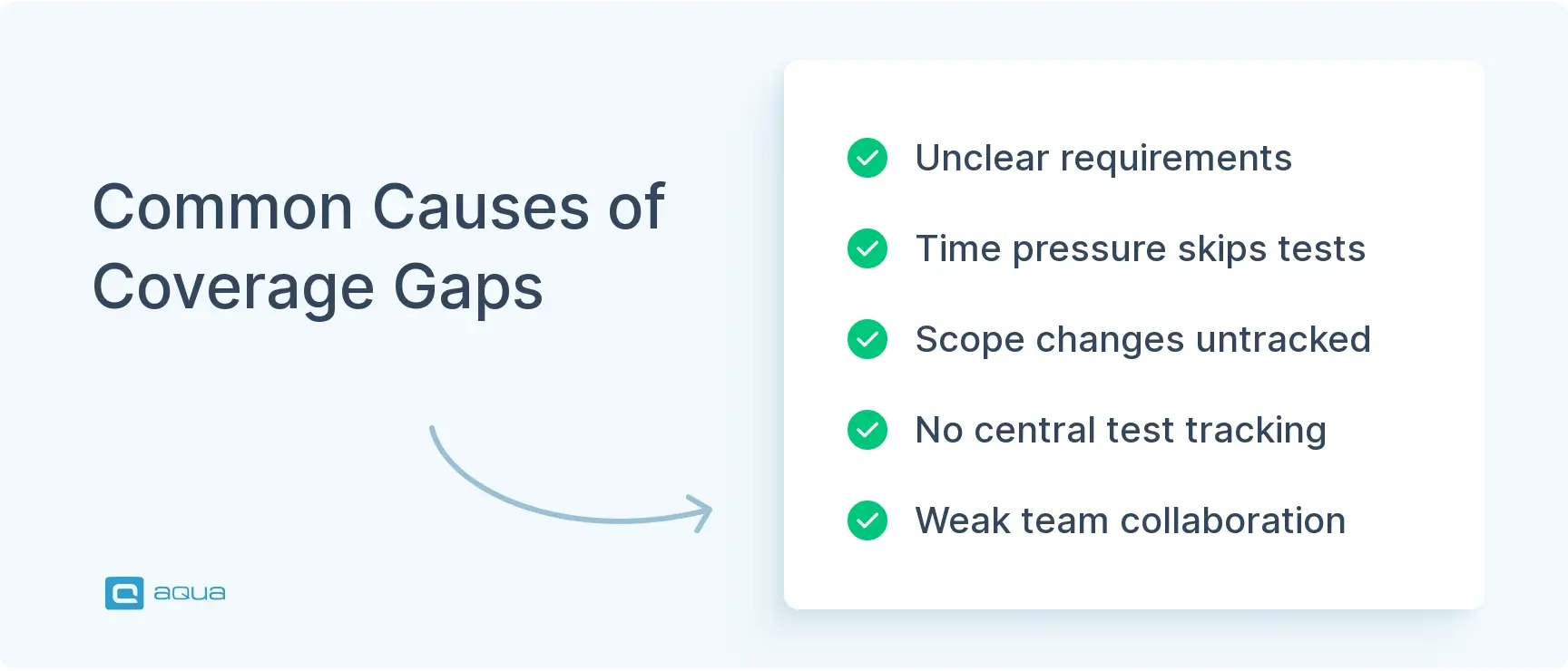
Common Causes of Coverage Gaps
Coverage gaps in testing don’t appear without reason. They are usually symptoms of deeper process issues that accumulate over time. Understanding the root causes allows your team to work toward fewer gaps and address the conditions that generate them.
Missing or poorly defined requirements are among the most frequent contributors. When a feature gets built without clear acceptance criteria, testers have no precise target for validation. The result is test cases that exercise basic functionality but miss edge cases, error handling, and integration points.
Solution: Establish a working definition of “ready” for user stories that requires at least draft acceptance criteria before development starts. A requirement that cannot be tested should not move forward.
Time pressure consistently pushes coverage toward happy-path scenarios. As deadlines tighten, negative tests, boundary conditions, and low-probability edge cases are usually the first to be deprioritized. Scope changes during development add to this: a feature gets modified mid-sprint, but the test suite never gets updated to reflect the new behavior.
Solution: Treat scope changes as test update requests. When a feature changes mid-sprint, the corresponding test updates should be tracked as part of the same ticket.
Lack of centralized visibility allows gaps to accumulate without detection. When there is no single view of what has been tested and what has not, coverage gaps in testing can carry over across multiple releases.
Solution: Centralize test tracking in one platform. When manual and automated results feed into the same system, your team can see the full coverage picture across every release cycle without guessing.
Weak collaboration between developers and testers creates recurring mismatches. Developers tend to write unit tests that cover code execution paths but may miss business logic. Testers write functional tests that cover user workflows but may miss the bigger technical risks within a feature.
Solution: Schedule brief joint reviews at the start of each sprint, where developers and testers walk through new functionality together. Catching a mismatch at that stage costs far less than finding it after release.
There is no right amount of coverage. A better practice is to track how many bugs are reported and how long it takes to fix bugs.
Addressing gaps in test coverage is a process that combines tooling, process discipline, and shared accountability across your team. The objective is a testing practice where gaps are detected early and get smaller over time.
Requirement-to-test traceability makes gaps easily observable throughout development.
Linking every requirement to at least one test case is the baseline expectation for any team that wants predictable coverage. When this connection gets enforced during planning, gaps become visible well before something breaks in production. Platforms like aqua support this at scale, making gaps in testing observable across entire releases and providing a continuous test coverage gap report for planning purposes.
Tester involvement in planning reduces gaps at their source.
When testers participate in requirement definition, architecture discussions, or API design, identifying test coverage gaps at the planning stage is significantly less costly than adding tests after a feature is complete. Regular test case reviews, including paired walkthroughs between developers and testers, help catch scenarios that automated suites are likely to miss.
Mutation testing exposes coverage that looks good but does not actually validate behavior.
Tools like PIT or Stryker inject small code changes, called mutations, and check whether existing tests detect them. Surviving mutations indicate weak assertions or shallow coverage, problems that traditional code coverage metrics would report as acceptable. This technique is computationally intensive but provides strong evidence that a test suite genuinely validates expected behavior.
Unreliable and outdated tests give teams a false sense of how much is covered.
Unstable tests, obsolete scripts, and unreviewed test failures all contribute to a misleading picture of coverage health. An effective test coverage analysis practice includes regular pruning of the test suite: removing obsolete tests, updating fragile ones, and ensuring CI pipelines have clear gates tied to coverage thresholds.
Gap analysis becomes more effective when it runs on a regular schedule.
Coverage gap analysis delivers the most value when it is part of the regular sprint rhythm. Reviewing a test coverage gap report during retrospectives, tracking trends over time, and flagging gaps before they carry forward into the next sprint all keep coverage in step with development pace. For a comprehensive view of how to find coverage gaps and connect them to risk management decisions, the guide on how to analyse test coverage provides a broader framework.
The practices covered in this article produce better results when requirements, test cases, and execution data live in one system, updated continuously across every sprint. Without that connection, gap analysis renders absolutely obsolete. aqua cloud, an AI-driven test and requirement management solution, keeps coverage status updated, tying every requirement to its test cases and every test run to real results. aqua’s AI Copilot learns from your project’s documentation through RAG grounding, generating test cases that are relevant to your actual workflows. Your team saves up to 43% of test design time while keeping coverage in step with development pace. Real-time dashboards, custom filters, and automated alerts give everyone a consistent view of where coverage stands. With native integrations across Jira, Jenkins, Azure DevOps, Confluence, JMeter, and 10+ other tools, aqua connects every part of your pipeline so gaps get flagged right on the spot.
Conclusion
Test coverage gaps are a product of real constraints. Requirements change, priorities shift, and timelines compress. The difference between teams that ship with confidence and those managing avoidable production incidents comes down to one thing: knowing where their gaps are before release.
A test coverage gap analyser gives your team that visibility. Gap analysis works best as a continuous practice, built into sprint rhythms and connected to CI/CD gates. The strongest test suite validates what actually matters to the business, and that starts with a clear picture of where coverage is missing.
A coverage gap is any part of your application, requirement, or workflow that isn’t validated by at least one test. This includes untested error paths, edge cases, and business logic that automated or manual testing never exercises, leaving those areas vulnerable to undetected production failures.
What are gaps in testing and why do they matter?
Gaps in testing are scenarios your suite doesn’t cover, such as null inputs, expired tokens, or network failures. They matter because they’re invisible until production breaks. A gap in a customer-facing workflow or compliance-critical path can result in outages, data issues, or regulatory exposure.
How do you identify gaps in test coverage?
Identifying test coverage gaps involves mapping requirements to test cases and looking for any with no links. Reviewing CI results for tests that never ran, then checking error paths and boundary conditions against assertions, helps reveal what’s missing. Traceability platforms make this process considerably faster at scale.
How do you find test coverage gaps in a large project?
A traceability matrix helps reveal unmapped requirements at scale across large projects. Priority should go to high-risk areas like payment flows, authentication, and compliance requirements. Mutation testing tools such as PIT or Stryker can also expose weak assertions hidden behind high line coverage numbers.
What is the difference between test coverage and coverage gap analysis?
Test coverage measures which lines, branches, or functions execute during tests. Coverage gap analysis goes further, comparing what was tested against what should be tested based on requirements, risk, and business logic, revealing functional blind spots that line coverage metrics alone will never show.
How often should teams perform a test coverage gap analysis?
A test coverage gap analysis ideally runs after every sprint and before major releases. Integrating it into CI/CD pipelines means gaps get flagged continuously. The more regularly your team reviews coverage, the smaller and easier to address each gap tends to be over time.
What causes coverage gaps in testing?
The most common causes include poorly defined requirements, time pressure that pushes toward happy-path testing, mid-sprint scope changes without updated tests, and limited collaboration between developers and testers. The absence of a centralized traceability system lets these gaps accumulate across sprints without detection.
How do you fix gaps in test coverage?
Addressing gaps in test coverage begins with linking every requirement to at least one test case during planning. Tests for error paths, boundary values, and dependency failures take priority. Mutation testing validates assertions, and automating gap detection in CI catches regressions before they merge.
Robert has several years of experience in process optimisation and test management. He is an expert in defining and implementing workflows by adapting aqua to the clients’ processes.
Nurlan, a QA Coordinator & Quality Standards Officer, takes pride in orchestrating seamless QA operations. His expertise in coordinating QA-focused projects and integrating QA solutions has consistently yielded top-tier client satisfaction. Aside from a full-time QA coordinator, Nurlan's role involves creating compelling content that educates…
Pavel, a Quality Assurance Consultant and Author, brings deep expertise to solving complex testing challenges. His background in software development has helped organizations transform their QA practices from reactive to proactive. Beyond consulting, Pavel develops best practice guides and case studies for aqua cloud that…
Home » 'How to' guides » Test Coverage Gap Analyser: Free Tool for Software Testers
Do you love testing as we do?
Join our community of enthusiastic experts! Get new posts from the aqua blog directly in your inbox. QA trends, community discussion overviews, insightful tips — you’ll love it!
We're committed to your privacy. Aqua uses the information you provide to us to contact you about our relevant content, products, and services. You may unsubscribe from these communications at any time. For more information, check out our Privacy policy.
X
🤖 Exciting new updates to aqua Intelligence are now available! 🎉