Test Case Specification: Complete Guide for QA Teams
Two failure modes dominate test libraries: cases too vague to execute, and cases too detailed to maintain. Both are missing the same thing: an expected result somebody should be able to objectively check. Without this pass condition, the verdict depends on whoever ran the case. This guide sets out what is test case specification, as per ISO/IEC/IEEE 29119-3:2021 and how to scale the detail level for your team. It also covers the proven techniques behind cases worth writing. You get a reusable template, a worked example, and a practical tool comparison.
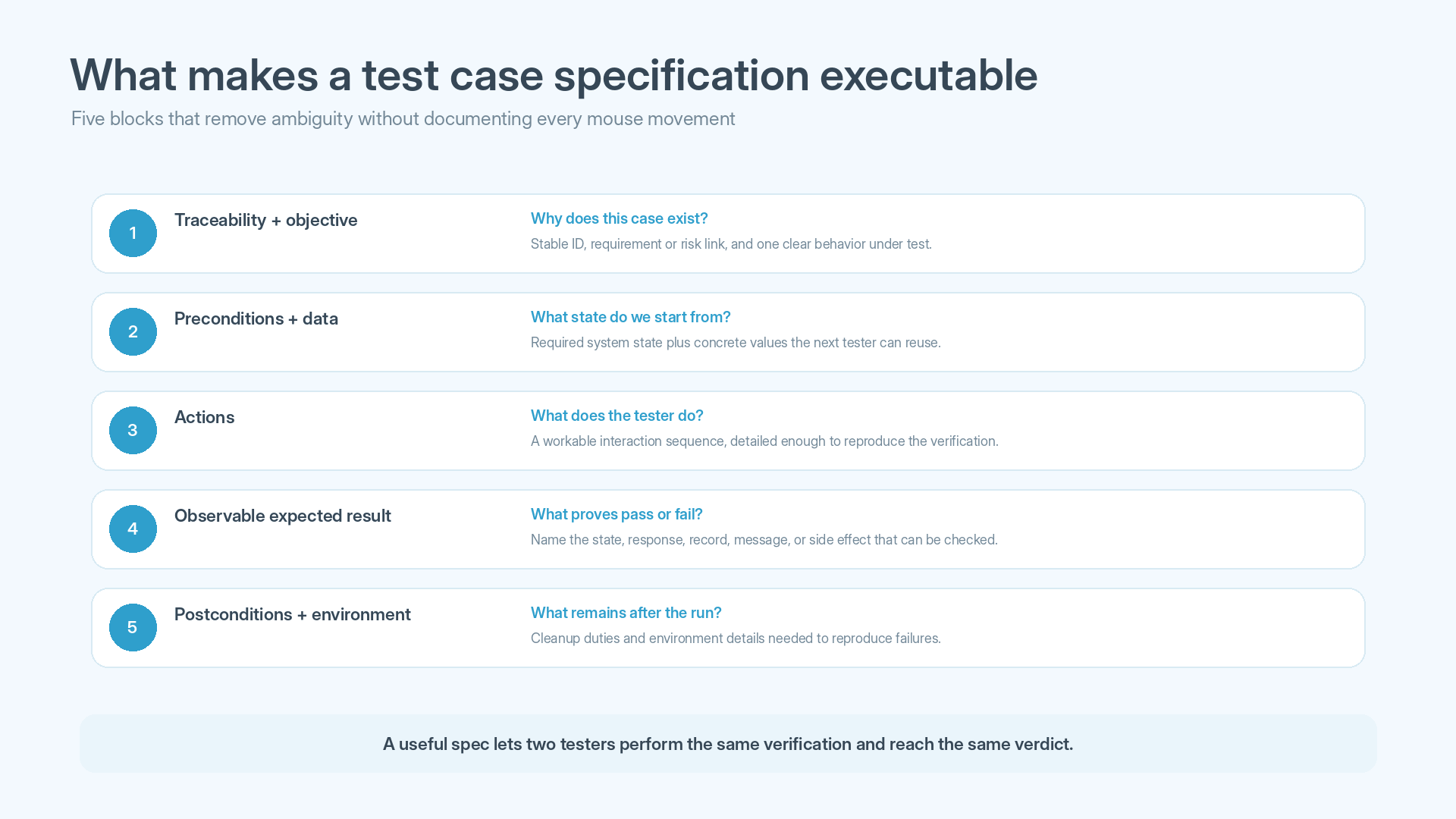
A test case specification defines preconditions, inputs, actions, and expected results precisely enough that two testers can run the same verification.
IEEE 829 formalized the artifact first, and ISO/IEC/IEEE 29119-3:2021 now serves as the international standard for software test documentation.
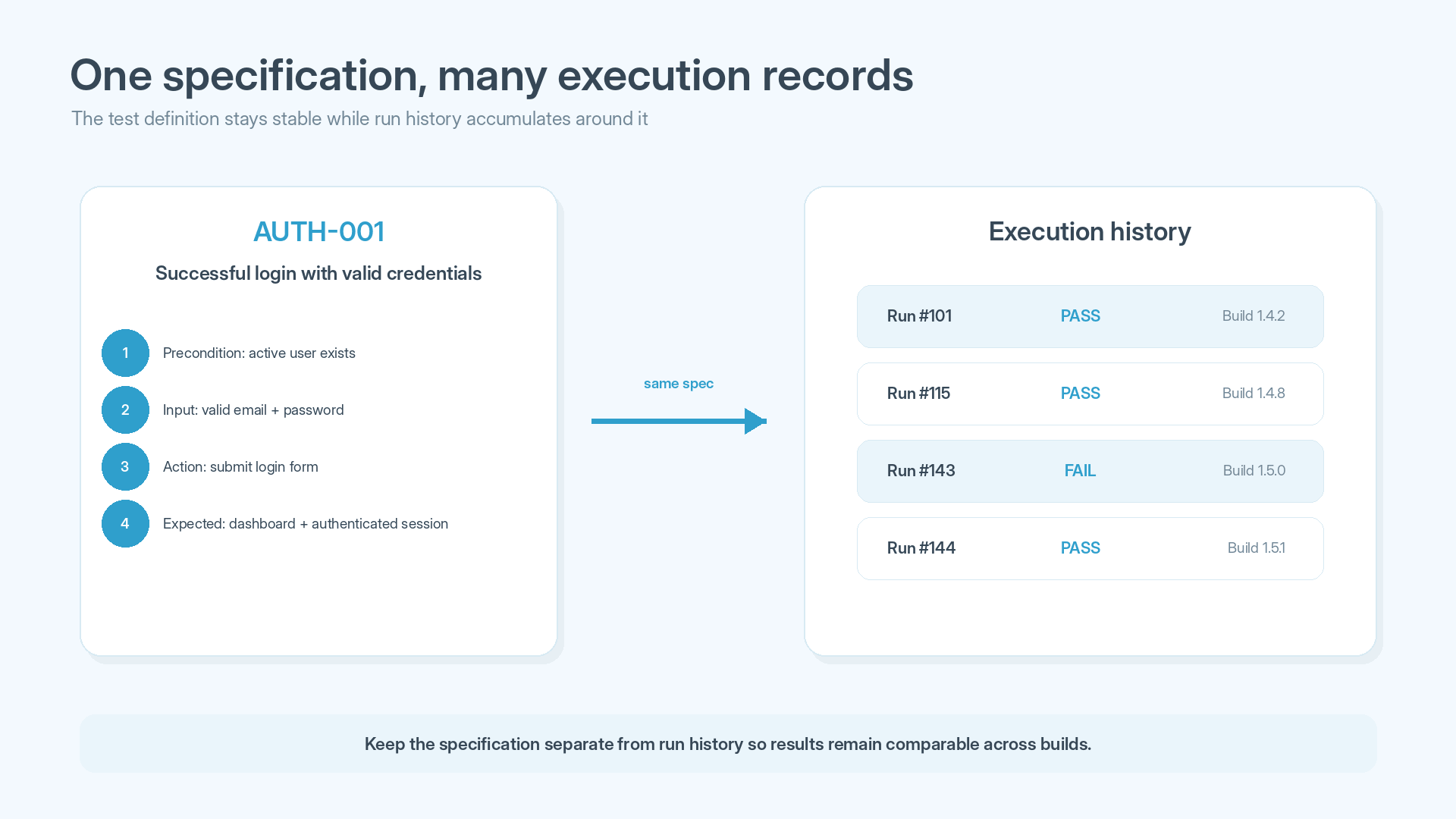
One specification collects dozens of execution records over time, so the spec stays constant while run history accumulates around it.
Expected results have to be observable. “Page works correctly” fails that bar, whereas “Order created with status Paid, cart empty, inventory decremented by 1” clears it.
Boundary value analysis and equivalence partitioning decide which cases carry information. For a field accepting 8 to 64 characters, the values worth testing are 7, 8, 64, and 65.
What Is a Test Case Specification?
A test case specification describes the preconditions, inputs, actions, and expected results needed to verify one aspect of your software. That requirement states what the system should do. The specification then defines a controlled way for you to prove it.
A test case specification in software testing is a formal artifact with a prescribed structure. Because of that structure, any tester on your team can pick the case up and reach the same verdict as its author.
In formal testing standards, a test case specification can describe a set of test cases. Modern test management practice uses the term for the structured specification of an individual test case, and this guide follows that meaning throughout.
Take a requirement such as “Registered users can log in with valid credentials.” On its own, that sentence gives your team nothing to run. The specification therefore supplies the missing detail:
Test case ID: AUTH-001
Objective: Verify successful authentication with valid credentials
Expected result: Authentication succeeds, the user reaches the dashboard, and an authenticated session is created
Without that level of precision, two testers on your team produce two different tests, and neither result carries much weight.
One Specification, Many Execution Records
The specification exists before anyone runs anything. Execution records appear afterward, and each one attaches back to the same spec. AUTH-001 passed on runs #101 and #115, failed on #143, then passed again on #144. Throughout that history the spec itself stays constant, which is why results remain comparable across builds.
Most platforms show both layers on a single screen, which suits daily work well enough. Even so, keeping them separate pays off whenever you audit coverage or diagnose a flaky suite.
AI-generated image.
Modern-Day Test Case Specification Standards
The IEEE 829 test case specification, published in the 1998 edition, was the first formal version of this document. Its fields covered the test case ID, test items, input and output specs, environmental needs, and inter-case dependencies. Since IEEE retired that document, ISO/IEC/IEEE 29119-3:2021 has served as the international standard for software test documentation. It supplies templates for test plans, test cases, procedures, and reports.
The underlying distinction survived the change of standard, though. A test case is the test itself, while the specification records how you perform and evaluate that test. Put another way, the role of a test case specification in software engineering is to connect requirements work with verification evidence.
Keeping a specification accurate through three product pivots comes down to storage and linking. aqua cloud, an AI-driven test and requirement management platform, centralizes the whole library with structured steps, reusable nested cases, and traceability that ties each case to its business purpose. Requirements, test cases, and defects are aggregated in one platform, which is what makes that traceability work without manual mapping. Shared steps mean one login precondition updates across 200 cases in a single edit. Coverage reporting shows which requirements carry no tests ahead of the release review. aqua Intelligence drafts project-specific specifications from requirements, grounded in the documentation your team uploads, so the wording matches your own product vocabulary. Those specifications then reach the tools already in use. That means bidirectional Jira sync, Azure DevOps and Confluence connections, plus Capture as well as 12+ other tools you likely already have in your tech stack.
aqua cuts 42% of test lifecycle time through AI-powered capabilities
Specifications make verification repeatable, which is the reason your team documents tests at all. The practical benefits are straightforward:
Repeatable execution. Two testers working from the same preconditions, data, and expected results reach the same verdict, and regression runs stay reliable between builds.
Requirement traceability. You answer coverage questions during planning, since every case points back to a requirement or risk.
Faster defect reproduction. The environment, data, and steps are already written down, so your developers reproduce the failure without a long thread of clarifying messages.
Audit evidence. Regulated releases need proof that a control was verified. A reviewed specification with its execution history gives your auditors exactly that.
A shorter path into automation. Concrete inputs and observable expected results map onto fixtures and assertions, so your engineers script the case without redesigning it.
Volume is beside the point here. A hundred precise specifications support a release better than a thousand vague ones.
A principle of mine is to always formulate a testcase as a postulate, that can be either confirmed or denied. Such "Login" is not a testcase, but "Registered users can log in" is. In principle.
No universal template fits every project, and yet usable specifications carry the same core fields. Ten of them do most of the work, and the third column names what fails when one goes missing.
AI-generated image.
Component
What it holds
What breaks without it
Test case identifier
A persistent ID such as CHECKOUT-PAYMENT-014
Requirements, defects, and automated tests have nothing stable to reference
Title or objective
The behavior under verification, e.g. “Active customer authenticates with valid email and password”
Reviewers read all the steps to work out the purpose
Traceability
Links to the requirement, user story, acceptance criterion, or risk
Nobody can answer which tests verify requirement PAY-17
Preconditions
Required state, e.g. cart contains one item or feature flag checkout_v2 is enabled
Setup work gets buried inside the test steps
Test data and inputs
Concrete values such as john.qa@example.com and QATest123!
Execution varies by tester, and automation stalls
Test actions
The interaction sequence at a workable level of detail
Ambiguity creeps in and results stop being comparable
Expected results
Observable outcomes, e.g. order status Paid and empty cart
Your team performs actions with no objective pass criterion
Postconditions
System state after the run, plus cleanup duties
Test data accumulates, and later runs inherit dirty state
Environment
Material factors like Chrome 152, API v3, or locale de-DE
Failures cannot be reproduced on demand
Dependencies
External services, accounts, feature flags, or other cases
A broken execution order blocks whole sections of the suite
Preconditions and dependencies cause the most trouble in practice. State belongs in the precondition and setup operations do not. A payment test should never hide account creation inside step one. Dependencies call for the opposite discipline: a chain where TC-01 blocks TC-02 through TC-04 leaves the whole suite fragile. For that reason, our guide to Test Case Dependencies covers the mechanisms that let each case establish its own state.
Tools for Managing Test Case Specifications
The platform holding your specifications affects how long they stay usable. Each option below takes a different position on structure and integration depth, so compare them against the way your team already works.
Teams that want AI-assisted specification drafting, requirements traceability, and audit-ready version history in one place
Value peaks when requirements and test cases both available in aqua
Qase
Fast, modern case management with a strong API, BDD support, and flexible templates
Reporting depth trails the older enterprise suites
TestRail
Regulated environments where audit trails, approvals, and detailed reporting carry weight
Heavier than teams with lightweight needs require
Jira with Zephyr or Xray
Teams already running planning, development, and defects inside Atlassian
Inherits Jira performance quirks and configuration complexity
Azure Test Plans
Microsoft-stack workflows with traceability to work items, builds, and releases
Weaker fit for multi-platform or mixed CI/CD setups
Tricentis qTest
Large regulated organizations that need deep analytics across a wider testing portfolio
Excessive for small teams
BrowserStack Test Management
Teams already running execution on BrowserStack browsers and devices
Value drops without that execution infrastructure
Your team keeps the tool it will open every day. In our experience, five capabilities usually decide that:
Flexible templates that fit high-level, structured, and BDD cases
Traceability connecting cases to requirements and defects
Version control, since specifications evolve with the product
Reporting that proves coverage to auditors and stakeholders
CI/CD integrations that return execution data automatically
A platform that makes specification writing feel like paperwork leaves you with incomplete cases and, before long, an abandoned library.
How to Write a Test Case Specification
Design comes before documentation in this work. You decide which conditions carry information first, and the write-up follows after that. The six steps below run in that order.
1. Start From Your Test Basis
Requirements, user stories, business rules, API contracts, risk analysis, and historical defects all feed the specification. When you pull each condition from one of those sources, every case has a reason to exist that survives review. Skip the step, though, and your library slowly fills with cases nobody can defend.
2. Derive Cases With Proven Techniques
The ISTQB Foundation Level syllabus v4.0.1 lists four black-box techniques: equivalence partitioning, boundary value analysis, decision table testing, and state transition testing. Apply them consistently, and the case count usually drops while coverage improves.
Consider a requirement that reads “Age must be between 18 and 65 inclusive.” Values of 25, 31, and 44 add almost nothing here. Boundary-driven values do the real work: 17 invalid, 18 valid, 19 valid, 64 valid, 65 valid, and 66 invalid.
3. Define Observable Pass/Fail Criteria
Every case needs an outcome somebody can check without debate, because a result like “page works correctly” cannot pass or fail objectively. Write the criterion at the interface where you can observe it. For an API, specify HTTP status 400 with response {“error”: “INVALID_EMAIL”}. Access control cases state that the request returns HTTP 403 and carries no customer data. Performance criteria follow the same rule, so a load case names a 95th-percentile response time at or below 500 ms.
Your test management tool should hold that criterion next to the steps, since reviewers need both to judge completeness.
4. Cover Positive and Negative Conditions
Specifications that describe only expected user behavior leave your riskiest paths untested. For a requirement of “User can withdraw up to €500,” your positive case might use €300, while the useful negative cases include the following:
€0 and negative amounts
€500 and €501 at the boundary
Non-numeric input
Insufficient account balance
Blocked or suspended accounts
ISTQB guidance on ATDD recommends exactly that order, with positive cases first, then negative testing, and finally the relevant non-functional characteristics.
5. Hold Each Case to One Objective
A case covering registration, login, profile editing, password reset, checkout, and logout is too broad to diagnose reliably. Once step 27 fails, the failure no longer points to a single capability, and your team has no obvious requirement to attach the defect to. ISTQB Test Analyst guidance therefore recommends reducing unnecessary complexity, since smaller cases make failure analysis easier and combine flexibly into larger procedures. Atomic still allows several steps, provided the case holds one coherent validation objective.
6. Match the Detail Level to Your Team
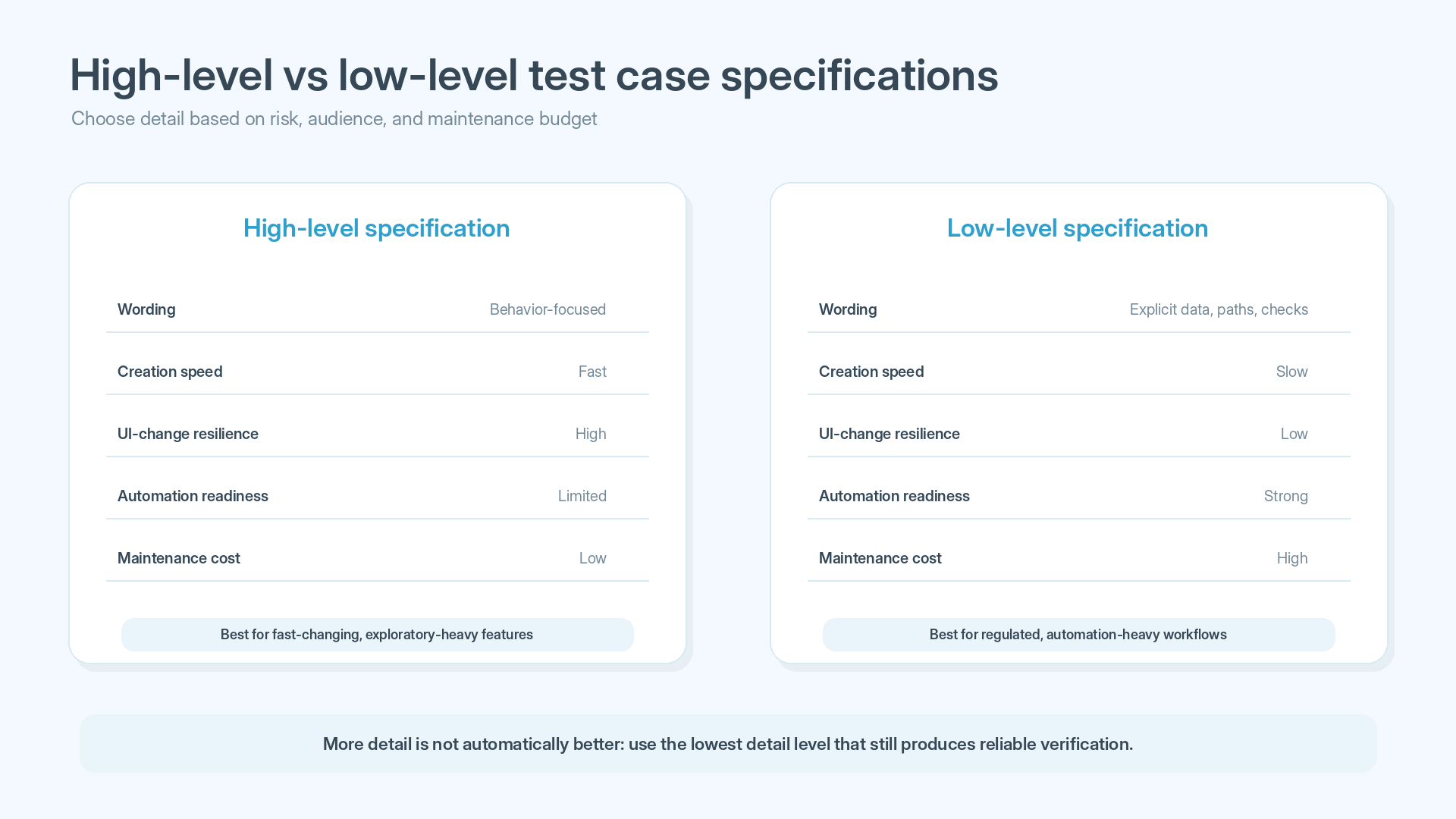
Detail level is a budget decision as much as a quality decision. Highly detailed cases pay off in regulated workflows, where approvals and audit trails carry legal weight. A fast-moving UI feature, by contrast, does better with acceptance criteria, high-level cases, and automated regression. Both levels appear side by side in the comparison further down this guide.
Test Case Specification Template
Consistency starts with a tested template, which keeps important fields from disappearing when your team works under deadline pressure. This test case specification template adapts to most testing contexts, and the worked example in the next section fills it in end to end.
Test Case ID: [Unique identifier, e.g. FEAT-MODULE-###]
Title: [Brief, descriptive name of the behavior under verification]
Objective: [Clear statement of the test’s purpose]
Traceability:
Requirement ID: [Link to requirement or user story]
Risk ID: [Associated risk where applicable]
Priority: [Critical / High / Medium / Low]
Preconditions:
[State requirement 1]
[State requirement 2]
Test data:
[Input value 1: specific data]
[Input value 2: specific data]
Test steps:
[Action 1]
[Action 2]
[Action 3]
Expected results:
[Observable outcome 1]
[Observable outcome 2]
Postconditions:
[System state after the test]
[Cleanup requirements]
Environment:
[Browser, OS, or device]
[API version]
[Configuration details]
Dependencies: [External factors or other test cases]
Notes: [Additional context or special considerations]
Treat the template as a starting point, then adapt the fields to your project and compliance duties. Fields that nobody on your team fills in honestly should come out, since half-completed forms cost review time and return nothing valuable.
Test Case Specification Example
The test case specification example below applies that template to an e-commerce payment flow. Several system states have to be verified after one transaction.
Test Case ID: CHECKOUT-PAYMENT-014
Title: Process successful credit card payment for single-item order
Objective: Verify that an authenticated customer completes a purchase with a valid credit card when the cart holds one available product.
User story: US-203 (As a customer, I want to pay with my credit card)
Risk: R-08 (Payment gateway integration failure)
Priority: High
Preconditions:
Customer account cust-4291 is active and authenticated
Shopping cart contains product SKU-1029 at €49.99
Payment sandbox environment is available
Feature flag new_checkout_flow is enabled
Test data:
Card number: 4532015112830366 (test Visa card)
Expiration: 12/25
CVV: 123
Cardholder name: Test Customer
Test steps:
Navigate to the checkout page
Verify the cart summary displays SKU-1029 at €49.99
Select “Credit Card” as the payment method
Enter the test card details
Select “Complete Purchase”
Expected results:
Order is created with status “Paid”
Confirmation page displays an order number in format ORD-YYYYMMDD-XXXX
Shopping cart becomes empty
Payment transaction record exists with status “Completed”
Confirmation email is queued for the customer
Product inventory decrements by 1
Postconditions:
Customer remains authenticated
Test order is flagged for automated cleanup
Test payment is voided in the sandbox
Environment:
Browser: Chrome 122+
API: v3
Sandbox: Payment gateway test environment
Every field here removes one source of ambiguity, and none of them documents mouse movements. Traceability links explain why the case exists, while the postconditions make cleanup explicit. Because the data is concrete, two people on your team executing this spec run essentially the same test.
Test Case Specification vs Test Case, Test Plan, and Test Procedure
Four artifacts share the same vocabulary and get mixed up constantly. Each one answers a different question:
Artifact
What it is
Question it answers
Test plan
The organization and strategy of testing across a project or release
How will testing be run?
Test case
An individual verification with defined inputs, conditions, and expected outcome
Which condition do we verify?
Test case specification
Formal, structured documentation of one or more test cases
How is that verification defined and evaluated?
Test procedure or script
The ordered sequence used to execute tests
In which order do we run them?
Test Case Specification vs Test Scenario
Test scenarios identify what needs testing, such as “Verify customer login,” and set the general scope. The specification then defines how one particular condition gets verified, with preconditions, steps, data, and expected results attached. To compare the two directly:
Aspect
Test scenario
Test case specification
Purpose
Identifies the testing objective
Defines the verification method
Detail level
High-level and broad
Low-level and specific
Example
Verify customer login
Login with valid credentials (TC-AUTH-001)
Login with incorrect password (TC-AUTH-002)
Login with unknown email (TC-AUTH-003)
Login with locked account (TC-AUTH-004)
Execution
Not directly executable
Directly executable
Scope
One-to-many relationship
Focused on a single condition
Audience
Product, stakeholders, test planning
QA, automation, execution
One scenario expands into several specifications, which is why the hierarchy runs from requirement to scenario to specification to execution. Your requirement says customers must authenticate, and the scenario beneath it says login works under various conditions. The specifications then enumerate those conditions with concrete setup and expected outcomes. If your team is building this hierarchy from scratch, our guide to test case management walks through the practical setup.
Types of Test Case Specifications
Specifications vary by detail level, execution method, and the quality attribute under test. Since detail level drives the most decisions, the high-level and low-level split comes first.
AI-generated image.
Dimension
High-level specification
Low-level specification
Wording
“Verify that an active subscriber can cancel a monthly subscription”
ISTQB Advanced Test Analyst guidance supports both levels without declaring either one superior. In practice, the choice comes down to your team’s skills and maintenance budget. Alongside that split, four further categories matter:
Manual and automated specifications share a structure, although they differ in tolerance for vague inputs. The automation section below maps the two onto each other field by field.
Functional specifications verify business logic and feature behavior, such as login flows or checkout processes. To do that, they combine preconditions, test data, step-by-step actions, and observable results.
Non-functional specifications target performance, security, usability, and reliability. A performance case might define 1000 concurrent users sustained for 10 minutes with a 95th-percentile response time at or below 500 ms, while a security case verifies that a request returns HTTP 403 with no customer data in the response.
BDD scenarios written in Gherkin serve as executable specifications. Because “Given an active customer account exists / When the customer enters valid credentials / Then the account dashboard is displayed” reads clearly, the same artifact communicates behavior to both product and automation teams.
Strong test suites mix these types deliberately. High-level specs suit exploratory-heavy features, whereas low-level specs suit compliance-heavy workflows. Non-functional specs then cover the attributes where performance and security decide the release.
How Test Case Specifications Support Test Automation
Automation frameworks consume the same information a specification already holds. Each element has a direct counterpart in the automated test:
Specification element
Automation counterpart
Practical effect
Precondition
Fixture or setup routine
The test builds its own state and stops depending on execution order
Test data
Parameters or a data provider
One script covers several partitions and boundary values
Test action
Automation command
Steps become code without a second round of analysis
Expected result
Assertion
The pass criterion becomes machine-checkable
Postcondition
Teardown
Test data gets cleaned up after every run
Traceability
Test ID linked to the requirement
Reports show requirement coverage from automated runs
This mapping only works when your inputs are concrete and the expected results are observable. Vague inputs like “enter a valid email address” need real values before anyone on your team scripts them. Automation therefore adds a lower-level implementation without changing the business intent of the specification. Observability sets the second condition. The expected result has to be visible at an interface the framework can reach, such as an API response or a database row.
Business intent belongs in the specification, and the framework owns the mechanics. As a result, a move between automation tools affects mainly the implementation layer. The specification itself stays in place.
Best Practices for Maintaining Test Case Specifications
Creating a specification is only the first step. Requirements and interfaces change over time, and a library nobody updates stops matching the product your team ships.
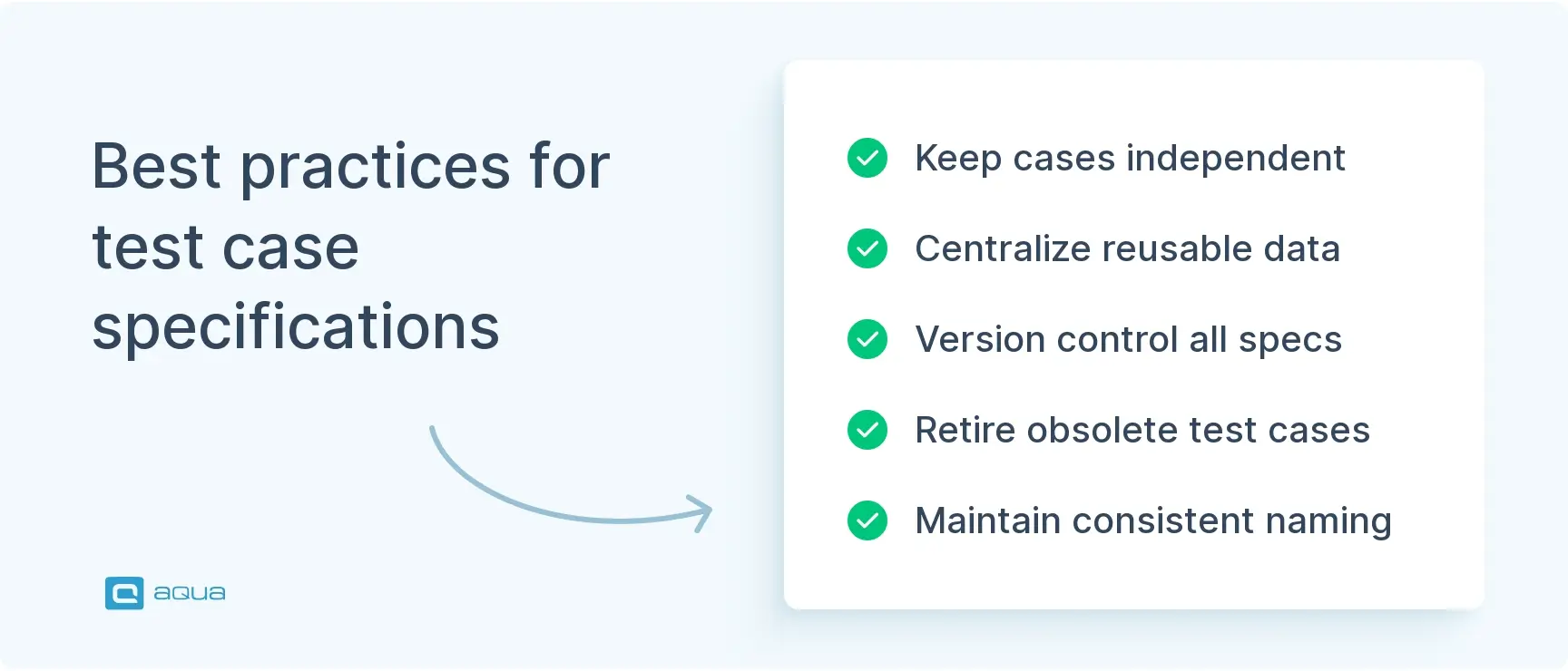
Keep cases independent. A chain such as create customer, edit customer, purchase product, delete customer collapses entirely once the first case fails. Preconditions should describe required state, which the framework can then establish on demand.
Avoid UI implementation detail unless the requirement depends on it. Button labels and CSS selectors age quickly, so a case built on them breaks during a cosmetic redesign that changed no behavior.
Centralize reusable test data. Shared accounts, sandbox cards, and fixtures belong in one place. A rotated credential then costs a single edit.
Version specifications when requirements change. Auditors ask what a case looked like at the time of a release. History matters as much as the current text.
Retire obsolete cases on a schedule. A quarterly pass removes cases for features your company no longer ships, which keeps regression runs honest about what they cover.
Keep naming and structure consistent. Predictable IDs and field order let reviewers scan a case in seconds, and they make bulk edits far safer.
Write the test case in a way that any person with no idea of the app can follow the steps and run it. This is helpful, but depending on the team you are in, you'll have to balance between time and resources you spend writing test cases, and the level of granularity of the test case.
The ISTQB Advanced Test Analyst syllabus also offers a review checklist worth running before any specification enters your library.
Quality characteristic
Review question
Traceability
Does the case connect to a test condition, requirement, or risk?
Consistency
Does it follow the same language and structure as its neighbors?
Precision
Does it support only one reasonable interpretation?
Completeness
Does it contain everything needed for execution and evaluation?
Conciseness
Has unnecessary complexity been simplified away?
Maintainability
Will a small product change force edits across hundreds of cases?
Maintainability is the characteristic teams add last and then regret skipping. A suite of 5,000 exquisitely detailed cases becomes a liability once every minor UI change triggers a week of editing.
Versioning, centralized test data, and retiring obsolete cases are all manageable by hand until the library passes a few thousand specifications. aqua cloud, an AI-powered test and requirement management solution, provides version history that records who changed each case and when, which covers most audit questions directly. Reusable test data sits in one place, so a rotated sandbox credential costs a single edit. Coverage dashboards indicate which requirements lost their tests after the latest round of changes. Each failed run links to its defect, keeping the specification, the execution, and the fix in one connected record. Manual and automated results appear in the same reporting view, so your coverage picture remains complete. Execution results return from your pipeline automatically. aqua connects to Jenkins, JMeter, SoapUI, Ranorex, PowerShell, UnixShell, MSSQL and Oracle databases, REST API, and 10+ native automation integrations
Save 12.8 hours per tester per week with aqua’s AI
The hardest part of this work is choosing a detail level and holding your team to it. Explicit IDs, exact steps, and database checks are worth the effort in a regulated payment flow. A UI feature that changes every sprint does better with acceptance criteria and a high-level case. Applying one standard everywhere costs you either maintenance hours or the precision that made the library valuable. Set the level per area of risk, record the reasoning, and revisit both when the requirement moves.
A test case specification is a documented description of the preconditions, inputs, actions, and expected results required to verify one aspect of software behavior. It defines how a test gets performed and how its outcome gets evaluated objectively.
What should a test case specification contain?
A complete specification carries an identifier, objective, traceability, preconditions, test data, steps, expected results, postconditions, environment details, and dependencies. Priority and notes fields then help larger teams sort and review the library efficiently.
What is the difference between a test case and a test case specification?
A test case is the verification itself, with its inputs, conditions, and expected outcome. The specification is the documented form that verification takes, covering one or more cases. Most test management tools present both as a single record.
How do you write an effective test case specification?
Start from your test basis, then derive conditions with proven techniques such as boundary value analysis and write observable expected results. Keep one objective per case, add traceability to the requirement, and choose a detail level your team maintains.
Which standard covers test case specifications today?
ISO/IEC/IEEE 29119-3:2021 is the current international standard for software test documentation, providing templates for test cases, plans, procedures, and reports. It replaced IEEE 829, which many QA teams still reference from older process documents.
How detailed should a test case specification be?
Detail follows risk and audience. Regulated workflows warrant explicit IDs, navigation steps, and database checks. Fast-changing UI features do better with high-level cases, since low-level specs cost more to maintain than the coverage they add.
Who writes and reviews test case specifications?
Testers and test analysts usually write specifications, while developers, product owners, and business analysts review them for correctness. Peer review against traceability and precision then reveals ambiguity before a case enters your permanent test library.
Pavel, a Quality Assurance Consultant and Author, brings deep expertise to solving complex testing challenges. His background in software development has helped organizations transform their QA practices from reactive to proactive. Beyond consulting, Pavel develops best practice guides and case studies for aqua cloud that…
Nurlan, a QA Coordinator & Quality Standards Officer, takes pride in orchestrating seamless QA operations. His expertise in coordinating QA-focused projects and integrating QA solutions has consistently yielded top-tier client satisfaction. Aside from a full-time QA coordinator, Nurlan's role involves creating compelling content that educates…
Enhancement of the aqua product is Martin’s main responsibility and biggest mission. His expertise covers ITIL Process Consulting, Change Management, Quality Assurance, Quality Management, and Requirements Management. Martin works in QA services for regulated industries for more than 18 years being an irreplaceable leader at…
Home » Test Automation » Test Case Specification: Complete Guide for QA Teams
Do you love testing as we do?
Join our community of enthusiastic experts! Get new posts from the aqua blog directly in your inbox. QA trends, community discussion overviews, insightful tips — you’ll love it!
We're committed to your privacy. Aqua uses the information you provide to us to contact you about our relevant content, products, and services. You may unsubscribe from these communications at any time. For more information, check out our Privacy policy.
X
🤖 Exciting new updates to aqua Intelligence are now available! 🎉