Test Orchestration: Importance, Components & Types
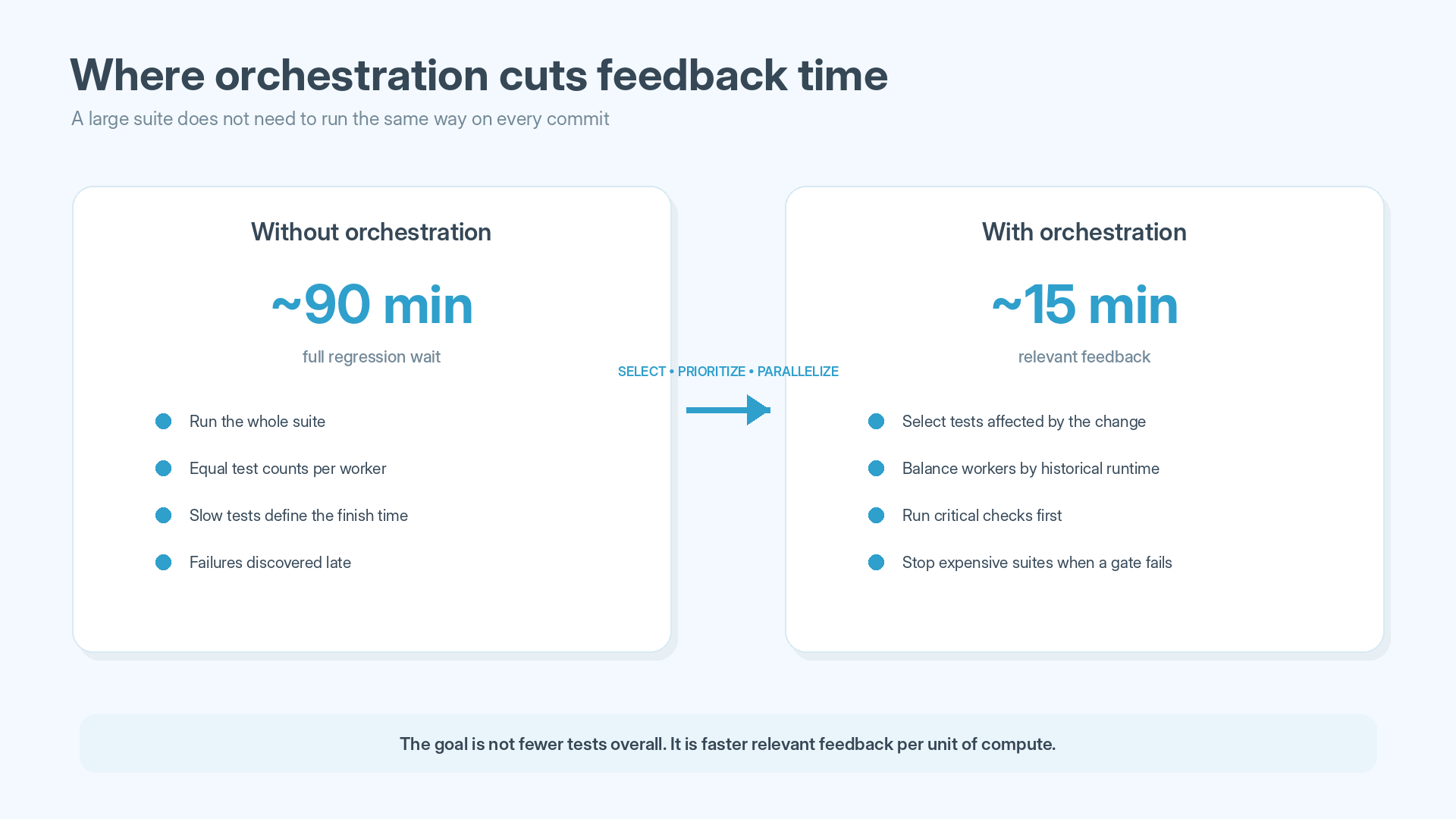
Do you have 500 automated tests in your suite with your team waiting 90 minutes for a result on a minor change? Most of that is simply idle time, and environment setup adds more. Test orchestration helps on many layers, including removing that unnecessary wait time by selecting only the tests your change affects. This guide covers what test orchestration does, which components it needs, and the types your team can apply. It also walks through implementation and the tools worth evaluating this year.
Test orchestration coordinates which tests run, when, and where across your pipeline. It works above automation frameworks.
The World Quality Report 2025–26 found that 60% of teams struggle with test data, 56% report fragmented strategies, and 48% hit scaling problems.
Smart orchestration uses code change analysis and historical data to run only relevant tests, balance workloads across workers by actual runtime, and retry infrastructure failures without blocking releases on flaky tests.
Orchestration cuts feedback time from hours to minutes by running high-priority tests first
Test orchestration tools range from CI platform features like GitHub Actions matrices and CircleCI dynamic splitting to specialized platforms
What Is Test Orchestration?
Test orchestration is the coordination layer that decides which tests run, when they run, where they run, and how testing activities interact across your pipeline. It sits above your test automation tools, so Playwright, pytest, and Selenium keep doing what they already do well.
Automation frameworks execute the scripts. They do not decide whether a suite belongs in a specific commit, which environment it requires, or how thousands of tests distribute across available workers. Those decisions form four questions your pipeline answers on every push:
Should these scripts run for this specific change, or is the checkout suite enough?
Do they wait for the staging deploy to finish first?
Which browser matrix do they target?
How do 4,000 tests spread across 20 workers without leaving half of them idle?
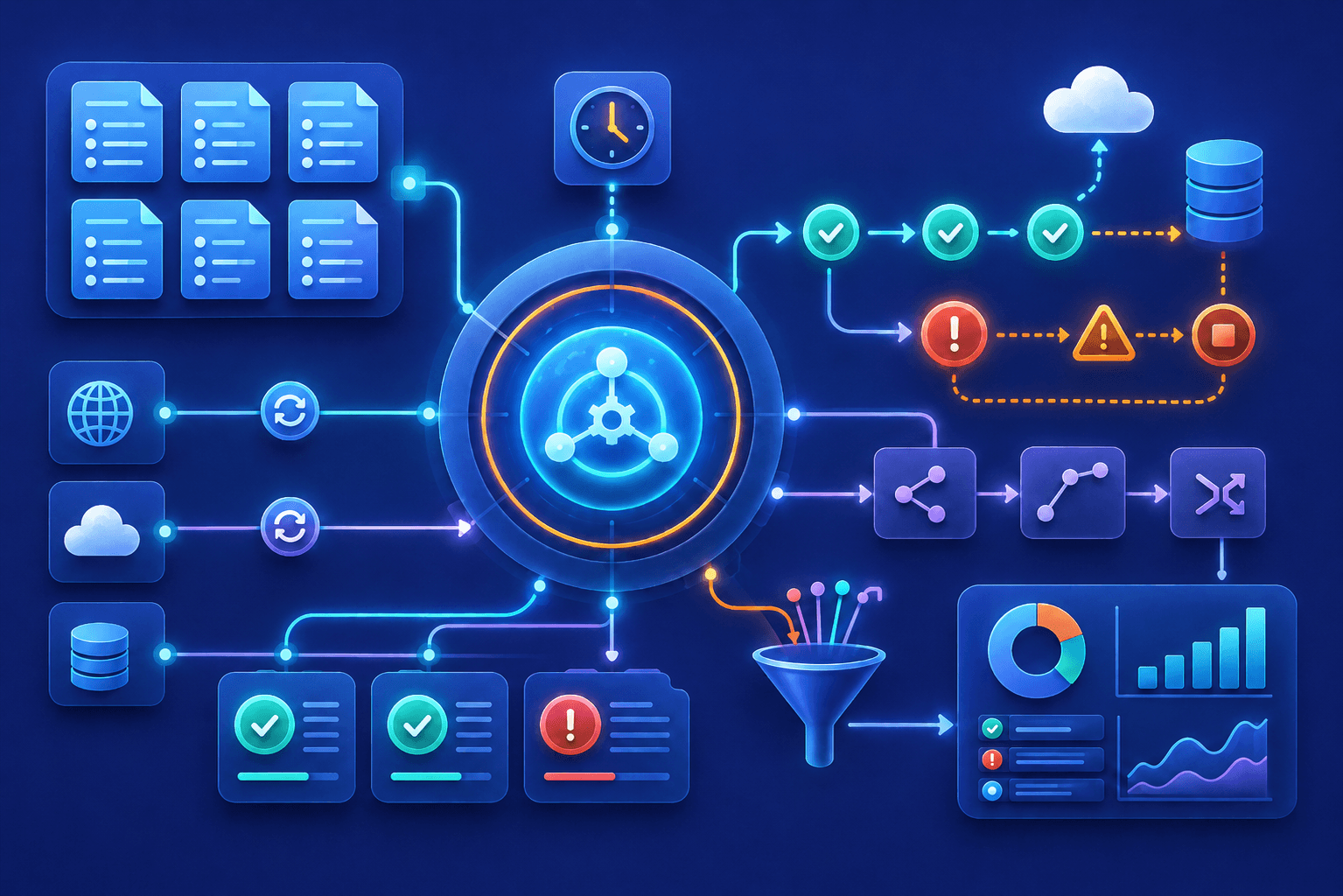
AI-generated image.
Test orchestration definitions from Ministry of Testing and TMAP
The Ministry of Testing describes test orchestration as automated coordination of the testing pipeline, so tests execute in the correct order, at the appropriate time, with the required data, while TMAP frames it as alignment of test automation with other quality assurance activities across teams working in CI/CD. Both definitions describe coordination above the framework level, since every suite can be perfectly automated while the execution process stays uncoordinated.
Orchestration decides how your tests run, and your team still needs a system of record for cases, runs, and results. aqua cloud, an AI-driven test and requirement management platform, stores manual and automated test assets in a single repository, schedules automated runs in advance, and triggers execution through automation agents on your own infrastructure. When a Jenkins job finishes, the outcome lands against the matching test case with logs attached, so your team does not reconcile CI output by hand. Aqua Intelligence adds domain-trained AI grounded in your project documentation through RAG, which keeps generated test cases tied to real requirements. On the integration side, aqua cloud syncs bidirectionally with Jira, connects to Jenkins and Azure DevOps for pipeline triggering, and pulls specifications directly from Confluence. 12+ other software solutions you likely already have in your tech stack are supported.
Run tests with 100% traceability aqua cloud
Try aqua for free
Test Orchestration vs Test Automation vs Test Management
These three terms are often used interchangeably, though each covers a different responsibility. The table below separates them by focus, scope, and the moment your team needs each one.
Aspect
Test Orchestration
Test Automation
Test Management
Primary Focus
Coordinating when, where, and how tests execute across the pipeline
Making individual tests execute automatically without manual intervention
Planning, tracking, and documenting test cases and results over time
Key Questions Answered
Should this test run now? Which tests run first? How many workers do we need? What happens when it fails?
How do we verify this behavior automatically? What assertions should pass?
What test cases exist? What requirements are covered? Who owns this test?
Typical Features
Test selection, sequencing, parallelization, environment provisioning, failure handling, result aggregation
Test frameworks such as Playwright, pytest, and Selenium, plus assertions, mocks, browser automation, and API testing
Test case repositories, requirements traceability, test plans, manual and automated run tracking, dashboards, historical reporting
Scope
Pipeline and infrastructure level, managing execution across multiple suites and environments
Individual test level, verifying specific application behavior
Organizational level, tracking testing effort across teams and releases
Main Outputs
Quality gates, execution metrics, optimized test distribution, aggregated pass/fail results
Test results, screenshots, logs, detailed assertion failures
Test coverage reports, traceability matrices, test execution history, status dashboards
Example Tools
BrowserStack Test Orchestration, Testkube, Buildkite Test Engine, CircleCI Test Splitting
Tests run too slowly, workers sit idle, test selection is manual, failure handling is inconsistent, results come from multiple systems
Manual testing is too slow or error-prone, regression runs happen frequently, execution needs to stay consistent
Multiple teams need shared visibility, compliance requires documentation, test cases span manual and automated, requirements need traceability
Relationship to Others
Coordinates execution of automated tests and can pull case definitions from test management systems
Provides the tests that orchestration coordinates and may sync results back to test management
Stores case definitions and results, may trigger orchestrated runs, and receives results from orchestration
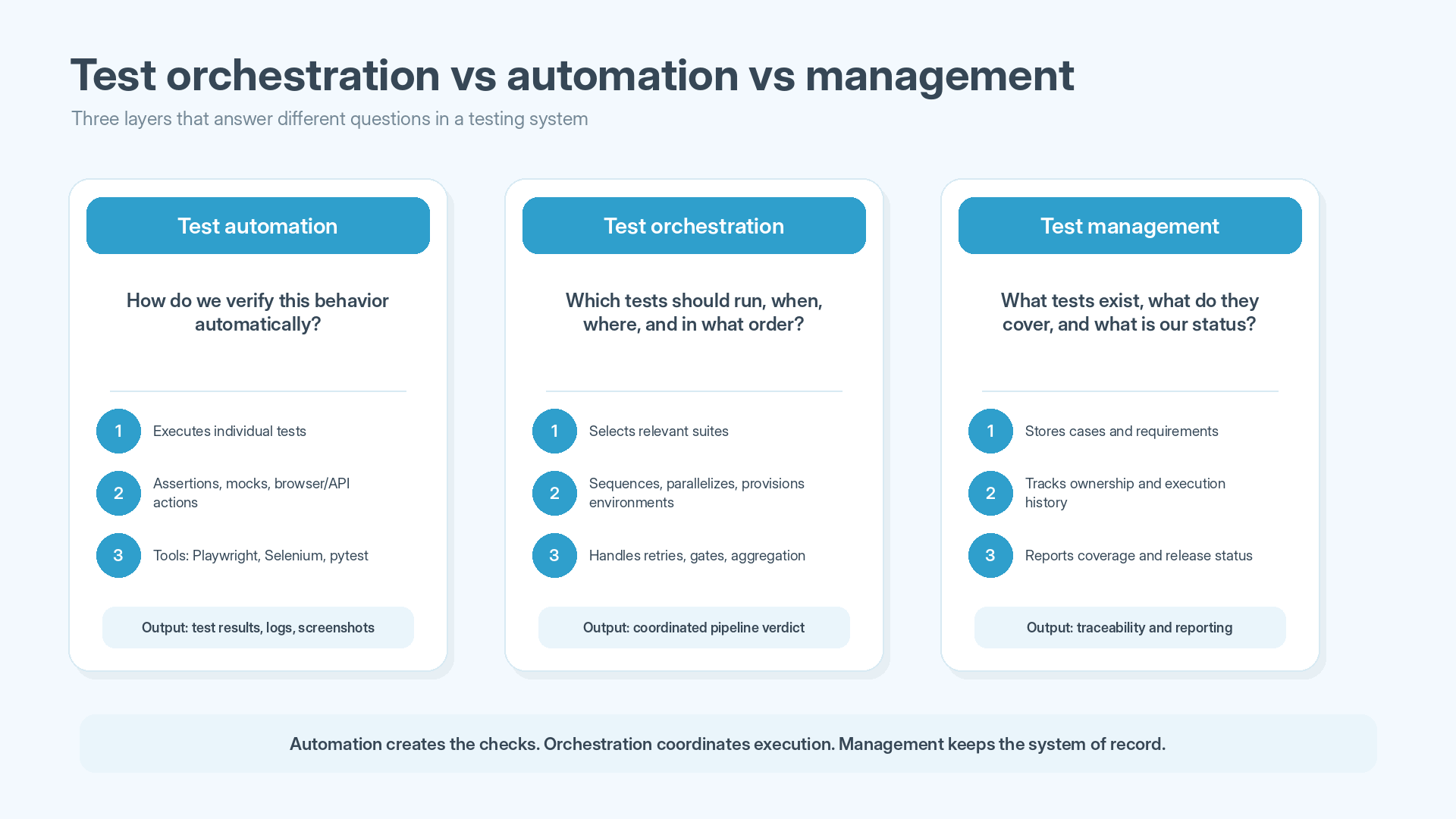
In practice, each layer answers a different question. Test automation answers “How do we verify this automatically?” Test orchestration answers “Which automated tests should run, and how do we coordinate them efficiently?” Test management answers “What tests exist, what do they cover, and what is our status over time?”
A Playwright test opens a page, fills a form, and verifies the result, which is automation. Deciding whether that test runs for this commit, whether it waits for the staging deploy, which browser it targets, and how it distributes across 20 workers is orchestration.
Test management systems like aqua cloud stay closest to your team day to day, since they hold the case definitions, trigger automated runs, and collect what the orchestration layer returns.
AI-generated image.
Why Is Test Orchestration Important?
Testing conditions changed on the infrastructure side. Your team no longer runs a single automated testing setup against one environment, since different services use different languages, UI automation runs against browser clouds, and performance tests hit Kubernetes clusters. Mobile tests need device farms, while API and integration tests require databases, queues, third-party mocks, and test data that never touches a real credit card.
Without orchestration, that complexity ends up inside CI/CD configuration files, and the approach works up to a point. A small team can run build, unit tests, staging deploy, API tests, UI tests, production deploy, and nothing breaks. Then the graph splits into six parallel tracks covering API tests, integration tests, two UI shards, accessibility checks, and security scans, all converging at a single quality gate. Add a dozen microservices, shared infrastructure, nightly regressions, pull request suites, and browser matrices, and execution strategy requires dedicated engineering effort.
Test automation challenges reported in the World Quality Report 2025–26
The World Quality Report 2025–26 surveyed organizations already using test automation, and the reported obstacles cluster around coordination.
Challenge reported by organizations using test automation
Share of respondents
Secure and scalable test data
60%
Fragmented strategies and skill shortages
56%
Selecting which tests to automate
54%
Maintenance and flaky scripts
50%
Scaling automation across the enterprise
48%
Integrating automation with CI/CD and legacy environments
44%
Each of those six items describes a decision about data, selection, sequencing, or environments, which the orchestration layer owns.
The same report records that roughly 25% of new automated test scripts are now generated with GenAI tools. More generated tests mean more suites competing for the same execution window, so generation costs fall while total execution time grows. Selection logic then determines which tests receive compute for a given change.
Key Components of Test Orchestration
An orchestration system combines eight components that operate as one pipeline:
Test selection engine. Picks which tests to run, based on code changes, previous failures, or tags. Advanced systems read the changed files and predict which tests matter.
Sequencing and dependency management. Sets execution order through workflows or dependency graphs. Smoke tests pass before expensive cross-browser suites start, and migrations finish before API validation.
Parallel execution coordinator. Spreads tests across workers to cut feedback time. Balancing by runtime works better, since ten tests rarely take ten equal slices of time.
Environment provisioning. Builds and tears down test environments, from ephemeral namespaces to database seeding. Integration and E2E tests run only once that infrastructure is ready.
Test data management. Creates, isolates, and cleans up data so parallel tests never overwrite each other. Your team can use dedicated test accounts or unique identifiers per run.
Failure classification and retry logic. Tells real regressions apart from infrastructure failures and test bugs. Your team then sets policies, such as retrying an infrastructure error automatically.
Result aggregation and reporting. Pulls output from every system into one view, with logs, screenshots, and artifacts in a shared dashboard.
Quality gates. Converts those results into a release decision, checking output against thresholds before code moves to the next stage.
These components cover decisions outside the scope of any individual framework: should this test run now, does it wait for something else, which environment executes it, what happens when it fails, and how do results from six tools become one consolidated verdict?
How Test Orchestration Works
The orchestration layer connects a code change to your execution infrastructure through seven steps, and they repeat on every push.
Analyze the change. The system examines modified files, affected components, and historical test relationships to identify relevant tests. If your team only touched checkout logic, the full authentication suite adds runtime without improving coverage for that change.
Build an execution plan. The plan takes the form of a directed graph covering dependencies and parallelization opportunities. Smoke tests may gate integration tests, while performance checks wait for functional validation to succeed.
Prepare environments. Provisioning covers isolated namespaces, deployed services, seeded databases, and running dependencies, so no test fails because someone forgot to start the message queue.
Distribute the work. Historical timing data drives the split. When some tests take 60 seconds and others take 10, the goal is minimizing the runtime of the slowest worker, since that worker decides when the pipeline moves on.
Monitor and handle failures. A network blip triggers an automatic retry, while a known flaky failure runs again without blocking the release. If a critical smoke test proves authentication is broken, the pipeline stops before 5,000 doomed E2E tests consume compute.
Aggregate results. Output from Playwright, pytest, JUnit, and any other framework gets normalized into a consolidated result set your team can review without opening each tool.
Decide and clean up. The system evaluates those results against your quality gates, publishes artifacts, tears down ephemeral environments, and returns a clear green or red.
Because the cycle repeats automatically on every change, coordination stops depending on who remembers the manual steps.
We built custom infrastructure to run all Playwright tests. Got our test suite with over 200 tests down from 30m to 2m. Lots of work, but worth it!
Each strategy addresses a different part of the coordination problem, and production pipelines often combine several.
Type
How it decides
Where it fits
Static workflow
Execution order, dependencies, and splits are predefined in configuration files or pipeline definitions.
Small, stable suites where predictability matters most. It cannot adapt when conditions change mid-run.
Data-informed
Historical runtimes, failure rates, and flakiness guide how tests split across workers. A faster worker receives more work upfront.
Suites with wildly uneven runtimes, where even splits leave machines idle.
Dynamic or adaptive
Remaining tests get reassigned in real time as workers free up. CircleCI’s Dynamic Test Splitting works this way and compensates for uneven startup times.
Large parallel runs with variable worker overhead.
Change-based
Changed files determine which tests are relevant, so a commit runs a subset of the regression suite. BrowserStack’s Smart Test Selection applies this model.
Pull request pipelines where full regression on every commit costs too much time.
Risk-based
Business risk and historical failure patterns set priority, so payment flows run before low-priority UI polish checks, and previously failed tests jump the queue.
Release gates where your team needs the most important results first.
Environment-aware
Provisioning, execution, and cleanup run as one workflow. Testkube applies this inside Kubernetes clusters.
Containerized stacks where environment setup dominates total run time.
Most production systems blend several rows of that table, so your test orchestration framework might combine change-based selection on pull requests with risk-based prioritization and dynamic distribution across workers. Each strategy should map to a bottleneck your team can name, so avoid adopting whatever your CI platform enables by default.
Common Test Orchestration Use Cases
Six use cases account for much of the practical demand for test orchestration.
Large regression suites. Your team has 4,000 tests and a 90-minute run that blocks every commit. The orchestration layer selects the affected subset and spreads the remainder across workers by historical runtime. Pull request feedback lands in minutes, while the full suite runs nightly.
Microservices testing. Services deploy independently, yet their contracts break together. API, integration, and E2E tests get sequenced across dependent services, and a change to a shared library triggers downstream suites. A broken contract then surfaces before the release.
Cross-browser and cross-device testing. Coverage across five browsers, three operating systems, and a device farm multiplies quickly. The matrix gets distributed across browser clouds and devices in parallel, and every result merges into one report.
Pull request validation. Developers need a verdict before context fades. High-priority and change-related tests run first, with fail-fast behavior on smoke checks. Slower performance suites wait until after merge, which keeps review cycles short.
Ephemeral environment testing. Shared staging becomes a queue where two branches collide. Each branch gets an isolated environment, seeded with dedicated data. The suite runs, everything tears down once results land, and branches no longer wait for a free slot.
Release validation. A release candidate needs a defensible sequence. Smoke tests run first, then integration, then E2E, then performance, with a quality gate between each stage. The pipeline halts at the first failing stage and saves compute on the rest.
In each case, decisions about scope, order, and placement become part of the pipeline configuration, so results stay consistent between runs.
Test Orchestration in CI/CD Pipelines
Orchestration covers both continuous integration and continuous deployment, and it determines how long your team waits for a verdict. Test orchestration in QA matters most once your pipeline coordinates dozens of suites, several environments, and multiple quality checks at the same time.
How orchestration shapes your critical path
Orchestration determines your critical path, meaning the sequence that sets your minimum feedback time. Unit tests may finish in two minutes, yet they still block a staging deploy that takes five minutes to provision, followed by integration tests that need another ten. Your floor is seventeen minutes no matter how many workers you add, so good orchestration restructures that sequence before it buys more compute.
Stages of an orchestrated CI/CD pipeline
Code lands, and the system analyzes the change to select relevant tests.
Fast checks run first: unit tests, static analysis, and critical smoke tests.
Once those pass, the environment gets provisioned and the application deploys.
Slower integration, API, and UI tests start, sharded across workers.
Performance tests and wide cross-browser matrices run last, or move to a scheduled nightly job when they carry low relevance for this change.
Quality gates run at defined stages along that path. One gate might require all smoke tests to pass before integration tests begin, while another requires 95% of functional tests to pass before performance testing starts. Gates like these stop your team from spending compute on expensive suites while basic functionality is already broken, and they create clear decision points where the pipeline either continues or halts with a notification.
Failure feedback and cross-repository coordination
Failure handling determines whether developers on your team rely on the pipeline. The system needs to surface which tests failed, why they failed, whether the cause was a real regression or an infrastructure fault, and which change likely triggered it. That requires aggregating results from multiple frameworks and correlating failures with commits, so developers no longer inspect twelve separate CI logs.
Coordination gets harder across multiple repositories, microservices, and deployment targets. A change to a shared library may need orchestrated runs across a dozen dependent services before it ships. An orchestration system manages those cross-repository workflows, which is why teams without one often retreat to a monorepo or an overly conservative release process.
CI platforms like GitHub Actions and GitLab CI cover the basics through job dependencies, matrices, and conditional workflows, and for simpler pipelines that is enough. Once testing volume grows, dedicated platforms become relevant, since they centralize test logic, improve observability, manage environment dependencies, and make runtime decisions that static YAML cannot.
Benefits of Test Orchestration
Proper orchestration moves metrics your team already reports on. The advantages of test orchestration platforms show up in eight places:
Faster feedback cycles. Selective execution and timing-aware splitting cut a 90-minute regression wait down to roughly 15 minutes of relevant coverage.
Better compute utilization. Fewer irrelevant tests mean lower infrastructure bills, and balanced splits stop Worker 1 idling for 20 minutes while Worker 8 finishes three slow cases.
Improved test reliability. Orchestration tracks flakiness separately from pass/fail status, so retries handle transient failures while reliability degradation stays visible.
Consistent execution environments. Environment prep, data setup, ordering, and cleanup become code, so a new hire on your team never memorizes twelve manual steps before an integration run.
Scalability without configuration sprawl. The orchestration logic stays stable as tests, suites, workers, and environments grow, and adding a microservice no longer means rewriting 47 pipeline files.
Better observability. Results from Playwright, pytest, JUnit, and Postman get normalized into one view, where your team can track cross-suite trends and identify fragile areas.
Intelligent quality gates. Release decisions account for which tests ran, their historical reliability, and coverage of the changed code, which prevents both “block everything on one flaky test” and “it is probably fine.”
Reduced context switching. Developers receive fast feedback plus the failure patterns, screenshots, logs, and timing comparisons needed to act on it.
Reported results include pipeline times reduced from hours to minutes, earlier regression detection, and less sprint capacity spent on debugging test infrastructure.
Common Test Orchestration Challenges
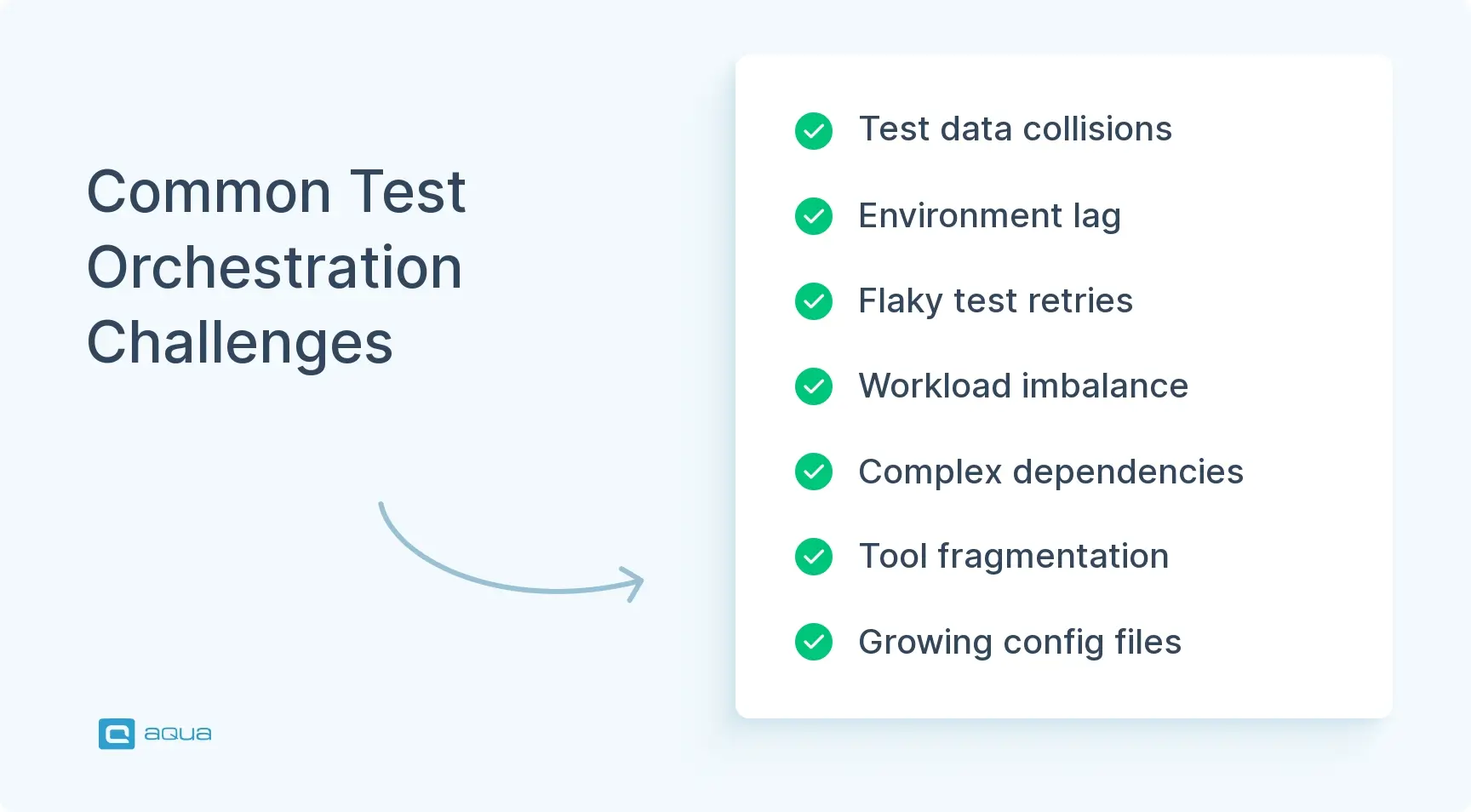
Most orchestration problems appear in the first month of parallel execution. The table pairs each obstacle with the cause and the fix your team can apply.
Challenge
Why it happens
How to mitigate it
Test data collisions
Parallel workers read and write the same accounts, records, or fixtures inside one shared database.
Assign each worker its own dataset, disposable database, or namespace, and generate unique identifiers per run.
Environment dependencies
Tests start before services, migrations, or message queues finish coming up.
Add readiness probes and health checks to the provisioning step, so execution begins only after a confirmed green state.
Flaky tests and retries
Automatic retries hide a real defect behind an eventual pass, and reliability data disappears with it.
Track flakiness separately from pass/fail, quarantine repeat offenders, and alert your team when the flaky rate climbs.
Uneven workload distribution
Equal test counts per worker ignore runtimes that differ by a factor of ten.
Split by historical duration first, then adopt dynamic reassignment once worker startup overhead varies.
Complex dependencies
Dozens of suites across services create an execution graph that becomes difficult to maintain.
Model dependencies explicitly as a DAG, and review it whenever a new service joins the pipeline.
Tool fragmentation
Playwright, Selenium, API tools, and CI each report results in a different format.
Normalize output to a shared format such as JUnit XML, then aggregate everything in your test management platform.
Growing orchestration complexity
Coordination logic accumulates in CI YAML until it reaches several hundred lines.
Move execution rules out of pipeline files into a dedicated orchestration tool once maintenance costs exceed the value of edits.
Shared data and environments cause many orchestration failures once tests start running in parallel. Isolating datasets and environments removes most of those conflicts. Retries need separate tracking as well, otherwise infrastructure failures and flaky tests become indistinguishable from genuine regressions.
My team has recently inherited an orchestration system of microservices that was overengineered to hell and back. It has several main flows which absolutely cannot break, and need to run efficiently at scale. It works great, but also has some serious tech debt and I'm hesitant to embark on doing any of it without proper automation tests
Here are severn steps covering implementation of test orchestration end-to-end:
Audit the current testing pipeline. Record suite runtime, queue time before execution starts, flaky failure rate, idle worker minutes, and environment setup duration. Without those five numbers, every later decision rests on opinion.
Identify the main bottleneck. Compare the audit results and name the single largest cost: unnecessary tests, sequential execution, environment setup, shared data conflicts, or poor worker distribution. One bottleneck usually accounts for most of the wait.
Map tests and dependencies. Group your suites into smoke, API, integration, UI, and performance layers, then document which suites depend on which services, deploys, or datasets. That map becomes your execution graph.
Define execution rules. Decide what runs on a pull request, on merge, on release candidates, and on nightly schedules. Set prioritization for high-risk areas, and add change-based selection where your suite is large enough to benefit.
Introduce parallelization and environment isolation. Configure sharding across workers, assign separate datasets per worker, and provision ephemeral environments per branch. Isolation matters here, since parallel execution without it produces failures your team cannot reproduce.
Define failure and quality-gate policies. Specify which failures retry automatically, which tests go to quarantine, which results block the pipeline, and at what point later suites should never start. Write these as policy, so they survive personnel changes.
Measure and optimize. Compare pipeline duration, worker utilization, flaky failure rate, and compute cost against your baseline from step one. Repeat the cycle each quarter, because suite composition changes faster than most teams expect.
Partial adoption is normal here. If your main bottleneck is a 90-minute regression suite, begin with test splitting and selective execution on pull requests. If setup consumes most of the clock, automate environment provisioning first and leave selection logic for a later iteration.
Test Orchestration Tools and Technologies
Test orchestration tools range from basic CI features to specialized platforms. Your choice depends on where tests execute, how many frameworks your team runs, and which bottleneck hurts most.
Tool
Category
Orchestration capabilities
GitHub Actions, GitLab CI, CircleCI
CI platform built-ins
Job dependencies, parallel execution, matrices, and conditional workflows. GitHub Actions generates up to 256 jobs in a single matrix workflow, while GitLab supports up to 200 parallel copies of a job.
Executes tests inside clusters, defines workflows with setup and teardown steps, and decouples test logic from CI provider specifics. Suits teams running many clusters or several CI systems.
Buildkite Test Engine
Test analytics and splitting
Splits tests by historical execution time, tracks reliability separately from pass/fail, and quarantines flaky tests. Reliability data survives even when a retry eventually passes.
CircleCI Dynamic Test Splitting
Adaptive distribution
Redistributes work according to actual worker availability, compensating for uneven startup times and execution overhead. Currently in beta.
Playwright sharding
Framework-level splitting
Divides a suite across machines. The documentation demonstrates four shards running as separate jobs, each executing part of the suite.
AI-based test orchestration extends several of the rows above. Vendors also label the same capability AI test orchestration, and it applies machine learning to predict likely failures, refine change-based selection, and adjust resource allocation during a run.
How to choose a test orchestration tool
Start from the bottleneck your audit identified, since your existing test automation solution may already cover part of the work.
Long suite runtime. When a 90-minute suite blocks merges, splitting and selection come first. Buildkite Test Engine handles timing-based splits, while BrowserStack Smart Test Selection narrows scope by code change.
Slow environment setup. Testkube fits teams already running Kubernetes, while your existing CI platform handles simpler provisioning through reusable jobs.
Large browser or device matrix. Selenium Grid keeps execution in-house, and cloud platforms remove the maintenance burden at a subscription cost.
Fragmented reporting. When results arrive from five frameworks and release status stays unclear, the fix belongs in test management.
Fragmented reporting calls for a system of record alongside the execution layer. aqua cloud stores manual and automated test assets in a single repository, schedules runs in advance, and triggers execution through automation agents. Results land against the matching test case, so requirements traceability stays current without manual reconciliation. Bidirectional Jira sync plus Jenkins and Azure DevOps integration connect aqua cloud to your CI pipeline, and it answers the reporting and coverage questions your execution tooling was never designed to handle.
Two tools with overlapping scope create reconciliation work, so map your workflow, confirm the problem each candidate solves, and pilot on one suite first.
Proper orchestration requires a single source of test assets. aqua cloud, an AI-driven test and requirement management solution, centralizes manual and automated assets in one repository. This removes the fragmented strategies that 56% of organizations struggle with. Your team schedules runs and keeps full execution history per release. Automated traceability maps every result back to requirements, so release reporting stops depending on spreadsheets. aqua Intelligence grounds test generation in your project documentation with RAG, keeping coverage aligned as requirements change. Teams on aqua cloud save 12+ hours per week per user and accelerate releases by 60%. Capture records for each session with video and screenshots, giving your reports the evidence they need. Moreover, execution connects through 10+ native automation integrations, covering JMeter, SoapUI, Ranorex, REST API, PowerShell, UnixShell, and MSSQL and Oracle databases.
Boost your testing efficiency by 80% with aqua Intelligence
Test orchestration becomes relevant once execution speed and coordination limit your pipeline. Your frameworks execute the checks. The orchestration layer decides scope, order, placement, and consequence. Start by mapping your current pipeline, then measure where the waiting happens: environment setup, worker imbalance, retries, or manual selection. Address the largest wait with whatever your CI platform already offers, and add a dedicated tool once coordination logic costs more to maintain than the tests themselves. Useful feedback per unit of compute remains the metric worth tracking.
Test orchestration is the automated coordination layer that determines which tests run, when, where, and how testing activities interact across your pipeline. It works above frameworks like Playwright and pytest, managing selection, sequencing, parallelization, environment prep, failure handling, and result aggregation.
What is the difference between test automation and test orchestration?
Test automation makes individual tests execute without manual intervention, so your team writes scripts that verify behavior. Test orchestration coordinates those scripts at pipeline level, choosing which run for a given change, how they distribute across workers, and how failures get handled.
Why is test orchestration important for CI/CD?
Modern pipelines coordinate dozens of suites across multiple environments and frameworks. Without orchestration, that complexity ends up in brittle configuration files, tests wait on each other, compute stays idle, and feedback stretches from minutes into hours before your team sees a result.
What tools are used for test orchestration?
Common test orchestration tools include BrowserStack Test Orchestration for cloud cross-browser runs, Testkube for Kubernetes-native coordination, Buildkite Test Engine for analytics and splitting, CircleCI Dynamic Test Splitting, and built-in features from GitHub Actions, GitLab CI, and Jenkins.
How do you measure the success of test orchestration?
Track four metrics: total pipeline duration from commit to verdict, worker utilization across parallel runs, the share of failures caused by infrastructure or flakiness, and compute cost per pipeline run. Improvement in all four confirms your orchestration strategy works.
Can a small QA team benefit from test orchestration?
Yes, though your starting point differs. Small teams get most of the value from CI platform features like matrices, job dependencies, and timing-based splitting. Dedicated platforms become worthwhile once suite runtime, environment count, or framework variety outgrows your configuration files.
How does test orchestration handle test data in parallel runs?
The orchestration layer isolates state so concurrent workers never collide. Typical approaches include dedicated test accounts per worker, disposable databases, namespace isolation, synthetic datasets, and unique identifiers generated per run, followed by automatic cleanup once execution finishes.
Robert has several years of experience in process optimisation and test management. He is an expert in defining and implementing workflows by adapting aqua to the clients’ processes.
Nurlan, a QA Coordinator & Quality Standards Officer, takes pride in orchestrating seamless QA operations. His expertise in coordinating QA-focused projects and integrating QA solutions has consistently yielded top-tier client satisfaction. Aside from a full-time QA coordinator, Nurlan's role involves creating compelling content that educates…
Pavel, a Quality Assurance Consultant and Author, brings deep expertise to solving complex testing challenges. His background in software development has helped organizations transform their QA practices from reactive to proactive. Beyond consulting, Pavel develops best practice guides and case studies for aqua cloud that…
Join our community of enthusiastic experts! Get new posts from the aqua blog directly in your inbox. QA trends, community discussion overviews, insightful tips — you’ll love it!
We're committed to your privacy. Aqua uses the information you provide to us to contact you about our relevant content, products, and services. You may unsubscribe from these communications at any time. For more information, check out our Privacy policy.
X
🤖 Exciting new updates to aqua Intelligence are now available! 🎉