Your end-to-end test suite just failed for the third time this week. Not because of actual bugs, but because someone changed a CSS class name. Meanwhile, the critical payment validation logic you shipped last sprint has been silently corrupting user data for two days, and your integration tests never caught it. This is what happens when your testing strategy is upside down: expensive tests at the top catching cosmetic issues while real problems slip through untested code paths at the bottom. The software testing pyramid flips this script. How? We will explain it in detail in this comprehensive guide. Let’s dive into the details together.
The testing pyramid in Agile workflows works by putting most testing effort into fast, cheap unit tests at the base, fewer integration tests in the middle, and the fewest, most expensive end-to-end tests at the top.
An inverted testing pyramid, where teams rely heavily on slow UI tests and barely write unit tests, is the most common and costly mistake teams make, and it is exactly what the pyramid model was designed to prevent.
Teams that implement the pyramid correctly reduce overall debugging time by up to 60%, according to Microsoft research cited in this guide.
The pyramid is not the only model. The testing trophy, the test diamond, and the testing honeycomb each adjust the proportions for different architectures, particularly microservices.
Manual and exploratory testing still matter. The pyramid governs automated test distribution, not whether human testing has a place in your strategy.
What is the Testing Pyramid?
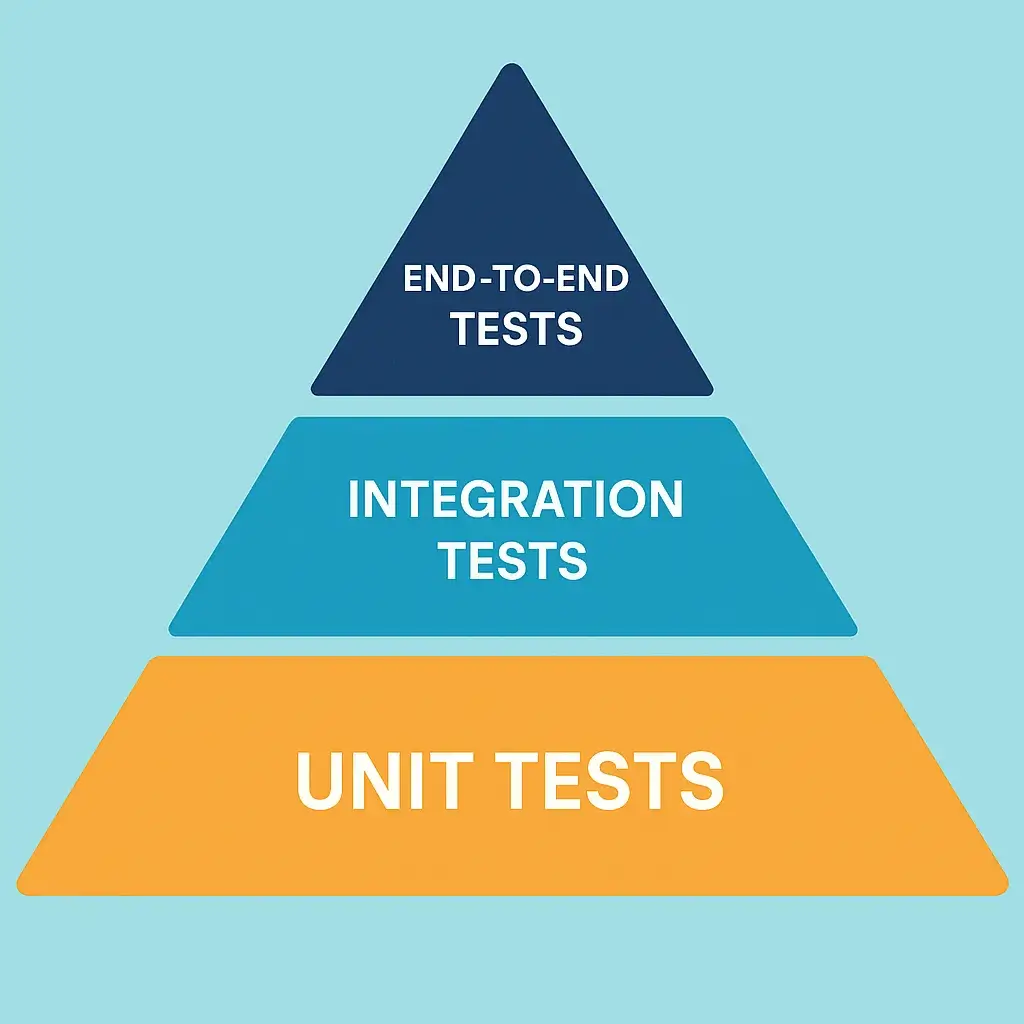
The testing pyramid is a model for distributing testing effort across three levels: a wide base of fast unit tests, a smaller middle layer of integration tests, and an even smaller top layer of end-to-end tests. Mike Cohn introduced it in “Succeeding with Agile,” and the shape is strategic rather than arbitrary. It’s a simple visual model that shows how to distribute your testing efforts across three levels. Picture a pyramid. A wide base of unit tests at the bottom. Smaller middle layer of integration tests. Even smaller top section of end-to-end tests. The shape is strategic, no matter how random it sounds. Most of your testing effort should happen at the bottom.
Think about it this way. A unit test runs in milliseconds and fails only when the code breaks. An end-to-end test takes minutes to run and might fail because your test environment is slow. Which one do you want running every time you save a file? Here’s what each level tackles:
Unit tests (base): Individual functions or methods in isolation
Integration tests (middle): How components work together
End-to-end tests (top): The full user journey through your application
The higher you climb the pyramid, the slower and more brittle your tests become. Unit tests catch logic errors in seconds. Integration tests catch interface problems in minutes. End-to-end tests catch user experience issues, hopefully before your users do.
Levels of the Testing Pyramid
Each level of the testing pyramid in Agile workflows catches a different category of problem: unit tests catch logic errors in isolated code, integration tests catch interface mismatches between components, and end-to-end tests catch failures in the complete user journey. Each layer serves a different purpose and catches different types of problems. Understanding when and how to use each one will determine whether your testing strategy helps or hurts your development speed.
Unit Tests (Base of the Pyramid)
Unit tests verify that individual functions do exactly what they’re supposed to do. Nothing more, nothing less. Think of testing a calculateDiscount() function with different inputs to make sure it returns the right percentage every time. These tests run thousands at a time in seconds. They give developers immediate feedback when something breaks. No waiting around for slow test suites or dealing with flaky network calls. A good unit test is isolated. No database calls. No API requests. No file system access. Just pure logic testing. The same input always produces the same output. If your test sometimes passes and sometimes fails with identical code, it’s not a unit test. It’s a headache.
Popular unit testing tools include:
JavaScript: Jest, Mocha, Jasmine
Python: pytest, unittest
Java: JUnit, TestNG
C#: NUnit, MSTest. Here’s the magic: unit tests catch regressions instantly. You write a function, test it works, then six months later, someone modifies it for a new feature. If they break the original behaviour, the test fails immediately. No debugging sessions. No “it worked on my machine” conversations. Most of your testing effort should happen here. Aim for this level to carry the heavy lifting.
Integration Tests (Middle Layer)
Integration tests verify that your components actually work together. Your user service talks to the database correctly. Your payment processor connects to your order system without errors. These tests cross the boundaries that unit tests can’t touch. Unlike unit tests, integration tests hit real systems. They call actual databases. They make HTTP requests to real services. They interact with the file system. This makes them slower and sometimes unreliable, but they catch problems that unit tests miss. Think about interface mismatches. Your user service expects a “userId” field, but the database returns “user_id”. Unit tests won’t catch this as they mock everything. Integration tests will fail immediately when they try to connect the real components.
Common integration testing tools include:
API Testing: Postman, REST Assured, Supertest
Database: DBUnit, TestContainers
Message Queues: JMSUnit, EmbeddedAMQ
Focus integration tests on critical system boundaries. Test your authentication flow from login request to token generation to database storage. Don’t try to test every possible user path. That’s what E2E tests are for.
End-to-End Tests (Top of the Pyramid)
End-to-end tests simulate real users clicking through your application. They fill out forms. They navigate between pages. They complete entire workflows from start to finish. These tests verify that everything works together to deliver the actual user experience. E2E tests are expensive but necessary. They catch problems that slip through other test layers. Can a customer complete checkout? Can they reset their password? Can they upload a file and see it appear in their dashboard? These are the questions E2E tests answer. The tradeoffs are significant. E2E tests run in minutes instead of seconds. They fail randomly due to timing issues, network problems, or browser quirks. UI changes break them constantly. That’s why you need fewer of them.
Popular E2E testing tools include:
Web: Cypress, Selenium, Playwright
Mobile: Appium, Detox, Espresso
API: Postman, Karate
Be selective with E2E tests. Don’t test every feature; test critical business paths. User login. Purchase completion. Account management. Data export. Pick the workflows that absolutely must work for your business to survive.
Is your team struggling to implement an effective testing strategy that balances speed and quality? The testing pyramid offers a clear structure, but managing different test types across your agile workflow requires the right toolset. This is where aqua cloud shines as your comprehensive test management solution.
With aqua cloud, you can seamlessly organize and track tests across all pyramid levels, from unit tests at the base to end-to-end tests at the top. Its AI-powered test case generation capabilities help you quickly create tests aligned with testing pyramid principles, saving up to 98% of your team’s time. The platform’s real-time coverage tracking instantly reveals gaps in your testing strategy, ensuring you maintain the ideal balance of test types while achieving 100% requirement coverage.For agile teams continuously shipping code, aqua’s integration with tools like Jira, Confluence and Azure DevOps keeps everyone synchronized, with complete traceability between requirements, test cases, and defects. No more guessing which requirements remain untested or where your quality risks lie.
Implement a balanced, efficient testing pyramid and deliver higher quality software faster
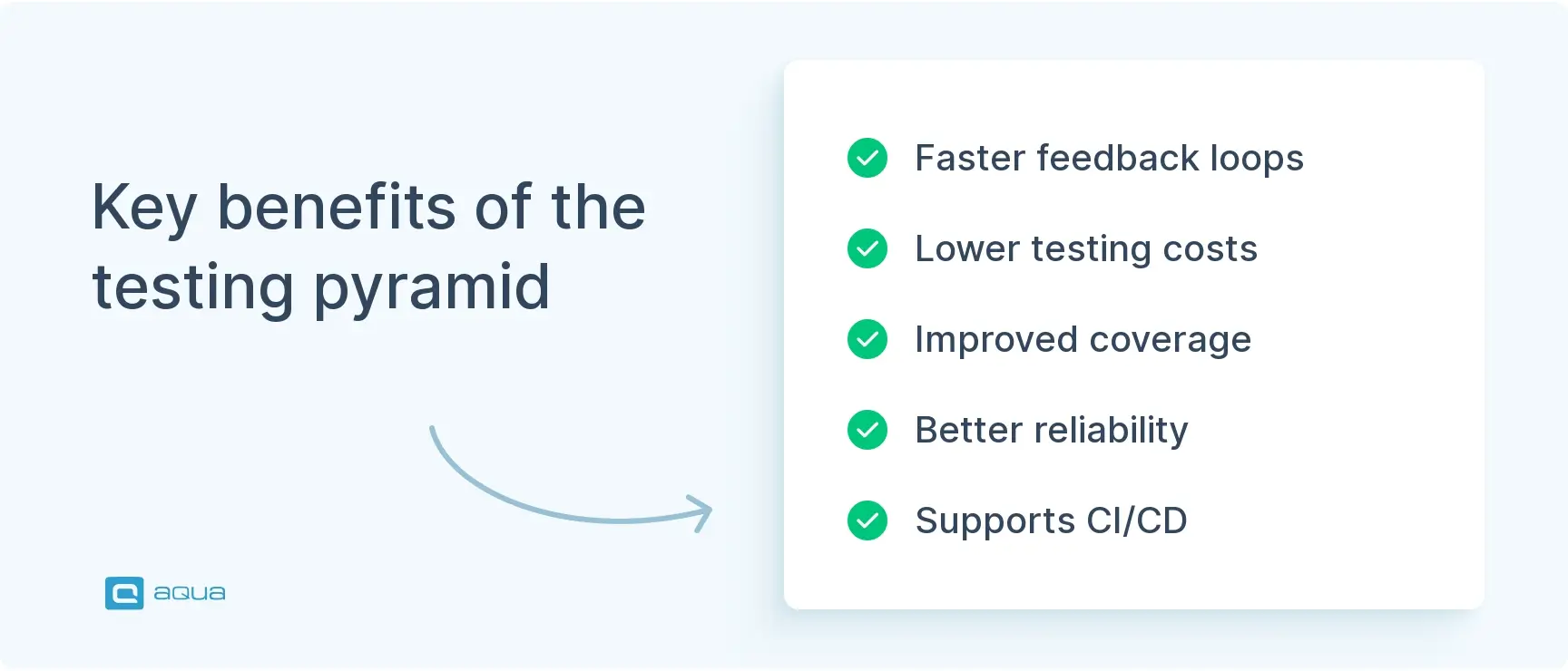
The testing pyramid has several benefits that do not stay on the paper, it delivers measurable improvements to your development process. Here’s what changes when you get the balance right. These benefits compound over time, making your team faster and your software more reliable.
Faster Feedback Loops
Unit tests give developers feedback in seconds. Write a function, run the test, see if it works. No waiting for builds. No deployment pipelines. No manual testing cycles. This speed changes how developers work. They catch bugs immediately instead of hours later during integration testing. Problems get fixed while the code is still fresh in their mind. Context switching becomes minimal. According to a study by Microsoft, teams that implement the testing pyramid reduce their overall debugging time by up to 60%.
Lower Testing Costs
Creating an end-to-end test takes 4-8 hours. Creating a unit test takes 10-30 minutes. The math is simple, you get more coverage per hour invested when you focus on the pyramid’s base. Maintenance costs follow the same pattern. Unit tests break only when logic changes. E2E tests break when someone updates a CSS class, changes a button label, or modifies the deployment environment. Consider this comparison:
Test Type
Creation Time
Run Time
Maintenance Cost
Unit Test
10–30 min
< 1 sec
Low
Integration Test
1–2 hours
5–30 sec
Medium
E2E Test
4–8 hours
1–5 min
High
Improved Test Coverage
The pyramid approach makes it feasible to test more of your application. A project might have thousands of unit tests but only dozens of E2E tests, yet achieve better overall coverage.
Better Test Reliability
Unit tests are deterministic. Same input, same output, every time. E2E tests fail for dozens of reasons that have nothing to do with your code: network timeouts, browser updates, third-party service downtime, and race conditions. When your test suite is mostly unit tests, failures actually mean something. Developers trust the results. Red builds get attention instead of being ignored as “probably flaky.”
Supports Continuous Integration
Unit tests run in seconds, so they can run on every commit. Integration tests run in minutes, so they can run on every merge. E2E tests run in hours, so they run nightly or before releases. This creates a fast feedback pipeline. Developers know immediately if they broke something. The team knows quickly if integration problems exist. Critical user paths get validated before customers see them.
How to Implement the Testing Pyramid in Your Workflow
Let’s get practical now.
Most teams don’t start with a perfect pyramid. You probably have scattered tests, heavy reliance on manual QA, or an inverted pyramid with too many slow E2E tests. Here’s how to fix it without rewriting everything from scratch.
1. Assess Your Current Testing Mix
Count your tests. How many unit tests do you have? How many integration tests? How many E2E tests? Most teams discover they’re top-heavy—dozens of brittle UI tests and barely any unit tests. Look at your test run times too. If your “quick” test suite takes 20 minutes, you’ve got pyramid problems.
2. Start With Unit Testing
Begin with the foundation. Pick a core module of your application and boost its unit test coverage. Focus on:
Business logic with complex rules
Code that changes frequently
Areas with past bugs
Resist the urge to test simple getters and setters. Test the logic that actually matters.
3. Set Concrete Goals
Don’t aim for perfect ratios immediately. If you currently have 10% unit tests, aim for 40% first. Then 60%. Then 70%.
Set time-based goals too. “New features must include unit tests.” “Bug fixes need regression tests.” “Refactoring requires test coverage first.” This gives everyone a clear direction without being overly prescriptive.
4. Add Integration Tests Strategically
Once you have solid unit test coverage, identify key integration points in your system:
API contracts between services
Database interactions
Third-party service connections
Write focused integration tests for these boundaries.
5. Reserve E2E Tests for Critical Paths
Identify the must-work user journeys in your application. These are your candidates for E2E tests:
Login and authentication
Core business transactions
Payment processing
Data-critical operations
6. Integrate With Your CI/CD Pipeline
Structure your pipeline to run tests in parallel (according to CI/CD pipeline), with the fastest tests first:
Unit tests run on every commit
Integration tests run on successful unit tests
E2E tests run before deployment or nightly
7. Monitor and Improve Test Quality
Monitor these metrics:
Test distribution: Are you moving toward the pyramid shape?
Failure rates: Which test types catch real bugs vs false positives?
Run times: Are your fast tests staying fast?
Developer adoption: Are people actually writing tests?
Adjust based on what you learn. If integration tests keep failing due to environment issues, simplify them. If unit tests aren’t catching bugs, improve test quality.
Challenges and Considerations
Almost every team hits roadblocks when shifting to pyramid testing. Good news is, these problems are predictable and solvable. Here’s what to expect and how to deal with each challenge:
Legacy Codebase Challenges
Old code wasn’t written for testing. Functions have hidden dependencies. Classes are tightly coupled. Methods do too many things at once. Don’t try to test everything immediately. Follow these instead:
Use integration tests as a safety net while refactoring
Implement the “Strangler Fig” and gradually replace untestable legacy code by building new, testable components around it. Redirect functionality step by step until the old code can be safely removed.
Add tests for new code while progressively improving test coverage for old code
Focus on the code that changes most often. That’s where tests provide the biggest return on investment.
I see it as a grid where one axis is control and one is scope. The more scope you test, less control. This is integration testing. You cannot decide a database call will fail randomly from the api layer. More scope (api, logic, database) with less control (cannot mock db response). This is fundamentally why unit testing is considered foundational. More control for less scope. What if the database is locked up? How will we respond? Well, just test the unit and mock the database and lets find out.
Nothing kills test confidence faster than random failures. E2E tests are the worst offenders, but integration tests can be flaky too.
Fix flaky tests immediately:
Implement retry mechanisms for non-deterministic tests
Quarantine flaky tests until fixed
Use explicit waits instead of implicit/fixed timeouts
Minimise dependencies on external services in test environments
Overemphasis on Coverage Metrics
Teams see “80% coverage” as a goal and start writing useless tests. They test getters and setters. They mock everything to hit coverage targets. They ignore critical business logic that’s hard to test. Coverage tells you what’s not tested, not what’s well tested:
Focus on testing business-critical paths rather than arbitrary coverage targets
Combine coverage metrics with other quality indicators
Emphasise requirement coverage over code coverage
Maintaining Test Data
Integration and E2E tests often need realistic test data. Creating and maintaining this data becomes a nightmare as tests multiply. Build data programmatically:
Use factories or builders to create test data programmatically
Implement database seeding in test environments
Consider using Docker containers for isolated test environments
Look into test data management tools for complex scenarios
Clean up after every test. Leftover data from one test shouldn’t affect another.
Skill Gaps
Not everyone knows how to write good tests. Some developers have never written unit tests. Others write tests that are harder to maintain than the code being tested. Invest in skills development:
Pair programming sessions focused on testing
Using AI to generate comprehensive unit tests faster
Regular code review with testing focus
Internal workshops and knowledge sharing
Establishing testing patterns and examples for the team
Common Testing Pyramid Anti-Patterns
Recommended placement: after “Challenges and Considerations” and before “Conclusion.” Challenges covers obstacles teams hit while implementing the pyramid correctly. This section covers what happens when teams get the shape itself wrong, which is a distinct and more fundamental problem.
The intro of this guide already names the core failure mode: an inverted testing pyramid, where expensive tests sit at the top and real problems slip through untested code at the bottom. This is worth naming explicitly because it is the single most common anti-pattern in real codebases, and recognizing it early saves months of accumulated technical debt.
The ice cream cone anti-pattern is the most extreme version of inversion. Picture the pyramid flipped upside down: a small base of unit tests, a slightly larger layer of integration tests, and a huge top layer of manual and end-to-end tests. Teams fall into this pattern gradually, usually because manual QA feels safer in the short term and unit tests get deprioritized under sprint pressure. The result is a regression cycle that doubles in length as the application grows, paired with steadily eroding trust in the automation suite.
The cupcake anti-pattern is a milder but still costly variant. Here, integration tests dominate instead of unit tests. Teams write integration tests because they feel more “real” than unit tests, but they run slower, cost more to maintain, and catch the same logic bugs a unit test would catch in a fraction of the time.
The 100% coverage obsession is a different kind of anti-pattern. Teams chase a coverage percentage rather than testing what actually matters, which leads to thousands of tests for trivial getters and setters while complex business logic remains genuinely under-tested. Coverage tells you what code executed during a test run. It tells you nothing about whether the test actually verified the right behavior.
Mocking everything is the automation equivalent of the cupcake pattern. When every dependency is mocked to make tests pass quickly, the tests stop verifying anything real. A unit test suite that mocks the database, the API, and every collaborator can pass while the actual integration between those pieces is completely broken.
The fix for all four anti-patterns is the same: measure your actual test distribution against the pyramid shape, not against an arbitrary coverage number, and treat any inverted testing pyramid you find as a structural problem to fix deliberately, not a temporary state to tolerate.
Testing Pyramid vs. Modern Alternatives
The classic pyramid is not the only valid shape for distributing test effort, and choosing the right one depends on your architecture rather than picking whichever model is currently trending.
The testing trophy, popularized by Kent C. Dodds, shifts the bulk of effort to integration tests rather than unit tests, and adds static analysis tools like linters and type checkers as a foundational layer beneath everything else. It fits projects where the cost of writing and maintaining true unit tests is high relative to the confidence integration tests already provide, which is common in component-heavy frontend frameworks.
The test diamond gives roughly equal weight to unit and integration tests, dropping the strict pyramid ratio in favor of a more balanced split. Teams with complex business logic spread across service boundaries, rather than concentrated in pure functions, often find this shape matches their actual risk profile better than the traditional pyramid.
The testing honeycomb, developed at Spotify, is built specifically for microservices architectures. Since most complexity in a microservices system lives in the interactions between services rather than within any single service, the honeycomb shifts emphasis toward integration-style tests that validate those service boundaries, while keeping a smaller layer of true unit tests and an even smaller layer of full end-to-end tests across the whole system.
None of these models replace the pyramid outright. They are adjustments to the same core principle the pyramid established: fast, cheap tests should outnumber slow, expensive ones. The testing pyramid in Agile teams building a monolith still tends to be the right default. Teams running distributed microservices, or frontend-heavy component architectures, often get better results from the honeycomb or the trophy. Pick based on where your actual complexity and risk live, not based on which shape is more fashionable this year.
Conclusion
So what did we learn? The testing pyramid works because it matches how software actually breaks. Most bugs live in business logic that unit tests catch quickly. Some bugs happen at integration points that focused integration tests find efficiently. A few bugs only surface in complete user workflows that E2E tests validate expensively. By putting most of your testing effort at the bottom of the pyramid, you catch more problems faster and cheaper than any other approach. Your goal is shipping better software more confidently. The pyramid gives you a framework to make smart tradeoffs about where to invest your testing time.
Now that you understand the power of the testing pyramid approach, how will you implement it effectively across your workflows, according to agile trends? Most teams struggle with maintaining the right balance of unit, integration, and end-to-end tests, especially when tests are scattered across different tools and repositories.
aqua cloud provides a unified platform for managing your entire test ecosystem. Its powerful requirement traceability features ensure complete visibility into test coverage across all pyramid levels, instantly highlighting areas where you need more unit tests or where expensive end-to-end tests could be replaced with faster alternatives. With aqua’s AI Copilot, your team can automatically generate comprehensive test cases using proper techniques like Boundary Value Analysis and Equivalence Partitioning, ensuring methodical coverage without the manual effort. The platform’s deep integration capabilities connect seamlessly with your existing tools like Jira, Confluence, and Azure DevOps, making the testing pyramid accessible to everyone in your organization, from developers to QA specialists to product owners. Custom dashboards and automated reporting provide instant visibility into your test distribution, helping teams maintain the ideal pyramid shape.
Reduce testing time by 80% while achieving 100% test coverage with aqua's balanced testing approach
The software testing pyramid is a testing strategy model that suggests having a large base of unit tests, fewer integration tests in the middle, and even fewer end-to-end tests at the top. It guides teams on how to distribute their testing efforts across different testing levels, emphasizing faster, more focused tests at the lower levels. The software test pyramid is fundamental to creating efficient and effective testing strategies in modern development environments.
Is the testing pyramid still valid?
Yes, the test pyramid is still valid in modern software development. While tools and technologies have evolved, the fundamental principle prioritising fast, reliable tests over slow, brittle ones still applies. Many successful organisations follow pyramid principles, though some adjust the exact proportions based on their specific needs.
What are the levels of the testing pyramid?
The traditional testing pyramid consists of three levels:
Unit tests (base): Testing individual functions, methods, or classes in isolation
Integration tests (middle): Testing interactions between components and services
End-to-End tests (top): Testing full user flows through the entire application
Some extended versions include additional layers like component tests, contract tests, or performance tests, but the core three-level model remains widely used.
Where do manual and exploratory testing fit in the testing pyramid?
The testing pyramid governs how you distribute automated test effort. It does not replace manual or exploratory testing, and trying to force every test type into the pyramid’s three automated layers misunderstands what the model is for. Exploratory testing, usability checks, and ad hoc bug hunting require human judgment that no automated test, at any level of the pyramid, can replicate. The practical approach most mature QA teams use is to run the testing pyramid in Agile sprints for regression coverage, while reserving dedicated time for manual exploratory sessions on new features and high-risk changes. Some teams represent this visually as a separate, parallel track rather than trying to wedge manual testing into the pyramid itself, since manual testing answers a different question (does this feel right to a real user) than automated testing does (does this code behave as specified).
How does the testing pyramid apply to microservices and distributed systems?
The classic testing pyramid in Agile monoliths assumes most complexity lives inside individual components, which justifies a large base of unit tests. In a microservices or distributed system, that assumption breaks down, because most of the actual risk lives in the interactions between services rather than within any single service’s internal logic. This is exactly why the testing honeycomb was developed at Spotify specifically for this context: it shifts emphasis toward integration-style tests that validate service-to-service contracts, while keeping a smaller layer of unit tests for the logic that genuinely is internal to each service, and an even smaller layer of full end-to-end tests across the whole distributed system. Contract testing tools become essential here, since validating every possible combination of services with full end-to-end tests becomes prohibitively slow and brittle as the number of services grows. Teams running microservices architectures should treat the honeycomb, not the classic pyramid, as their starting default.
Robert has several years of experience in process optimisation and test management. He is an expert in defining and implementing workflows by adapting aqua to the clients’ processes.
Nurlan, a QA Coordinator & Quality Standards Officer, takes pride in orchestrating seamless QA operations. His expertise in coordinating QA-focused projects and integrating QA solutions has consistently yielded top-tier client satisfaction. Aside from a full-time QA coordinator, Nurlan's role involves creating compelling content that educates…
Join our community of enthusiastic experts! Get new posts from the aqua blog directly in your inbox. QA trends, community discussion overviews, insightful tips — you’ll love it!
We're committed to your privacy. Aqua uses the information you provide to us to contact you about our relevant content, products, and services. You may unsubscribe from these communications at any time. For more information, check out our Privacy policy.
X
🤖 Exciting new updates to aqua Intelligence are now available! 🎉