Defect Clustering in Software Testing: What It Is and How It Works
Defect clustering in software testing means most of your bugs come from a few modules, not from the whole application. If half the defects in your last release came from two modules, that's clustering, and it's why experienced QA teams don't spread their effort evenly. Once you know which modules cause the trouble, you know where to test harder and what to run first in regression.
Defect clustering means a small share of your modules produce most of your bugs. Often 70 to 90% of defects sit in a few modules, close to an 80/20 split.
Login, payments, and anything that calls an outside API are the usual suspects. They’re complex, they change often, and they depend on systems you don’t control.
To find clusters, export defects from your tracker, count them by module, and compare defect density so big and small modules get judged fairly.
Test and automate the clustered modules first. Stable code needs a lighter touch.
Clustering only reflects past bugs. A module with few defects may simply be untested, so don’t write it off.
If 80% of your crashes come from 20% of your code, testing everything equally wastes time. Here’s how to find that 20% and put it to work.
What Is Defect Clustering in Software Testing?
Defect clustering is the pattern where a small group of modules holds most of an application’s defects, usually 70 to 90% of them. Picture finding every missing sock in one corner of the dryer. The bugs aren’t spread across the whole load.
That’s the defect clustering definition most QA teams work with. The defect clustering meaning in practice is simple: some code breaks far more often than other code. Maybe it’s the payment gateway that’s been patched six times this year. Maybe it’s the search feature three developers rewrote since spring. Your own bug history shows you which ones, so you don’t have to guess.
So what is defect clustering in plain terms? A planning tool. The shaky modules get more test coverage and more exploratory time. The quiet legacy modules, the ones with no bugs in two years, get a quick smoke test and are left alone. That’s how defect clustering in testing turns a pile of bug reports into a plan.
The Principle Behind Defect Clustering
The defect clustering principle comes from the Pareto Principle, the 80/20 rule: roughly 80% of defects come from 20% of modules. The ratio moves. Some projects land at 70/30, others at 90/10. The shape stays the same.
Two things drive it. The first is complexity. A module that handles business rules and calls several APIs has far more places to break than a settings page. The second is change. Every edit to a busy module can break something that worked yesterday. Deadlines make it worse, since a feature rushed out by a tired team usually carries more bugs than one built with time to spare.
The defect clustering testing principles are about patterns, not people. When one module keeps filling your tracker, treat that as information. It may need a refactor or its own integration tests, or just a second reviewer on every pull request. The data lets you ask for that with evidence.
Examples of Defect Clustering
A typical defect clustering example looks like this: the same few areas fill your bug list every release. These are the ones teams report most often:
Login and authentication – OAuth, session handling, and token expiry all have to work together, and locked or expired accounts add edge cases. A SaaS product can find that 60% of its critical defects trace back to login.
Payments and checkout – Money logic leaves little room for error. Currency conversion and tax rules interact with discount codes and refunds, and gateway timeouts add more failure points. One bug can block revenue, so e-commerce teams notice this cluster first.
Third-party API integrations – You depend on someone else’s uptime and schema. When a mapping or email service renames a field or hits a rate limit, your feature breaks and the bug lands in your tracker.
Search and filtering – Query parsing, ranking, pagination, and load all affect results. Users search constantly, so they report these bugs fast.
Admin dashboards and reporting – These get built late and tested lightly, then power users push them in ways nobody planned. A reporting module can end up with half of a product’s production bugs.
Mobile-specific modules – Push notifications, offline sync, and biometric login depend on device hardware and OS permissions that you can’t fully control.
Every example of defect clustering comes down to complex logic that changes often and depends on other systems. If you see that combination in your own product, start there.
How to Identify Defect Clusters
You identify defect clusters by counting defects per module and checking which modules hold most of them. Export defects from Jira or GitHub Issues with a module or component tag. If your tracker doesn’t tag by module, add tags by hand or write a short script that sorts bugs by keywords in the title.
Then rank modules by defect count and add up the percentages as you go down the list. If three modules cover 70% of all defects, those are your clusters. A bar chart or Pareto chart makes this obvious at a glance. Repeat the exercise at the end of every sprint or release, because a quiet module can become a hotspot right after a big refactor.
Next, check defect density, which is defects per 1,000 lines of code or per function point. Module A with 200 defects in 5,000 lines has eight times the density of Module B with 50 defects in 10,000 lines. Density lets you compare a small module against a large one fairly. Add severity too, because a pile of minor UI glitches is a different problem from a pile of security holes.
Then ask people. Developers know which modules they dread editing, and support knows which features generate the most tickets. Those answers often point to clusters your numbers haven’t caught yet.
Defect Clustering vs Defect Density
Defect clustering tells you which modules hold most of the bugs. Defect density tells you how many bugs a module has for its size.
Aspect
Defect Clustering
Defect Density
Question it answers
Which modules hold most defects?
How defect-prone is this module for its size?
Definition
Most defects concentrate in a few modules.
Defects per unit of code, such as per KLOC or function point.
Main use
Deciding where testing effort goes.
Comparing quality across modules or releases.
Example
80% of bugs come from 3 of 20 modules.
Module A has 10 defects per 1,000 lines of code.
Data needed
Defect counts per module.
Defect counts plus code size.
Use clustering to decide where testing goes. Use density to decide whether a module needs a rewrite or just more coverage. A small module can have terrible density and a low bug count. A huge central module can have mild density and still be your biggest cluster, simply because so much of the app runs through it.
How Defect Clustering Helps QA Teams
Defect clustering helps QA teams spend limited time on the modules that cause the most damage. Instead of covering every feature equally, you put testers, scripts, and review time where bugs actually appear.
It also gives you a straight answer when someone asks what your biggest risk is. You can say Module X caused 65% of critical defects over the last three releases. That’s far easier to defend in planning than a gut feeling, and it makes extra testing or a refactor an easier sell.
Regression testing improves too. A module with no bugs for months needs a smoke test. A known hotspot needs the full suite every time someone touches it.
Developers respond better to this data than to complaints. Showing them that two features produce 75% of production bugs makes it a shared problem, and the conversation moves to root causes like technical debt or missing unit tests.
Defect clustering in manual testing works the same way. A manual tester who knows which modules misbehave can spend exploratory time there instead of splitting it evenly across the app. That matters most right before a release, when there’s never enough time to cover everything. It only works if the underlying data is clean, so keep a solid bug reporting habit. Teams that work in sprints can use agile reporting tools to keep module tags consistent.
How to Apply Defect Clustering in Software Testing
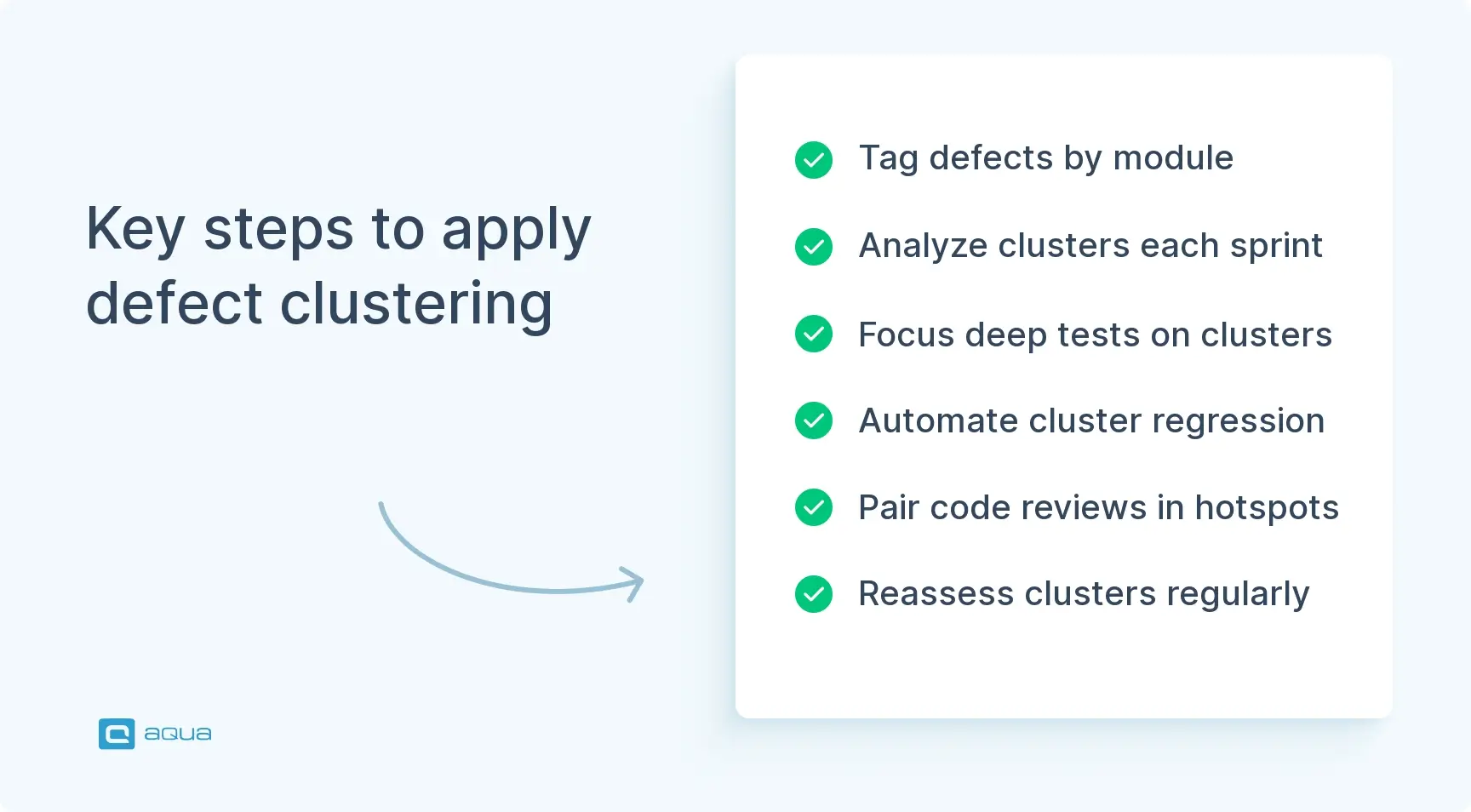
Start by sorting your past defect logs by module. If tagging isn’t in place yet, set it up first, because every step below depends on clean data. Then work through these steps:
Write deeper test cases for clustered modules – If checkout is a cluster, test error states and integration points, not just the happy path.
Add exploratory testing there – Put your most experienced testers in those modules without a script. They’ll find what scripted tests miss.
Automate regression for clusters first – These modules break often, so automation pays back quickly. Automating a feature nobody touches doesn’t.
Add code review and pair programming for clustered code – A second pair of eyes catches bugs before they reach QA.
Re-run the analysis every sprint – Clusters dissolve after fixes and new ones appear, so your focus has to follow them.
Show the data to stakeholders – A chart or heatmap in a retro makes the risk visible and helps you get time for testing or refactoring.
Defect Clustering in Risk-Based Testing
Defect clustering feeds risk-based testing by showing where failures are most likely, which is half of any risk calculation. The other half is impact: how much it hurts the business when that module fails.
Put both on a simple matrix. A cluster that handles payments or customer data is high likelihood and high impact, so it gets the heaviest coverage: automated regression and exploratory sessions on top of performance and security checks. An admin report used by three people may have just as many bugs, but a failure there costs little, so it gets less attention. That trade-off is what risk-based testing is about, and clustering makes it concrete.
It also helps you see what’s coming. A module that has been a hotspot for four releases will probably be one for the fifth unless someone refactors it. When a stakeholder wants to add a feature there, you can point out that the module already causes half your critical bugs and ask for refactoring time first.
Defect Clustering in Regression Testing
Defect clustering tells you which modules need the heaviest regression coverage. Regression is expensive, and running everything on every change burns through a sprint before you’ve finished.
Modules that clustered before are more likely to break again when touched. Say two of the three features in next sprint’s scope are known clusters. Run the full regression suite on those two and a smoke test on the third.
Automation follows the same rule. An automated test only pays off if the module it covers actually breaks. Automate the clusters first and let your CI pipeline run those tests on every build.
After a deployment, a quick smoke test of the whole app catches obvious breakage. Save the deep regression work for the clusters. When release day is close and time is short, that’s where it belongs.
Tools for Analyzing Defect Clusters
You can analyze defect clusters with tools you probably already use. A spreadsheet is enough to start.
Jira dashboards – Build filters that show defect counts by component or label, then export the data for a closer look.
A defect tracking tool – A dedicated defect tracking tool that tags bugs by module and links them to test cases gives you the cluster view without manual exports.
TestRail or Qase – Both link test cases to defects and show which modules have the most failing tests, which tracks closely with clusters. Qase also offers analytics dashboards.
Excel or Google Sheets – Export the data, build a pivot table, and chart a Pareto. You’ll see your clusters in five minutes.
Tableau or Power BI – Live dashboards you can slice by severity, module, or release. Overkill for a small team, useful at scale.
GitHub Issues or GitLab – Labels categorize bugs, and a short Python script using the API can pull counts per label for charting in matplotlib.
SonarQube – It tracks technical debt by module, and high debt often predicts where bugs will cluster next.
Which tool you pick matters less than checking it every sprint.
Advantages of Defect Clustering
Testing time goes where it matters – Stable code stops eating hours it doesn’t need.
Bugs surface faster – Testers dig into known weak spots instead of wandering the whole app.
Risk conversations get easier – You can show numbers instead of opinions.
Automation budget goes further – You automate the modules that break most.
Dev and QA work on root causes together – The data points at the problem, not at a person.
Improvement becomes visible – A hotspot that goes quiet after a refactor proves the work paid off.
Limitations of Defect Clustering
It only sees the past – Clustering reflects bugs you already found. A stable module can turn into a hotspot after a rewrite, and the old data won’t warn you.
Bad tagging ruins it – If bugs aren’t tagged by module, the numbers mislead. Clean data comes first.
Zero bugs doesn’t mean clean – A module with no defects may just be untested, and clustering can pull attention away from it.
Quiet modules aren’t safe – One rare bug in a calm module, like billing, can still be a disaster.
Data goes stale – After a refactor or a swapped dependency, old clusters mean little.
Developers can feel singled out – Those working in hotspots may read the data as criticism. Present it as a system problem.
Treat clustering as one input. Pair it with exploratory testing and code review. When a cluster shows up, debugging tells you why it formed.
Best Practices for Using Defect Clustering
Tag every defect by module from day one. Make it a required field in your tracker and explain why it matters, so people don’t just click through it. Without tags, clustering data stays incomplete no matter how good your analysis is.
Put the data where people already look. A spreadsheet in a shared drive gets ignored. A chart in the team’s Slack channel or on the sprint board gets read.
Pair the numbers with conversations. The data shows where the clusters are, and the developers who work in that code can tell you why. The real root cause usually comes from that second part.
Re-run the analysis every sprint or release and update your test plan when the picture changes. A cluster you fixed last quarter shouldn’t still be driving this quarter’s priorities.
Frame hotspots as system problems. Complexity, technical debt, and thin test coverage cause them, and blaming one developer fixes none of that.
Keep exploratory testing running alongside clustering. Clusters show where bugs have been. Exploration finds the ones you didn’t know to look for.
Defect Clustering vs. Other Software Testing Principles
Defect clustering is one of seven standard testing principles. Here’s how it relates to the others:
Principle
Definition
Relationship to Defect Clustering
Defect Clustering
Most defects concentrate in a few modules.
Guides where to focus testing.
Pesticide Paradox
Repeating the same tests finds fewer new bugs over time.
Focus on clusters, but refresh those tests regularly.
Testing Shows Presence of Defects
Testing proves bugs exist, never that none remain.
Clustering finds bugs faster but can’t promise zero.
Exhaustive Testing Is Impossible
You can’t test every input and path.
Clustering is the practical answer: test where risk is highest.
Early Testing
Testing early makes defects cheaper to fix.
Data from early builds shows where clusters will form.
Testing Is Context Dependent
Strategy should fit the project.
A SaaS app and an embedded system cluster differently.
Absence of Errors Fallacy
A bug-free product can still fail its users.
Clustering finds technical defects, not unmet needs.
Clustering works best next to these principles, not in place of them. It sharpens where you look but doesn’t replace early testing or exploration.
Defect Clustering Checklist for QA Teams
Tag every defect by module or component, and make the field required.
Run a clustering analysis at the end of every sprint or release.
Find the top 20% of modules that hold most of your defects.
Calculate defect density for those modules to see how severe they are for their size.
Write deeper test cases and add exploratory sessions for each cluster.
Automate regression for the highest-risk clusters first.
Schedule code reviews or pair programming for clustered code.
Track how clusters change over time and adjust the test plan to match.
Share the findings with developers and product managers using simple charts.
Keep exploratory testing going in low-defect areas so they don’t become blind spots.
Use the data to argue for refactoring in modules that stay hotspots.
Talk about clusters as system problems, not individual mistakes.
Review the whole process every quarter to check that tagging and cadence still work.
You’ve learned how defect clustering works, how to identify it, and how to apply it strategically. Now it’s time to put those principles into action with tooling that makes clustering analysis effortless. aqua cloud gives you everything you need to track, visualize, and respond to defect patterns in real time. Build customizable dashboards that surface defect distribution across modules, set KPI alerts that notify you when hotspots emerge, and leverage comprehensive reporting to communicate risk to stakeholders with confidence. With aqua’s end-to-end traceability, every defect is automatically linked to test cases and requirements, giving you the context you need to understand not just where clusters exist, but why. And when it comes to focusing your testing efforts on those critical hotspots, aqua’s domain-trained AI (aqua Intelligence), grounded in your project’s own documentation through RAG technology, generates targeted test cases that speak your codebase’s language, helping you achieve up to 100% coverage in high-risk areas. aqua brings together intelligent defect management, seamless Jira integration, AI-powered test generation, and analytics that actually guide your decisions.
Identify clusters, prioritize smarter, and eliminate 98% of manual testing effort
Defect clustering in software testing sounds obvious once you see it. Bugs gather in complex modules, in code that changes constantly, and in features that rely on outside systems. The teams that notice this and act on it spend their time where it counts.
Clustering gives you evidence for those choices. You can explain your biggest risk with numbers, point developers at the real root causes, and show stakeholders why one module needs a refactor. It won’t tell you what hasn’t broken yet, so keep exploring the quiet parts of the app too. Pull your defect data this week and see which modules come out on top.
Defect clustering is the pattern where a few modules or features account for most of an application’s defects, often 70 to 90% of them. It follows the same shape as the 80/20 Pareto rule. It tells QA teams where to focus testing instead of spreading effort evenly.
What is an example of defect clustering in software testing?
Login is the classic example. OAuth, session handling, and token expiry all interact, so authentication often produces a disproportionate share of critical bugs. Payment and checkout flows show the same pattern, because currency conversion, discount logic, and gateway timeouts each add their own failure points.
How does the Pareto principle relate to defect clustering?
The Pareto Principle is the statistical idea behind defect clustering. It says roughly 80% of effects come from 20% of causes, which in testing means about 80% of defects come from 20% of modules. The exact split varies by project, but a small part of the system carrying most of the risk shows up consistently.
How can QA teams identify defect clusters?
Export defects from your tracker, tag them by module, and chart the counts with a bar or Pareto chart. Then calculate defect density so large and small modules compare fairly. Ask developers and support which areas cause the most trouble, since that often reveals clusters the numbers miss.
What are the advantages and limitations of defect clustering in software testing?
The main advantages are better use of testing time, faster bug detection, clearer risk conversations, and smarter automation choices. The main limitations are that it only reflects past defects and can hide risk in untested modules that show few bugs. Use it alongside exploratory testing and code review, not as your only strategy.
Nurlan, a QA Coordinator & Quality Standards Officer, takes pride in orchestrating seamless QA operations. His expertise in coordinating QA-focused projects and integrating QA solutions has consistently yielded top-tier client satisfaction. Aside from a full-time QA coordinator, Nurlan's role involves creating compelling content that educates…
Enhancement of the aqua product is Martin’s main responsibility and biggest mission. His expertise covers ITIL Process Consulting, Change Management, Quality Assurance, Quality Management, and Requirements Management. Martin works in QA services for regulated industries for more than 18 years being an irreplaceable leader at…
Home » Test Automation » Defect Clustering in Software Testing: What It Is and How It Works
Do you love testing as we do?
Join our community of enthusiastic experts! Get new posts from the aqua blog directly in your inbox. QA trends, community discussion overviews, insightful tips — you’ll love it!
We're committed to your privacy. Aqua uses the information you provide to us to contact you about our relevant content, products, and services. You may unsubscribe from these communications at any time. For more information, check out our Privacy policy.
X
🤖 Exciting new updates to aqua Intelligence are now available! 🎉