How to Analyse Requirements Coverage to Identify Gaps in Software Testing
It is right: 100% requirements coverage does not guarantee a bug-free application. But this does not undermine the importance of requirements coverage: the more you ignore it, the more negative surprises you will face along the way. Gaps in requirements coverage will lead to missed functionalities and undetected issues, and affect user experience massively. Is there a way to identify these gaps before they become a headache? Of course, there is, and in this guide, we provide it to you with a video proof.
Requirements coverage analysis is not a formality. It is how you find out which parts of your system are untested before users find out for you. Here is what this guide covers:
Requirements coverage tells you how well your test cases map to what the system is supposed to do, not just how much code you execute.
Gaps appear for predictable reasons: vague requirements, scope changes with no documentation update, and no real traceability between requirements and tests.
Tracking the right requirements coverage metrics helps you prioritise testing effort and catch problems before they compound.
Reviewing coverage once is not enough. High-performing QA teams treat it as a recurring process, not a pre-release checklist.
aqua cloud gives you the visibility and tooling to find gaps fast, close them with AI-assisted test creation, and keep coverage tracked automatically.
Common reasons for requirements coverage gaps
Requirements coverage means the extent to which test cases address a project’s specified requirements. It measures how comprehensively the testing process verifies that the system meets the defined requirements.
Shortly put, requirements coverage helps you with these:
Ensuring completeness
Improves traceability
Enhances compliance
Keeps stakeholders informed
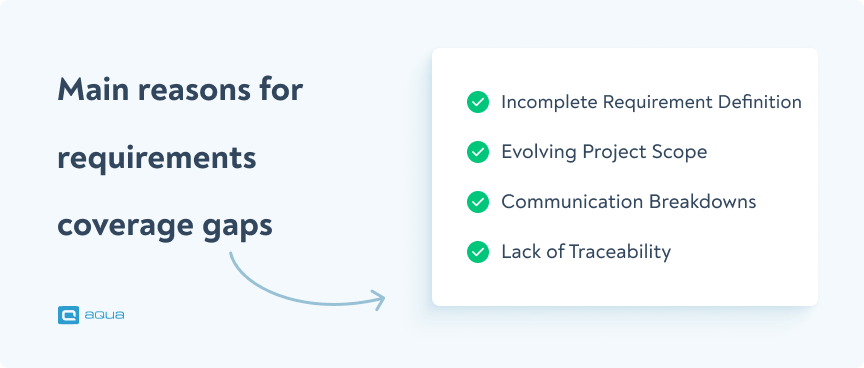
So, how and why do gaps occur in requirements coverage analysis? Let’s look at some “usual suspects” here:
Incomplete Requirement Definition: Requirements often lack clarity or miss certain details. This leads to coverage gaps.
Evolving Project Scope: Changes in project requirements without proper updates to the documentation can create inconsistencies. If you don’t update the documentation regularly, you can’t expect your team to stay up-to-date with those requirements.
Communication Breakdowns: Misunderstandings between various stakeholders and developers can result in incomplete requirement coverage. For example, a
study carried out by Deviniti showed that 8.9% of developers have a problem clearly understanding customer requirements.
Lack of Traceability: Without proper tools to track requirements coverage metrics through development and testing, gaps are inevitable. We will talk about a tool that will solve your traceability problems once and for all later in this article.
According to a 2023 survey, 53.8% of software development companies identified adapting to changing client requirements as a major challenge. This shows how important robust requirements management is for comprehensive coverage. But how can you master your requirements management, leaving no gaps behind? We introduce you to the ultimate, AI-powered requirements management tool for this.
Before you can close coverage gaps, you need to know where they’re hiding. Take this 2-minute assessment to uncover which areas of your process are most vulnerable.
Requirements Coverage Metrics and KPIs
Most teams know their coverage is not perfect. Fewer have a clear picture of how imperfect it actually is. That is where tracking the right requirements coverage metrics makes a real difference.
Requirements coverage percentage. The ratio of requirements with at least one linked test case to your total requirements. For most projects, 80% is a reasonable baseline. Regulated industries like medical or finance typically require 100%, with documented traceability to prove it.
Uncovered requirements count. A raw number of requirements with zero test cases. Track this sprint over the sprint. If it keeps growing, something in your process is systematically broken.
Test-to-requirement ratio. How many test cases exist per requirement on average? Too low suggests thin coverage. Too high may mean you have duplicate tests, inflating numbers without adding real protection.
Coverage gap age. How long has a requirement been sitting uncovered? Long-standing gaps rarely fix themselves. They tend to surface as high-severity defects at the worst possible moment.
Change impact coverage. When a requirement changes, what percentage of linked tests get updated? A low number here means your team is running stale tests against changed requirements. That is a false sense of security, not coverage.
aqua cloud surfaces all of these metrics in real time through custom dashboards and reports, so you always have an accurate picture of your requirements coverage analysis without assembling it by hand.
🔍
Coverage Gap Detector (Click to open)
Identify where gaps are most likely in your testing process
Answer 5 quick questions about your current practices to discover which types of coverage gaps are most likely affecting your projects. You'll receive a personalized risk profile with targeted recommendations.
1 of 5Requirement Definition
How clear and detailed are the requirements you receive before creating test cases?
2 of 5Evolving Scope
When project requirements change, how quickly is the documentation updated?
3 of 5Communication
How often do you have direct communication with stakeholders or product owners about requirements?
4 of 5Traceability
Can you easily see which requirements have test cases and which don't?
5 of 5Coverage Monitoring
How do you track requirements coverage throughout the project lifecycle?
Your Coverage Gap Risk Profile
Based on your answers, here's where gaps are most likely to occur
Overall Gap Risk Level
Medium
Status message
Risk Breakdown by Area
🎯 Priority Actions
I have said in interviews that I setup test case review meetings with product owners and businesses and didn’t get any pushback on it. That’s how I keep the communication on line regarding the coverage problems.
FabilousContact
Posted in Quality Assurance Reddit thread, 10 months ago
How to identify and close the gaps in test coverage with aqua cloud?
To properly analyse test coverage, you need to know which requirements already have test cases mapped to them and which ones have nothing at all.
First off, let’s introduce aqua cloud. It is a test management solution (TMS) that brought the power of AI to software testing first. It has been serving companies of different backgrounds perfectly for more than 20 years and brings German quality to everything testing-related. No tool in the market helps you use AI this efficiently, as it helps you:
Create requirements from a simple, fast voice prompt
Generate comprehensive, complete test cases from these requirements
Produce large volumes of test data that will save you a lot of time and resources.
So aqua cloud is your guardian throughout the entire testing cycle with its AI powers.
With aqua, you can streamline various phases and parts of your software testing process, but for this time, we focus on requirements coverage.
Achieving complete requirements coverage in your project with aqua cloud goes through 4 main steps:
Define Your Set of Requirements and Identify Coverage:
Access Requirement Coverage: In aqua cloud, you can directly access the requirement coverage from the main requirements view. This allows you to see which of your requirements are already covered and which are not, along with the specific test cases covering each requirement. The immediate visibility helps you quickly identify coverage gaps.
Grouping Function: You can use the grouping function to organise requirements and test cases. This helps you easily identify how many requirements are covered and which ones need attention. The grouping function provides you with a clear and structured overview.
Create and Add New Test Cases for Uncovered Requirements:
AI Capabilities: aqua cloud’s built-in AI capabilities make it easy to create comprehensive test cases. The aqua AI Copilot analyses your initial requirement and generates detailed test cases, sets of test cases, or even test scenarios in seconds. All you need to do is verify the context and save them. This significantly speeds up the process and ensures thorough coverage. And you will use less manual effort to create test cases.
Track Dependencies Between Requirements and Test Cases:
Automatic Dependency Tracking:When you create a test case from a requirement in aqua cloud, the dependency is automatically added. This can be easily displayed in the ‘dependencies’ view or found using the ‘Find dependent test cases‘ function. With this feature, you don’t need to track dependencies manually. Automatic dependency also ensures that all relationships are clearly documented.
Monitor Requirement Coverage as a Recurring Metric:
Dashboards and Reports: You can set up simple dashboards or reports to quickly get an overview of your project status and identify uncovered requirements. aqua cloud allows you to merge the requirement coverage view with the ‘Last run results’ view, enabling you to monitor all relevant data in one chart. This continuous monitoring helps maintain high standards of AI test coverage and keeps your testing process efficient and transparent.
These steps ensure that your testing processes are both comprehensive and efficient. By using aqua cloud’s advanced features, you can effectively fill test coverage gaps and maintain high standards in your software quality.
Although aqua cloud is the perfect requirements management tool that offers 100% traceability, it is not limited to a single set of features. With aqua, you can:
Generate test cases from requirements in a few seconds.
Access a centralised hub to manage all your manual and automated testing efforts in a single repository.
Achieve 100% traceability with no requirements left behind
Sync with Jira to ensure real-time updates and seamless collaboration
Integrate with Capture (screen recording tool), to have the most seamless bug-reporting experience in the industry.
aqua is an all-in-one solution that takes away the pain of testing. So why wait?
Go above and beyond achieving 100% traceability in your testing efforts
Common Pitfalls When Closing Coverage Gaps and How to Avoid Them
Getting coverage gaps on the radar is the first step. The second, harder step is closing them without introducing new problems. Here are the mistakes that come up most often.
Writing tests just to hit a number. Coverage percentage is a signal, not the goal. Test cases written purely to get a requirement ticked off without verifying actual behaviour give you inflated numbers and zero protection. A test that always passes regardless of what the system does is not a test.
Treating coverage as a one-time activity. Requirements change. Scope evolves. A coverage report from three sprints ago may be completely misleading today. Set a recurring review cadence and enforce it as part of your process, not as an afterthought at release time.
Skipping traceability under pressure. When delivery timelines tighten, linking test cases to requirements feels like extra work. It is the opposite. Without traceability, closing a gap means hunting through documentation manually, which takes far longer and introduces the kind of human error that causes gaps in the first place.
Keeping coverage inside the QA team. Requirements coverage analysis is not a QA-only concern. Unclear requirements create gaps that testers cannot fix by writing more tests. Product owners and developers need to be part of the conversation about whether requirements are complete, testable, and up to date.
Relying on spreadsheets past a certain scale. Manual tracking breaks down the moment a project gets complex. A dedicated test management platform that connects requirements, test cases, and defects in one place removes the bottleneck entirely and keeps your coverage data reliable.
Final thoughts
Perfect requirements coverage means leaving no gaps behind, and it is more achievable than you might think. Now picture your day in QA after starting to use aqua cloud: you quickly identify and address coverage gaps, ensuring all requirements are met. Throughout the day, you effortlessly maintain a clear overview of project status, making proactive adjustments as needed. Requirements coverage report through bug reporting becomes a breeze, fixing all the communication issues with developers. All in all, aqua cloud transforms your QA process into a seamless, efficient, and highly productive experience, allowing you to focus on what truly matters—delivering exceptional software. Who says no to this? Just contact us and let us handle your struggles.
Requirements coverage is a metric used to determine the extent to which the requirements of a project have been addressed through the development process. It assesses whether all specified requirements have corresponding test cases and whether these test cases have been executed successfully. This ensures that every requirement has been validated and verified.
What is the Importance of Requirements Coverage?
Requirements coverage is crucial because it:
Ensures completeness: By tracking requirements coverage, you can verify that all specified requirements have been tested, reducing the risk of missing critical functionality.
Enhances quality: It helps identify gaps in testing and development, leading to higher quality software.
Facilitates compliance: Many industries have strict regulatory requirements. Requirements coverage ensures that all necessary criteria are met for compliance.
Provides traceability: It links requirements directly to test cases, offering clear traceability throughout the project lifecycle.
What are the Differences Between Requirements Coverage and Test Coverage?
While both requirements coverage and test coverage are important metrics in software development, they focus on different aspects:
Requirements Coverage:
Focus: Ensures all specified requirements have corresponding test cases.
Scope: Concerned with validating that each requirement is addressed and tested.
Goal: To confirm that the software meets all the defined requirements.
Test Coverage:
Focus: Measures the extent to which the source code is tested by the test cases.
Scope: Concerned with the comprehensiveness of testing on the code itself, often evaluated by metrics like statement, branch, and path coverage.
Goal: To ensure that the code is thoroughly tested to catch potential bugs and issues.
Understanding both metrics helps ensure comprehensive testing and high-quality software development.
How often should you review and update requirements coverage?
At the end of every sprint or release cycle at minimum. More importantly, every time a requirement changes, the linked test cases need to be reviewed. Using a tool that notifies your team when a requirement is modified removes the risk of stale coverage slipping through.
What is a good requirements coverage percentage to aim for?
80% is a solid baseline for most software projects. For safety-critical or regulated systems, 100% traceability with documented proof is typically required. The number only means something if your tests actually verify behaviour. 100% coverage with shallow test cases is worth less than 85% with well-written ones.
Sylwia's prowess in QA stems from her comprehensive understanding of enterprise ecosystems. As a Lead QA Expert, she has been instrumental in streamlining QA processes for numerous customers and users of aqua, guaranteeing consistent delivery of high-caliber results.
Nurlan, a QA Coordinator & Quality Standards Officer, takes pride in orchestrating seamless QA operations. His expertise in coordinating QA-focused projects and integrating QA solutions has consistently yielded top-tier client satisfaction. Aside from a full-time QA coordinator, Nurlan's role involves creating compelling content that educates…
Home » 'How to' guides » How to Analyse Requirements Coverage to Identify Gaps in Software Testing
Do you love testing as we do?
Join our community of enthusiastic experts! Get new posts from the aqua blog directly in your inbox. QA trends, community discussion overviews, insightful tips — you’ll love it!
We're committed to your privacy. Aqua uses the information you provide to us to contact you about our relevant content, products, and services. You may unsubscribe from these communications at any time. For more information, check out our Privacy policy.
X
🤖 Exciting new updates to aqua Intelligence are now available! 🎉