Key takeaways
- API testing validates communication between software components through endpoints, focusing on request/response cycles, data formats, and authentication mechanisms.
- Unit testing examines individual functions or methods in isolation with mocked dependencies, providing millisecond-speed feedback on specific code functionality.
- API tests remain stable during internal refactoring but require complex environment setup, while unit tests are faster but break when implementation changes.
- Effective testing strategies combine both approaches, with unit tests catching logic errors early and API tests verifying integration points between services.
This guide compares API testing and unit testing by scope, speed, failure signals, and pipeline fit, so you can structure both effectively. 👇
What is API Testing?
API testing checks whether your endpoints return the right response for the right request, all without going through a user interface. In practice, that covers request/response behavior, HTTP status codes, data format accuracy, and authentication flows across the full cycle.
Practical example: Consider a mobile app requesting user profile data from your server. An API test confirms the request returns the correct JSON structure with proper authentication, within acceptable timeframes. It’s evaluated through direct HTTP calls. That scope matters because APIs carry data between your frontend, backend, and external services. A single unreliable endpoint can cause failed transactions or leave users on a loading screen with no feedback.
Test automation tools let your team cover a range of scenarios, from valid requests and edge cases with missing parameters to concurrent load conditions and security vulnerabilities like SQL injection. API testing exercises the communication layer that holds your microservices and integrations together.
Managing both API and unit tests across a growing codebase gets complicated quickly. Test cases pile up and it becomes harder to tell which endpoints and functions in your system actually have coverage. aqua cloud, an AI-powered test and requirement management platform, keeps both testing layers organized in a single repository. Full traceability between tests, requirements, and results is ensured. The platform’s AI Copilot generates context-aware test cases for both API and unit testing scenarios. It applies boundary value analysis and equivalence partitioning to build out coverage efficiently. According to aqua’s internal benchmark, this saves up to 12.8 hours per tester weekly. aqua also integrates with SoapUI for API validation, Jira, Selenium, and other solutions, so your team doesn’t need to manage separate toolchains across both layers. Everything connects directly to your CI/CD pipeline and existing test frameworks.
Boost your QA efficiency by 80% with aqua's AI
Key Methods of API Testing
- Functional testing covers whether each endpoint produces the expected output for a given input. Response schemas, status codes, and data accuracy are all confirmed against defined expectations.
- Load testing measures how your endpoints hold up under concurrent requests, identifying throughput limits and latency increases before production traffic reaches them.
- Security testing exercises endpoints for vulnerabilities like broken authentication, data exposure, and injection flaws through structured attack simulations.
- Contract testing confirms that your APIs maintain backward compatibility across versions, catching breaking changes before they affect downstream consumers.
- Integration testing covers whether multiple endpoints work correctly when chained together in realistic user workflows, exposing failures that single-endpoint tests miss.
Benefits and Challenges of API Testing
Above anything else, API testing fits naturally into polyglot environments, meaning software projects that mix multiple programming languages. That works because tests operate at the HTTP level, independent of implementation language. This way your frontend and backend teams can write and run them regardless of which stack each uses. Another practical benefit is timing: your team can run API tests before any UI is built. This means integration problems between services get flagged weeks earlier in the development cycle. Because APIs respond predictably to programmatic requests, automated data validation is straightforward to configure and maintain across test runs.
Key advantages in practice:
- Language-independent test execution, useful across your mixed technology stacks.
- Early integration feedback, before UI development begins.
- Predictable, automatable request/response cycles that support consistent regression testing.
- Clear performance data, including response times and throughput limits, without GUI complexity.
API testing does come with real tradeoffs. Realistic test scenarios often require specific database states, prepared test data, and sometimes full environment provisioning. Auth token management, i.e., generating, storing, using, and invalidating digital tokens like JWTs across test cases, adds ongoing maintenance overhead. Outdated API documentation frequently causes incorrect test expectations and wasted debugging cycles.
Specific challenges to account for:
- Environment setup complexity for data-dependent scenarios.
- Auth flow management across test cases.
- Documentation drift causing incorrect test expectations.
- Version management overhead across parallel API releases.
When to Perform API Testing
API testing should be performed at several points in your development cycle:
- After implementing or modifying endpoints. Running tests at this stage catches regressions before code review, when fixes are cheapest.
- During integration phases. When your services connect to each other or to third-party APIs, API tests confirm that contracts hold under varied conditions.
- On every merge to main. In your CI pipeline, API tests work well as merge gates, triggering an automated suite that blocks deployments when critical endpoints fail.
- Before major releases. Load tests against staging environments identify performance degradation before your users encounter it.
- During penetration testing cycles. Security-focused testing benefits from a dedicated API testing pass, since injection and auth bypass issues require targeted scenarios to reveal.
At the same time, unit testing covers a small layer in development. That’s what the next section examines.
What is Unit Testing?
Unit testing is a development practice focused on testing individual functions, methods, or classes in isolation.
In the case of unit testing, dependencies like databases and external APIs are replaced with mocks or stubs, keeping each test scoped to the logic it was written for. Due to that, tests can be run in milliseconds, giving your team near-instant feedback on whether a code change introduced a regression.
Practical example: Take a function that calculates discount percentages for loyalty members. A unit test supplies inputs like member tier and purchase amount, then asserts the function returns correct discount values. Edge cases such as zero amounts, negative numbers, and null inputs are each covered in separate scenarios. The function has no connection to the database storing member data or the service providing product prices. Mock objects replace those dependencies, so the test evaluates only the function’s logic. The expected result is that when the test fails, the failure points directly to the function at fault, which is exactly the goal.
Key Methods of Unit Testing
Unit testing uses the following techniques, distinguished by their verification goals:
- State verification inspects the resulting state of an object or return value after a method executes. It is the most common form: assert that calling
applyDiscount(user, cart) with a gold-tier member returns a value 20% lower than the input total. The focus is on outcomes only, with no assumptions about internal implementation.
- Behavior verification uses mock objects to confirm that specific collaborators were called with specific arguments. This applies when the unit under test delegates work to a dependency, such as confirming that a payment service’s
charge() method was invoked exactly once with the correct amount and currency.
- Parameterized testing runs a single test definition against a matrix of inputs and expected outputs. It is particularly effective for boundary conditions, like testing a rate-limiting function across zero, threshold-minus-one, threshold, and threshold-plus-one requests, without duplicating test code for each scenario.
- Test-driven development (TDD) writes tests to be executed before the implementation phase. The cycle is: write a failing test that defines desired behavior, write the minimum code to pass it, then refactor. Code written this way tends to be smaller and more composable because functions that are hard to test in isolation are usually also hard to maintain.
- Mutation testing introduces small, deliberate code mutations, such as flipping a
> to >= or removing a conditional branch, then checks whether your existing tests catch them. A suite that passes despite mutations has gaps in its assertions. This technique quantifies how much of the logic is actually exercised.
Benefits and Challenges of Unit Testing
The most immediate advantage of unit testing for your testing team is speed. Unlike many other QA procedures, unit tests run in milliseconds, so regression signals appear without waiting for builds or environment provisioning. That makes the full suite practical to run both during local development and in CI pipelines. A well-maintained suite also protects against re-introducing old defects during feature work, since any regression against a previously tested behavior fails visibly. At the end of the day, having tests that describe expected software behavior reduces the time needed to understand unfamiliar code. It’s especially useful when your team is onboarding new engineers.
Key benefits in practice:
- Millisecond execution time, which allows for continuous local feedback during development.
- Persistent regression protection across refactors and new feature work.
- Executable documentation that stays current by nature.
- Architectural pressure toward better separation of concerns and loosely coupled components.
Maintenance costs, on the other hand, deserve a line item in your sprint planning. Tests couple to implementation details, so internal refactors that preserve external behavior still require test updates. Heavy mock use can produce tests that pass despite incorrect integration behavior, creating misleading coverage metrics. Writing thorough tests takes time, and for complex logic, the effort can roughly double initial development time. That cost is typically recovered through reduced debugging and incident response later.
Specific challenges to plan for:
- Implementation coupling means refactors trigger test updates even when behavior is unchanged.
- Mock-heavy suites can pass while hiding real integration failures.
- High coverage percentages do not confirm system-level correctness.
- Upfront writing time is significant for complex business logic.
When to Perform Unit Testing
Unit testing works best as a continuous QA practice. In other words, it should be a part of the testing routine at all times when new features are developed and planned to be added. A local suite run before each commit prevents obvious regressions from reaching your shared branches.
The best part about unit tests is that their execution time makes that frequency practical. When a bug is confirmed, writing a failing test that reproduces it before fixing the code keeps the defect documented and verifiable long term. During refactoring sessions, running tests continuously gives your engineers the confidence to make structural changes without introducing behavioral regressions. And that’s something that tech leads love to have at all times.
Unit tests test specific code, they assume dependencies work as expected. Dependencies are therefore mocked to ensure unit tests run quickly (no network) and deterministically.
Difference Between API Testing and Unit Testing
The core difference between API testing and unit testing comes down to scope and speed. Unit tests exercise individual functions in isolation, while API tests cover entire request/response cycles across network boundaries. That distinction shapes where each fits in your workflow.
Unit testing:
- Exercises individual functions in isolation using mocks to eliminate external dependencies
- Runs in milliseconds with no I/O operations involved
- Gives your developers immediate feedback during coding
API testing:
- Covers full request/response cycles, checking how your components behave under realistic conditions
- Involves network calls, database queries, and sometimes complex authentication flows
- Takes seconds or minutes to complete, so comprehensive suites run less frequently because of the execution cost
Maintenance patterns also differ in ways that affect your long-term planning. As such:
- Unit tests break when internal implementation changes, even when external behavior stays identical. A function refactor that produces the same output through different logic will still require test updates.
- API tests hold stable as long as endpoint contracts remain consistent, meaning URLs, request formats, and response schemas stay unchanged. A significant backend refactor can leave API tests passing while requiring widespread unit test updates across your codebase.
| Aspect |
Unit Testing |
API Testing |
| Scope |
Individual functions/methods |
Endpoint request/response cycles |
| Dependencies |
Mocked or stubbed |
Real or simulated services |
| Execution Speed |
Milliseconds per test |
Seconds to minutes per suite |
| Failure Localization |
Pinpoints exact function |
Identifies integration breakpoint |
| Environment Needs |
Minimal, runs locally |
Requires test environment/services |
| Test Stability |
Breaks with implementation changes |
Stable across refactors |
Best Practices for Effective API and Unit Testing
Tests should be scoped to get the most bang for buck - i.e., they should verify the most possible behaviour of the application for the least cost in time and complexity. Every application has a different sweet spot, and that's where the bulk of the tests should live.
QA practice shows that testing strategy only holds up if it stays well maintainable as your codebase grows. Below are practices that consistently deliver in production environments.
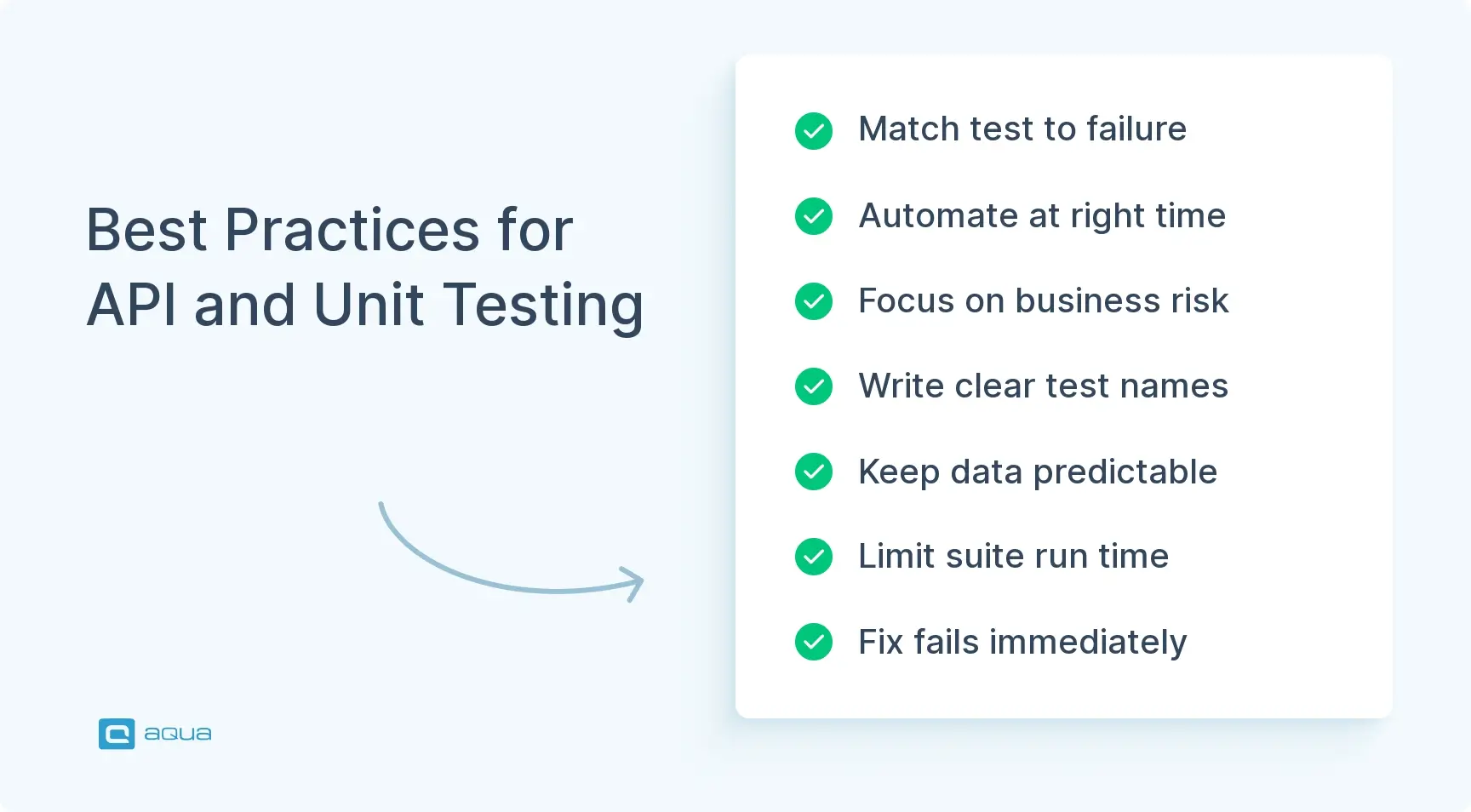
- Match the test type to the failure mode. Logic defects in a calculation function belong in a unit test. A broken authentication handshake between two of your services belongs in an API test. Mismatched test types produce suites that are expensive to maintain and unreliable.
- Automate at the right frequency. Unit tests belong on every commit. API smoke tests belong on every merge to main. Full regression and load test suites are better suited to nightly builds or pre-release cycles, where slower execution is less disruptive to your team’s workflow.
- Prioritize coverage by business risk. Your authentication flows, checkout processes, and core data retrieval endpoints carry more risk than rarely-used admin pages. Concentrating API test coverage on high-traffic, high-consequence paths delivers more value per hour of your team’s engineering time than chasing uniform coverage across the entire codebase.
- Write descriptive test names. A test named
test_user_login_with_expired_token_returns_401 tells you what broke without even checking the file itself. Descriptive naming applies equally to unit and API tests, and matters most when your team is diagnosing incidents quickly.
- Keep test data deterministic. Randomized or environment-dependent test data makes failures hard for your team to reproduce and debug. Versioned, consistent datasets produce stable results across runs and environments.
- Set a hard limit on suite execution time. Suites that take 30 minutes get skipped. Parallelizing tests and stubbing expensive external calls keeps execution time low enough that running the suite stays a practical part of your daily development workflow.
- Fix failing tests immediately. A test that sits in a failed state for days stops functioning as a signal. Fix it promptly or remove it if it no longer reflects current behavior in your system.
A test management solution helps your team maintain this structure as both headcount and test suites grow, keeping unit and API test results, requirements, and coverage data in one place to track tests, requirements, results, and CI/CD status together.
Keeping your API and unit tests aligned with changing requirements is where most QA processes start to break down. aqua cloud, an AI-driven test and requirement management solution, addresses this at the workflow level. It has a unified test repository that links test cases to requirements and tracks coverage across both testing types. When requirements change, the impact on your existing tests is visible immediately. Teams working through the unit testing vs API testing question often find the bigger problem is visibility: not knowing where gaps exist until something fails in production. aqua’s customizable dashboards show coverage status across all test layers, helping your team identify weak spots before release. The SoapUI integration handles API test management, while unit test results feed into the same reporting view. Combined with 12+ integrations with tools like Jira and Selenium, this gives your engineering and product teams a shared picture of system quality across all integration points.
Improve visibility across API and achieve 100% unit test coverage
Conclusion
Unit tests confirm that individual functions work as intended, while API tests confirm those functions communicate correctly when assembled into a working system. Skip either layer, and a category of failures goes undetected until production. It’s recommended to start with one high-risk endpoint and one business-critical function in your codebase. Add coverage there first, automate both layers, and fix failures when they appear. Long term, consistency across sprints matters more than perfect coverage.